

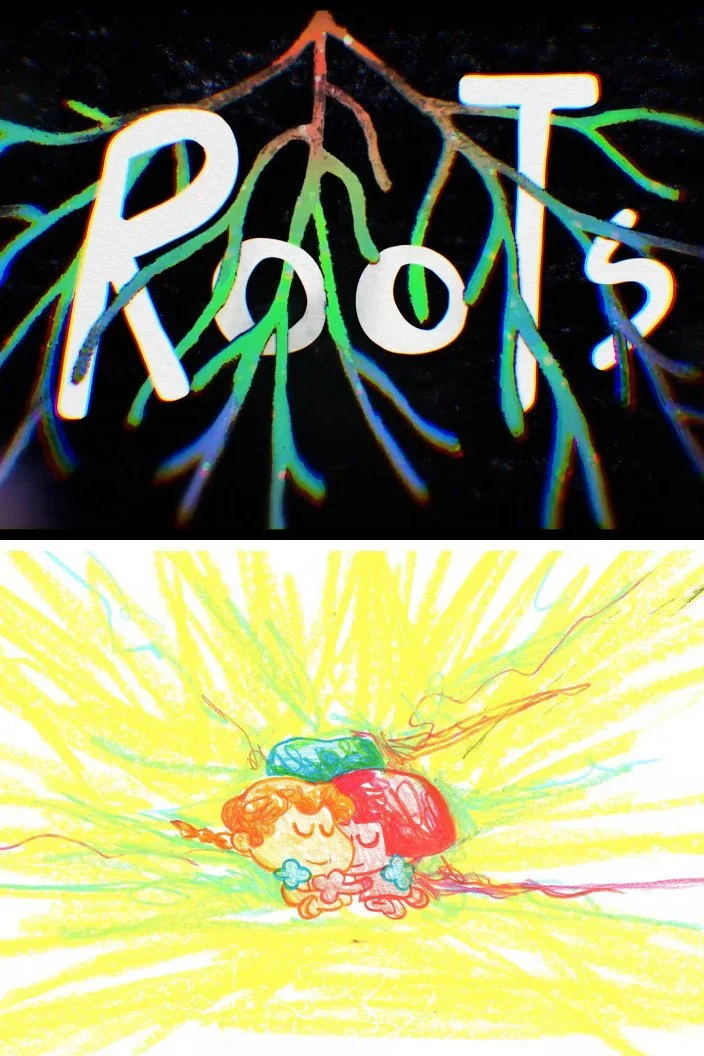
We all have roots, whether they are cultural, communal, ancestral, or actual plant roots, but for animators Vanessa Webster and Christine Raiko Llamas, roots are the heart of a story. Their debut short film, Roots, follows three Filipino characters, Richel, John, and Marisol, as each rediscovers their connection to their roots.
It is always a privilege as a Filipino-Canadian journalist to be able to share the voices of Filipino artists in Canada. Christine (who goes by her middle name, Raiko) was born and raised in the Philippines, while Vanessa grew up in Canada, and the two brought those different perspectives into the film’s characters. This was a short-film I found myself relating to and I sat down with Raiko and Vanessa to talk about identity, language, food, and what it means to feel rooted far from where your family began.
REVERIE: Hey Vanessa and Christine! Could you tell me a bit about yourselves?
Vanessa Webster: Raiko, do you want to go first?
Christine Raiko Llamas: Sure! My full name is Christine Raiko Llamas but I go by Raiko – that’s what my friends call me. I am an artist, animator and Alberta University of the Arts alumni. We’ve just kicked off. Or I’ve just kicked off my career as well alongside Vanessa with our film groups. It’s been a journey and it’s been a pleasure to be working on this!
Webster: I’m Vanessa Webster, and as Raiko mentioned… I am an animator, illustrator and I’m also a teacher! Which is cool. Raiko talked about it a little bit but we’ve kind of got to kick off our careers together with our debut film Roots
REVERIE: I know both of you were a part of Quickdraw Animation’s 2024/25 Intermediate Animator's Production Residency (IAPR), how did that opportunity come about?
Llamas: Do you want to go ahead, Vanessa?
Webster: Sure! We started the development of Roots in our fourth year of university as a project to segue us into our professional careers. We were also able to connect with the director of Quickdraw Animation, Ryan Von Hagen. He helped us along our journey with this project, supporting us with the project’s development. By the end of fourth year, we had like 40 pages worth of ideas. That is what we ended up submitting to the residency, which was juried by some lovely and talented artists. They were gracious enough to trust us with this opportunity, and that was the beginning of us working at Quickdraw!
REVERIE: Could you tell me about your short film Roots?
Llamas: Our film Roots follows three characters: Richel, John and Marisol. They delve into their own connections to their roots as Filipinos. It's sort of about rediscovering your culture and your connection to your roots.
Webster: It gives you the different perspectives of these three characters and how they connect their roots to themselves.
REVERIE: Is there anything else you both wanted to add regarding that?
Webster: One thing that was really exciting about getting to work on the project with Raiko was that we both connect to our identities in different ways. Raiko was born and raised in the Philippines and I grew up here, and was able to navigate those different perspectives within the film itself. I think that brought us closer to connect with our culture in a way. I think that the theme is hopefully quite prevalent in the film itself of having these different points of roots and connection within Filipino identity. That’s one thing that was really exciting to explore with our storytelling, while also being able to discover those parts about each other.
REVERIE: Your short film Roots is playing during GIRAF22. How are you both feeling about that?
Llamas: So nervous! But honestly it’s been a long time coming and we’re both really nervous, but also excited at the same time! We’re excited to have our film shown and the privilege to be able to have the community show up and see what we’ve been working on makes us feel so pumped.
Webster: I’ve been a ball of nerves the whole time to be honest. Sharing a personal part of yourself with such a large group and your own community definitely brings a lot of pressure. But as Raiko said, it’s been a long time coming. We’ve been working on this for so long that we’ve been excited to kind of just get it out there.
REVERIE: If you don’t mind me asking, how long did it take for the short film to be created? What were some ups and downs you both faced and how did you tackle it?
Llamas: I would say within the residency period it was 2 years, but even before that with all the pre-production work in total it is about four years. Actively 2 years though. It’s been a long time. The most challenging part for us was that we were learning everything as we were going. It was a huge learning curve like animating all of the technical stuff. We did get a lot of guidance from Quickdraw and the people we work with like Lyndon Navalta and Amanda Torres – who is also from Quickdraw. They really helped us when it was crunch time in trying to meet deadlines. Having each other was a big part of it too. Just having each other ground ourselves because it would have been impossible to do it all alone. Vanessa has been a big part of that and I think she was my rock throughout it all.
Webster: Same here. It would have been impossible to do this all alone. Animation is a labour of love, especially hand-drawn animation. For reference, 1 second of animation is 24 frames, so it is 24 individual drawings for just 1 second of animation. So Raiko and I created hundreds if not thousands of drawings just to make this thing move. Learning how to do that was already very difficult but being persistent and continuing to be motivated especially during the tedious parts of the process were difficult. The highs were just being able to work on this with someone who is so important to me. I would not have seen this project through if Raiko wasn’t there pushing me forward and cheering me on. If I could give advice to anyone who ever wants to do a project like this is to do it with someone you care about and love. They push you forward in the process.
REVERIE: The scene of John crashing out over life in what I presume in the new city is like vs. the barrio, then being offered a lumpia from Marisol was really funny to me. What is both your favourite Filipino foods?
Llamas: I love home-y foods, but I also love fiesta food, I love lechon. Crispy skin and everything? That’s my favourite food.
Webster: I fear I also love fried food, I love sisig, I love pork kawali. I love fried rice. All so good!
REVERIE: You use a lot of Filipino phrases such as “sumpain kita” or “lintik ka,” do either of you use these phrases on a daily basis?
Llamas: I never use it around my family because… well you just don’t say that stuff around your Filipino family but with my partner I do use it when I’m a bit annoyed.
Webster: I also think that the animation is played to the very top of the drama. They are a lot more crass than Raiko and I have ever been. When we were translating everything to English, we didn’t realize how bad it was until we were translating.
REVERIE: What was really striking to me was Marisol’s dialogue when she explains about how she wasn’t born in the Philippines. Witnessing her friends complain about the city they live in doesn’t make them feel Filipino enough and how she feels regarding that. What led to the inclusion of that dialogue in the short film?
Webster: Growing up here and just being around first generation people, even within your family setting there is still a feeling of being outside of your own culture in a way. Having the privilege of exploring Marisol’s character was incredibly important for that. My mom didn’t teach me Tagalog because she was afraid that I wouldn’t be as fluent in English, so even to just be able to explore the language a little bit just by talking to the voice actors. Some of their dialogue is not scripted. We told them to just go for it which is why some of it is so crass. Even being able to delve into more of my connections within my existing community now has been rewarding in so many ways. I hope that speaks to the people in the same position as us, where growing up in Calgary or growing up in Canada, and exploring what it means to be connected to your roots.
Llamas: For me, it was trying to connect back to your culture but your environment is taking you away from that because you have to be a part of the new “Canadian” culture, therefore it is hard to stay rooted. It is not a strictly Filipino experience but rather an experience for a lot of immigrants. We wanted it to be personal in a way while also making it relatable to those who may not have a Filipino background or roots that aren't just Canadian.
Webster: As someone who grew up here, there isn’t really a place in the Philippines that calls me home, in the sense of identity and culture. As I got to university and moved out of a small town, I became more immersed in my culture outside of family life. There will always be a small part of me that feels like an insider in that way but there are connections even with our mundane life and lived experiences that helps connect us back. We wanted to drive that aspect in that script. Even towards the end, the exploration of a child-like, innocent and authentic part of yourself that has allowed you to immerse yourself in the culture, even though the awareness might not always be there. That was incredibly healing to expose.
REVERIE: What is something you hope viewers take away from your film?
Webster: We hope that it speaks to people who are feeling lost or separated. That it brings them comfort in being able to feel the connection always exists and will always exist within. You’ll find it within yourself and the people around you. I hope that comes through.
Llamas: I was thinking of all the overseas workers too, like all the Filipino workers working abroad to provide for their family back home. Those who are not in their home and their roots can reconnect to it and we cover it through food, just eating lumpia so they can feel a little bit more at home.