

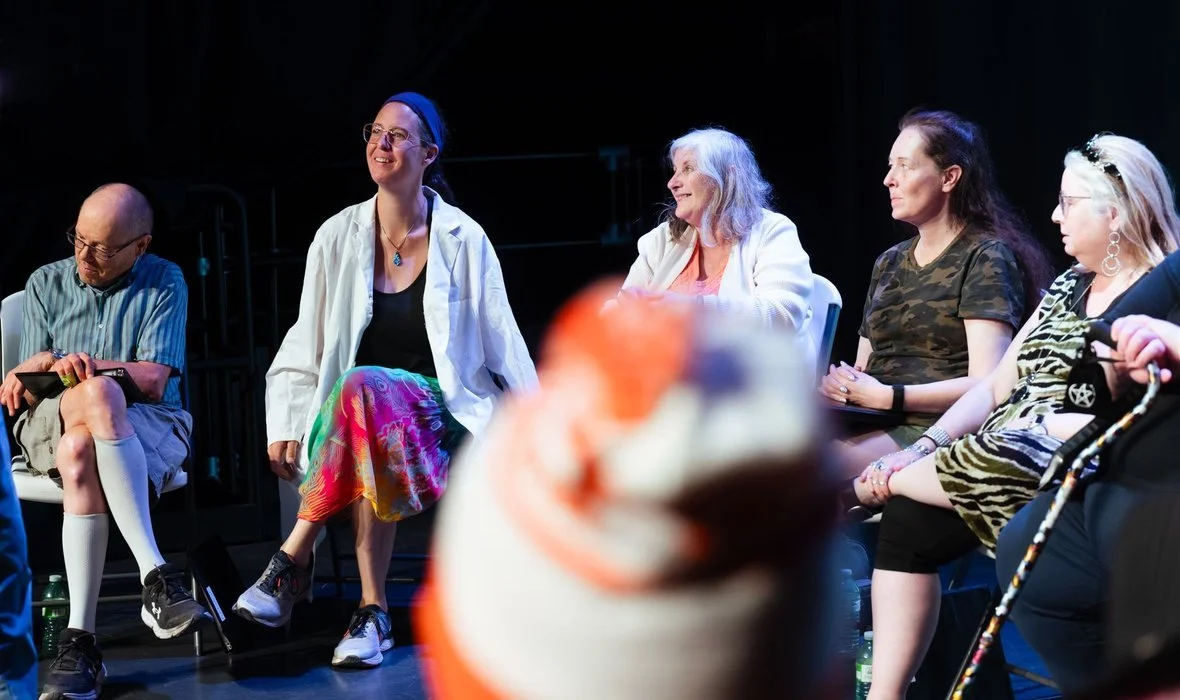
Still from Starry Night. Photo courtesy of CUFF.Docs.
In 1998, the Schizophrenia Society of Alberta’s production Starry Night first hit the stage. Now, over twenty years later, members of the society still rehearse and perform it regularly.
In a brand new documentary of the same name, filmmaker Bruce Thomas Miller follows the stories of several people living with schizophrenia, and how participating in this stage production has provided them a life-changing sense of chosen family, support, and purpose.
While filming this stage production behind-the-scenes, director Bruce Thomas Miller details his own healing journey, and finds commonalities with participants through the healing power of storytelling. We spoke with Miller about his transformative role at the Schizophrenia Society of Alberta, and how his prior experiences in social work have impacted his caring and attentive filmmaking, and the stories he chooses to tell.
Reverie: Having worked at the Schizophrenia Society of Alberta, and being involved with the stage production of Starry Night there, when did your initial interest in making this film come up?
Bruce Thomas Miller: When I first did the interview for that role, I shared that I wasn’t going to be there forever, I want to do film. They said this was no problem, and were very supportive. I showed them some of my films, and they suggested maybe doing a film together down the road. Eventually, the Schizophrenia Society had some potential film funding, that then fell through. But by then I was in producing classes, writing, and doing a bunch on my own to further my film career. I had a relationship with with Telus. I told them the idea, and they thought it was amazing, so they jumped on board and off I went. I'm always serious about what I do, and also creating a good product, and I was worried because I didn't get the exact story I wanted to get with Starry Night. We wrote it a different way, so when we did the first assembly we didn't have all the right pieces. It didn't work because we tried to make the film like the script, you know? Then we had to revamp it and tell a different story. That's the thing about documentaries, life doesn't turn out the way you wanted to, you know?
Reverie: How did the story change from what you thought it would be, to what you see on screen?
Miller: Well, originally it was going to follow two main characters, and then one of the people we’d chosen was suffering too much from his illness. His health was really taking a toll on him. He's in the film, just not as much as we intended him to be. So we went with someone else, and we tried it, but it just didn't work out. Then we went well, what are we going to do now? It's like, we got like, we got all this footage. Then my editor said, “do you ever think about yourself being a character in this?” I like being behind a camera and capturing things, but being in front of the camera is something that was really hard. It's tough for me to look at myself on screen or edit myself. I said, yes because I thought I had to. You know, after seeing myself in it, and then I was like, all right. I had to realize that putting myself out there would just be helping the film. Something similar ended up happening with another series I had in production, so this project helped me to get over my own insecurities of being on camera. It was nice in the end.
Reverie: This film mostly the participants in the stage production, but it does also become about your role as a filmmaker and storyteller. In the film, you show the decision to step back from your role at the society to focus on filmmaking. How has your time there impacted your own artistic filmmaking journey?
Miller: It was tough at first because I was doing pretty much twelve hour days of work. Eight hours was doing the Schizophrenic Society work and then another eight hours was doing my film work, doing applications, going to festivals, writing and whatnot. I did that for about a year or so, and it took a lot out of me. Finally, I told them where I might be headed in my career, and then they said, “Bruce, do you want to leave now? I said, yes., I guess so. I needed that push. Once I left, it was one of the most liberating things ever. Now I'm just investing in myself and the stories that I have, and it's been wonderful. I'm sure I'll have challenges in the future, but right now it's working out great.
Reverie: I’m so glad to hear that! I really felt your care for this group of people come forward in your filmmaking. I’m sure that this will come through in all your future projects. How do you see your role in establishing care with the people whose stories you are helping to share?
Miller: I take the time with the subjects. Hopefully you'll see the same care come through. A person's a person, they're not higher than you are lower than you. It’s about giving them your full attention when you're with them, and being there in that moment. I think that's what I do with people in general, you’ve got to be like that because people can see through you when you're somewhere else, you know?
I also did fifteen years of social work at the Drop-In Centre. This gave me a sensitivity with filmmaking and how I want to run my crews. I take lessons from that space and bring them into my film work. That’s also why it took the time to find the right people for Starry Night. We didn't hire just any sound guy or DP. We went around and found people that were sensitive to the community, who knew how and were ready to work in those situations. We had to find people who were not afraid of that community.
Reverie: What was the process of working with this group of people who you have these existing relationships with? Did that change the way your told this story?
Miller: Oh yeah, indeed. It was pretty much a year that I was working there, and they really trusted me. It was wonderful, and I also took that trust as an honour. So I had to honour them and not exploit them or hurt them in any way; making them look good and giving them good positive representation on screen. That was something that I did in my practice with them. My relationships were very honest because I was also a friend to them. They came in and told me some struggles that they had. It was very eye-opening to realize that this goes on in someone's mind, and you can understand how the mental illness has taken its toll on someone. I said to them, you know, your strength is beyond my strength. Yeah, but your community, great community, and you know, I hope that this film helps that community in some way somehow.
Reverie: Starry Night is also about how making art can be an empowering way to tell your story, and even a form of recovery itself. In the documentary, you share a bit about the role of filmmaking in your own healing journey. What was the process of telling this story like for you?
Miller: The process was just me telling an honest story about how [the participants] taught me. In those fifteen years of social work, I saw people were so deep in their in schizophrenia and there was no way out for them sometimes. Some got out, but most were very affected. That almost broke me, and I was pretty jaded. Then I went to the Schizophrenia Society and they really opened my eyes to to the illness by saying, “we recovered and other people can too.” That gave me the hope I really needed at that moment. I'm still going through my PTSD and working through it the way I need to. Making film and telling stories helps me in a way that I can't explain. I pick stories and projects that really resonate with me and are something I can learn from. Just trying to share a story that will help other people helps me too. When I work on these films, I also heal myself.
Reverie: One of the things that I felt most touched by was the depiction of the community that they have built. I know from my own mental health journey that reaching out for support can be an incredibly difficult thing to do and seeing this group of people have that was really inspiring. What made it so important to show the love, and friendship, and acceptance of this journey, rather than just the hardship?
Miller: Pretty much what you said. I watched how they care for each other, how they talk to each other, how they help each other. You'll see it on screen and go, “oh my God, these guys are amazing!” When somebody with schizophrenia has an episode, I can't say I know what they’re going through. The best I can do is “I don't know what you're going through, and I'm here for you.” But another friend that's living with illness can say, “I know what you're going through, try this or do this, either way I’ll be there for you.” The amount of care that they had for each other, it was like a family. But they would always invite people in, they would never shut people out, they would always try to work with them.
It's pretty cool to see on screen, but it was cooler to see every day. I would see that and go, this is a community that people need to see and learn from about how we should operate as a society, work together, and empower each other. That's one of the reasons why I wanted to make this film.
Reverie: What do you hope the main takeaway is from people watching the film this CUFF.Docs season?
Miller: That's a tough one. I want them to feel hope, but everyone's going to get something different from it. Some people might be have a family member or friend living with schizophrenia, and after the film they’ll hopefully have a little more compassion towards that person. Someone watching that doesn't know anything and feels concerned might feel educated by it. If someone who's lives with schizophrenia is watching, it'd be nice to have them see themselves on screen and go, “there's hope for me, I can still do things I want to do and be part of a community.” So there's many things, but I think the universal thought I hope people will walk away with is just, “wow, what a cool group of people this is!” People with schizophrenia can be so stigmatized, you often don't see the community like I portrayed on screen. So I want them to just see something different. It's just an illness, and like anything else, you can treat it. There’s people who’ve got to live with it, but they still have things to contribute. They're not of lesser of value than any one of us.