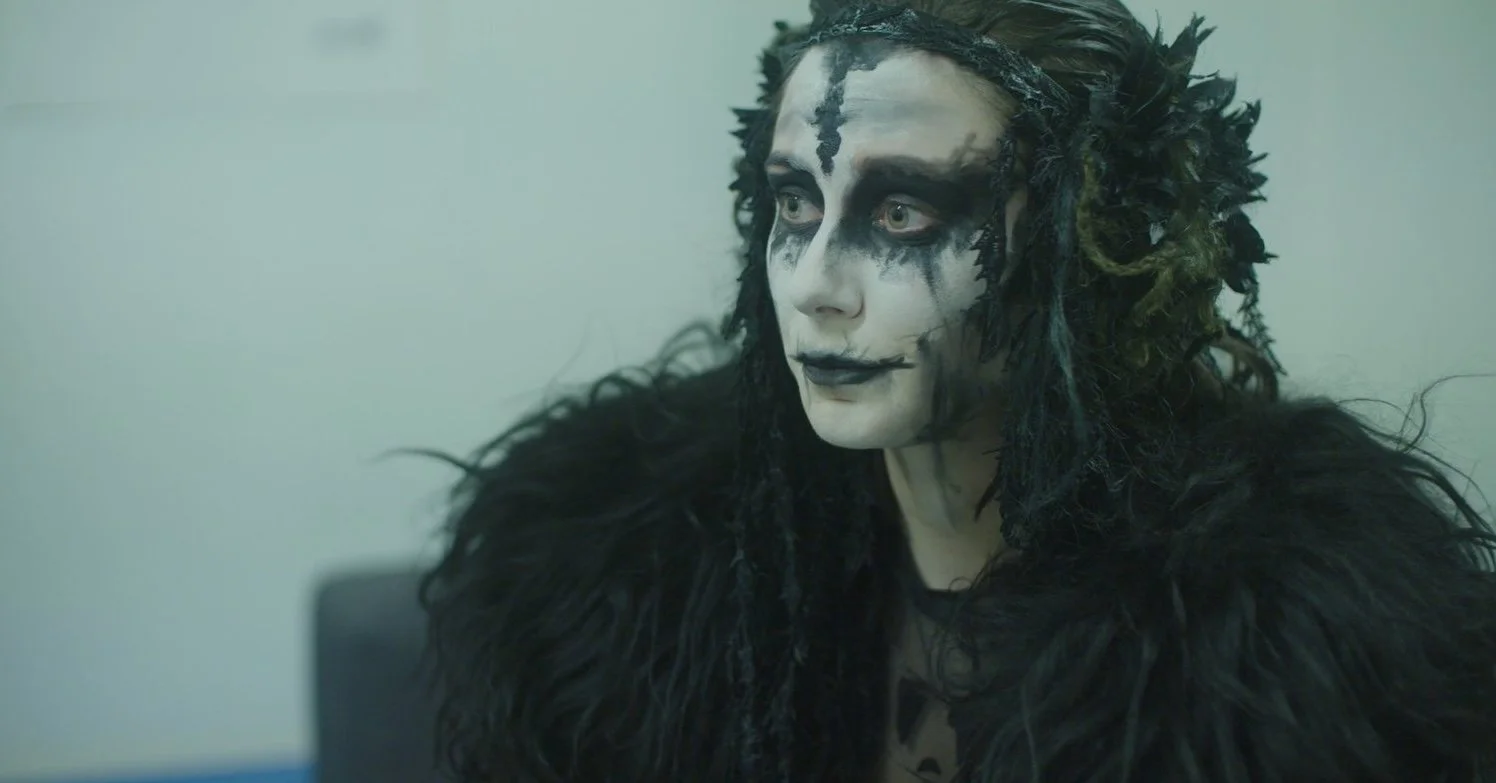
Following the rise of Norwegian black metal trio Witch Club Satan, Maja Holand's documentary HEX explores witchcraft, artistic freedom and the power of taking up space in a world that doesn't always welcome you.
Three women enter Norway's notoriously male-dominated black metal scene. They don't know how to play their instruments, they call themselves witches, and they have no intention of asking for permission. In her feature directorial debut HEX, Norwegian filmmaker and cinematographer Maja Holand follows Nikoline, Victoria and Johanna, the women behind Witch Club Satan, across three formative years as they transform from musical novices into an internationally recognized black metal act. But beyond the corpse paint, theatrical performances and sonic extremity, HEX becomes an exploration of something much bigger than music.
Drawing parallels between Norway's historical witch trials and the contemporary treatment of women who challenge societal expectations, Holand examines the enduring symbolism of the witch as a figure of rebellion, independence and self-determination. Through a combination of intimate documentary footage, visceral live performances and staged historical sequences, HEX considers what it means to embrace anger, challenge convention and carve out space for yourself on your own terms.
Ahead of the film's Alberta premiere at the Calgary Underground Film Festival's CUFF.Docs, REVERIE spoke with Holand about disrupting black metal's conventions, the historical persecution of women, the transformative power of artistic expression and why, sometimes, we all need to be a little angrier.
HEX screens Wednesday, November 18, at 9:15 p.m. at Calgary's Globe Cinema as part of CUFF.Docs 2026. Tickets and screening information are available here.
REVERIE: HEX follows Witch Club Satan over three years, from their beginnings as a group of women with little musical experience to their emergence on international festival stages. What initially drew you to their story, and at what point did you realize there was something larger unfolding beyond the formation of a black metal band?
Maja Holand: What first drew me in was the sheer audacity of it. Here were three women entering one of the most male-dominated music genres in the world without really knowing how to play their instruments, calling themselves witches and creating something entirely on their own terms.
At first, I thought I was making a film about an unconventional black metal band. But the more time I spent with them, the more I realized that I was witnessing something much larger. The project opened up questions about identity, freedom, belonging, power and what it means to take up space in a world that does not always welcome you.
The band became a doorway into exploring the figure of the witch, not simply as a historical character, but as an idea that still resonates today.
REVERIE: Norway has such a deeply established black metal history. Witch Club Satan seem to embrace many of those same conventions while simultaneously challenging them. How did you approach exploring that contradiction?
Maja Holand: What interested me was that they were not challenging black metal from the outside. They were doing it from within.
I never wanted to make a film that judged the genre or tried to explain it away. In many ways, Witch Club Satan takes black metal very seriously. They embrace its intensity, its theatricality, its symbolism and its commitment to artistic freedom.
At the same time, their presence raises interesting questions. Black metal has always defined itself through rebellion and opposition to established norms. So what happens when a new generation arrives and challenges some of the genre's own conventions? For me, that tension became one of the most fascinating aspects of the story.
REVERIE: Did following their evolution change your understanding of what makes someone an artist or musician?
Maja Holand: Absolutely.
I think we often place too much emphasis on technical skill and too little on vision, courage and conviction. Of course, craftsmanship matters, but Witch Club Satan reminded me that many powerful artistic movements start because someone has something they urgently need to express.
What impressed me was their willingness to begin before they felt ready. They didn't wait for permission. They didn't wait until they were perfect. They simply started.
Following their journey reinforced my belief that art is often less about mastery and more about the courage to create something that feels necessary.
REVERIE: Witchcraft is such a powerful recurring motif throughout HEX. What inspired you to incorporate the history of witch trials?
Maja Holand: The deeper I went into the project, the more I found myself reading about the history of witch trials in Norway. I became fascinated by stories like Lang-Anne, from my hometown, and many of the women who were accused centuries ago.
What struck me was not simply the brutality of the trials, but the kinds of women who often became targets. Women who stood out. Women who were independent. Women who were feared, admired or misunderstood.
I'm not suggesting that women today face the same reality as women in the seventeenth century. But I did begin to notice certain patterns. Society still reacts strongly to women who refuse to conform to expectations.
The witch became a powerful lens through which to explore these ideas, both historically and in the present.
REVERIE: The film incorporates a staged witch trial. How did that idea develop?
Maja Holand: Over several years, I collected reactions, criticism and comments directed toward the band. Much of this happened on social media, which isn't immediately visual in a film.
Sometimes I was surprised by how familiar some of the language felt. Not because people were literally accusing them of witchcraft, of course, but because many of the underlying fears felt strangely similar.
The idea of the witch trial emerged as a way of making those patterns visible. By placing contemporary criticism inside a historical framework, I wanted audiences to reflect on how societies create outsiders and why certain people provoke such strong reactions.
Creatively, it was also an exciting way of exploring some of the film's ideas and presenting the kinds of insights often delivered through "talking heads" in music documentaries in a different way.
The scene is not meant to provide answers. It is meant to encourage questions.
REVERIE: How did you balance capturing the ritualistic intensity of their performances while revealing the people behind the personas?
Maja Holand: As a cinematographer, I have always been fascinated by contrasts.
On stage, Witch Club Satan is almost mythological. There is blood, ritual, noise, symbolism and transformation. But off stage, there are three young women navigating friendship, doubt, ambition, exhaustion and uncertainty.
For me, the film only worked if both sides could exist together. The larger-than-life performances become more powerful when we understand the human beings behind them. And the everyday moments become more meaningful because we have seen what they are capable of creating on stage.
That tension between myth and humanity became the visual heart of the film.
REVERIE: Do you think there's an inherent tension between maintaining a radical artistic identity and becoming part of the industry you're trying to challenge?
Maja Holand: I think that's a challenge faced by almost every artist who experiences success.
The moment more people start paying attention, new expectations appear. Audiences have expectations. Institutions have expectations. The industry has expectations.
The question becomes how to engage with those systems without losing the thing that made your work interesting in the first place.
I don't think the goal is necessarily to remain outside the system forever. The challenge is maintaining your integrity once the system begins to embrace you.
REVERIE: Did making HEX change your understanding of anger as a form of artistic expression?
Maja Holand: Yes, very much.
I think female anger is often misunderstood. It is frequently seen as something disruptive, something excessive or something that should be controlled.
What fascinated me about Witch Club Satan was how they transformed anger into creative energy. Rather than becoming destructive, it became productive. It became music, performance, community and artistic expression.
The film made me think differently about anger. Sometimes anger is a sign that something matters deeply. Sometimes it is a response to injustice. And sometimes it can become a force for change. We need to be more angry!
REVERIE: What did this project teach you about yourself as a filmmaker?
Maja Holand: HEX taught me to trust my instincts.
I never planned to become a director. This project simply demanded that I step into that role. There were many moments where I had no roadmap and had to figure things out as I went.
Watching Witch Club Satan embrace uncertainty had a profound effect on me. They repeatedly walked into situations where there were no guarantees and no clear outcomes. They simply trusted themselves and kept moving forward.
I think some of that courage rubbed off on me. The project definitely made me braver as a filmmaker.
REVERIE: Have you noticed any interesting differences in how international audiences respond to the film?
Maja Holand: There are certainly differences in cultural references and familiarity with black metal, but what has surprised me most are the similarities.
Some audiences arrive through the music. Others come through feminism, folklore, spirituality or documentary cinema. Yet people often end up talking about the same issues: freedom, identity, belonging and the courage to be yourself.
The figure of the witch seems to resonate across cultures in a way I hadn't fully anticipated. Whether in North America, Europe or elsewhere, people recognize something of themselves in that story.
REVERIE: What do you hope audiences ultimately carry with them after watching HEX?
Maja Holand: I don't necessarily hope that everyone will agree with Witch Club Satan or even like them.
What I hope is that audiences become curious about their own reactions. Why do certain people inspire admiration in some and discomfort in others? Why do some forms of freedom feel inspiring while others feel threatening?
More than anything, I hope people leave the cinema thinking about what it means to live authentically and what it costs to do so.
And perhaps I hope they take a little of the witch with them. Not the stereotype, but the courage. The courage to take up space, to challenge expectations and to become who they really are.