Premiere: Feast, Fantasy and Female Gaze in APACALDA’s “Lie 4 U”
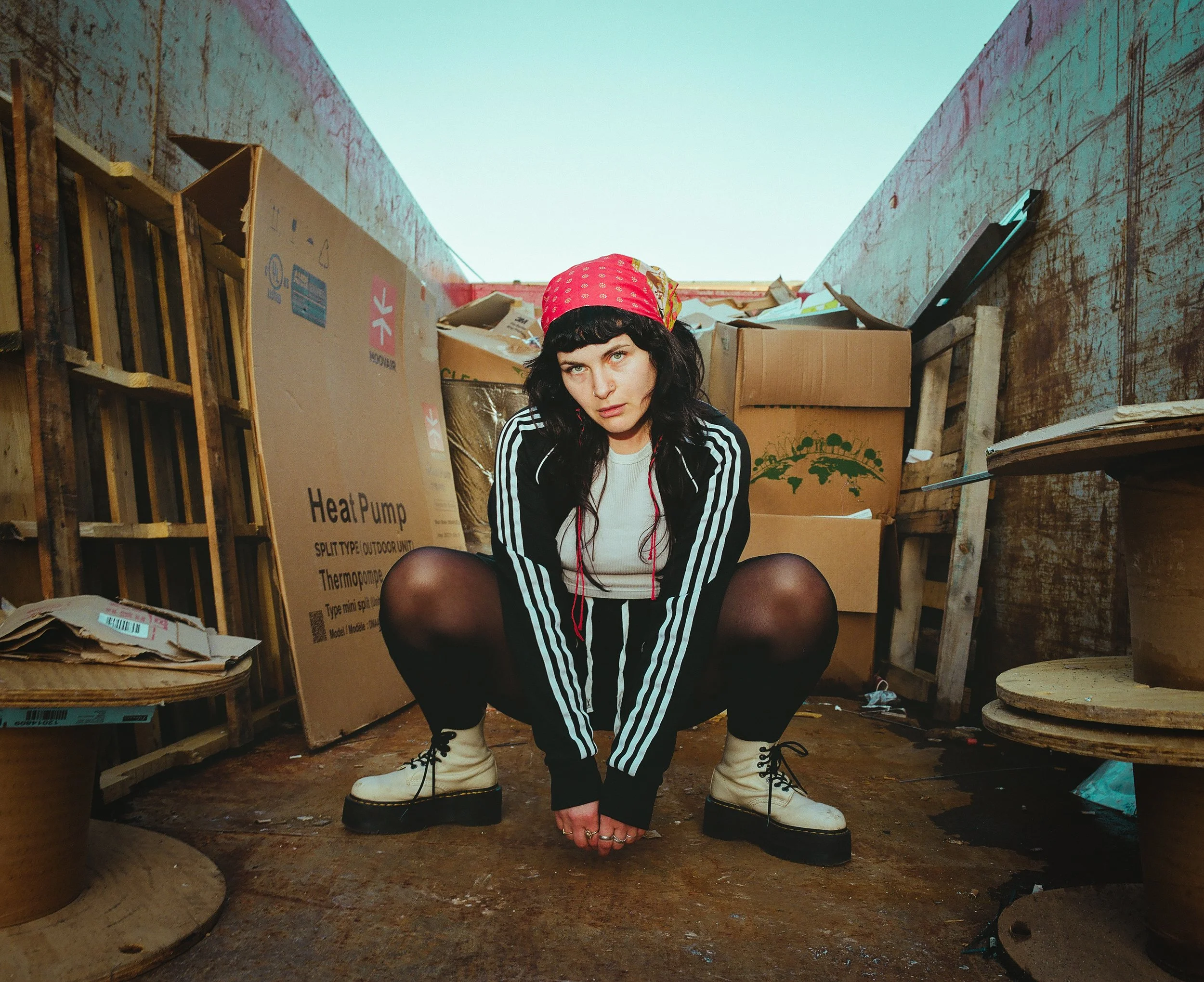
Photo credit: Kandle Osborne
Montreal alt artist APACALDA has long been drawn to the places where beauty and unease overlap, where desire can feel devotional one moment and destabilizing the next. On “Lie 4 U,” that tension sharpens into something more explicitly concerned with power and how it seduces, how it distorts, and how often intimacy itself becomes shaped by subtle negotiations of control. Produced by Mishka Stein and Samuel Woywitka, the track drifts through ghostly vocals, dark dream-pop textures and the gothic sensuality that has come to define her work, but beneath its luxurious surface sits a sharper provocation about complicity, selective truths and the fantasies we sustain to preserve comfort.
Directed by Stacy Lee, the accompanying video renders those tensions in striking symbolic form. Bathed in a golden hue, surrounded by figs and decadent fruit, APACALDA sits at the head of a surreal banquet, men positioned as the very architecture supporting the feast. It is opulent and uncanny at once — as pleasure, projection and domination collapse into each other. Yet through a distinctly female gaze, the visual resists simple inversion; it is less about reproducing power than exposing its performance, recasting desire as something authored on her own terms. As the final visual from There’s a Shadow in My Room and It Isn’t Mine, “Lie 4 U” feels less like a closing statement of the album’s deeper thoughts that are laced with radical honesty, emotional self-deception, and the uneasy spaces where longing and control become difficult to untangle. Read our Q&A with Apacalda down below.
REVERIE: “Lie 4 U” explores the quiet negotiations of power within relationships — the truths we bend or ignore to preserve connection. What first sparked those ideas, and how did they take shape in the song?
This song actually began as something entirely different. It was originally titled Lie To Me, written from the perspective of a friend’s partner during the final stretch of their long-term relationship. As things unraveled, and in a desperate attempt to grasp onto the familiar, he exhibited such complacent behaviour in regards to her boundary crossings.I thought that was interesting; the idea of us betraying ourselves for the illusion of safety. That dangerous head space of doing whatever it takes to keep the environment comfortable. Finding any sort of justification that will allow you to continue to avoid the discomfort of confrontation and ultimately, the discomfort of growth. Some questions come with answers we aren’t ready for. It’s funny, isn’t it? That we avoid discomfort even when it directly benefits us. It was during the pre-prod sessions that I was challenged by producer Mishka Stein, to dive deeper into the theme of lying and what it meant to me personally. That question sent me down a rabbit hole, unpacking the complexity of human behavior and the choices we make. I realized that, more often than not, I had experienced lies from the receiving end, so, I chose to switch the narrative and write from the perspective of the one telling them.The song evolved into a reflection of that exploration, examining the subtle, layered nature of deception. Whether we’re lying to someone else or to ourselves, the nuances are endlessly fascinating to me.
REVERIE: How were you thinking about power, complicity, and emotional self-deception while writing it?
It started off on a small scale. The power dynamic between two people, in this case, the anxious and the avoidant. Tale as old as time. One is driven to fully indulge in the moment, choosing to avoid the cost later, while the other takes a wider view, searching for clarity and security without disrupting what is. And in doing so,they ironically sacrifice their own inner stability, clinging instead to the illusion of the present moment and the false belief that it’s unfolding in their favor.I later realized that this dynamic extends far beyond the personal, it actually mirrors what I see unfolding on a much larger scale. The imbalance of power, the awareness of injustice, and the conscious choice to look away in the name of comfort, often from a place of entitlement.
I have a hard time believing that the way things are unfolding is truly in our favour.
REVERIE: The video feels seductive but subtly destabilizing, almost like a fantasy tipping into something darker. What world did you and Stacy Lee want to build around the song?
You absolutely nailed it. It is meant to feel like this playful, beautiful fantasy that also has a grotesque, opulent and gluttonous energy to it. Symbolizing the aura of the person in the position of power.
REVERIE: You’ve framed the visual through a female gaze. How did that perspective shape the storytelling?
There’s a layer within both the song and the visual that leans into pleasure-seeking. From the opening moments, where the men are positioned on their hands and knees, to the more playful, suggestive imagery like the fig, these choices intentionally shift the narrative. Instead of reinforcing the traditional dynamic of women as submissive to men, the visual reclaims that space, subverting it through a female gaze and a sense of control.
Even in the symbolism, that intention was deliberate. Rather than choosing something overtly phallic, I opted for the fig, something softer, more delicate, and inherently feminine. It allowed me to explore desire in a way that feels nuanced and intentional, reframing it as something directed, owned, and expressed entirely on my own terms.
REVERIE: As the final visual release from There’s a Shadow in My Room and It Isn’t Mine, does “Lie 4 U” feel like a kind of closing statement for the record or a lens that brings some of its themes into focus?
The common thread running through the album is radical honesty, especially towards oneself. I’d say Lie 4 U, as the final visual release, drives that message home. It’s less of a conclusion and more of a lens, sharpening the themes that have been present all along.
At its core, it speaks to personal reflection and the responsibility we carry as individuals, how we show up, how we relate to one another, and the truths we choose to confront or avoid.
REVERIE: Your work often feels as visual as it is musical. Do you see your videos as extensions of the songwriting, or as spaces where songs can reveal something new about themselves?
I love that my work feels as visual as it is musical and that it translates beyond my own perception. To me, it’s both an extension and a space where things can oftentimes reveal themselves in unexpected ways. Those unanticipated moments often give me a deeper understanding of the subconscious currents within my songwriting. And when I approach visuals as an extension, it becomes an opportunity to express something that perhaps wasn’t immediately obvious in the music alone, adding another layer of meaning to the work.
REVERIE: Anything else that you’re working on or want to plug?
I’m currently finalizing a remix of Almost Burnt The House Down which I’m really excited about because it’s got this ‘house’ vibe to it. *New genre unlocked* (Goth Haus?) I’m also working on new demos that carry a strong, cohesive direction, something that feels very much aligned with who I am sonically, artistically and where I want to take my music next. I’m also super excited to go on tour this summer. I will be playing in Montreal, Toronto, Calgary, Vancouver and Victoria. Keep an eye out for the official announcement.