

Premiere: Sook-Yin Lee Opens a Portal into 72RHR with “Mending Wall”
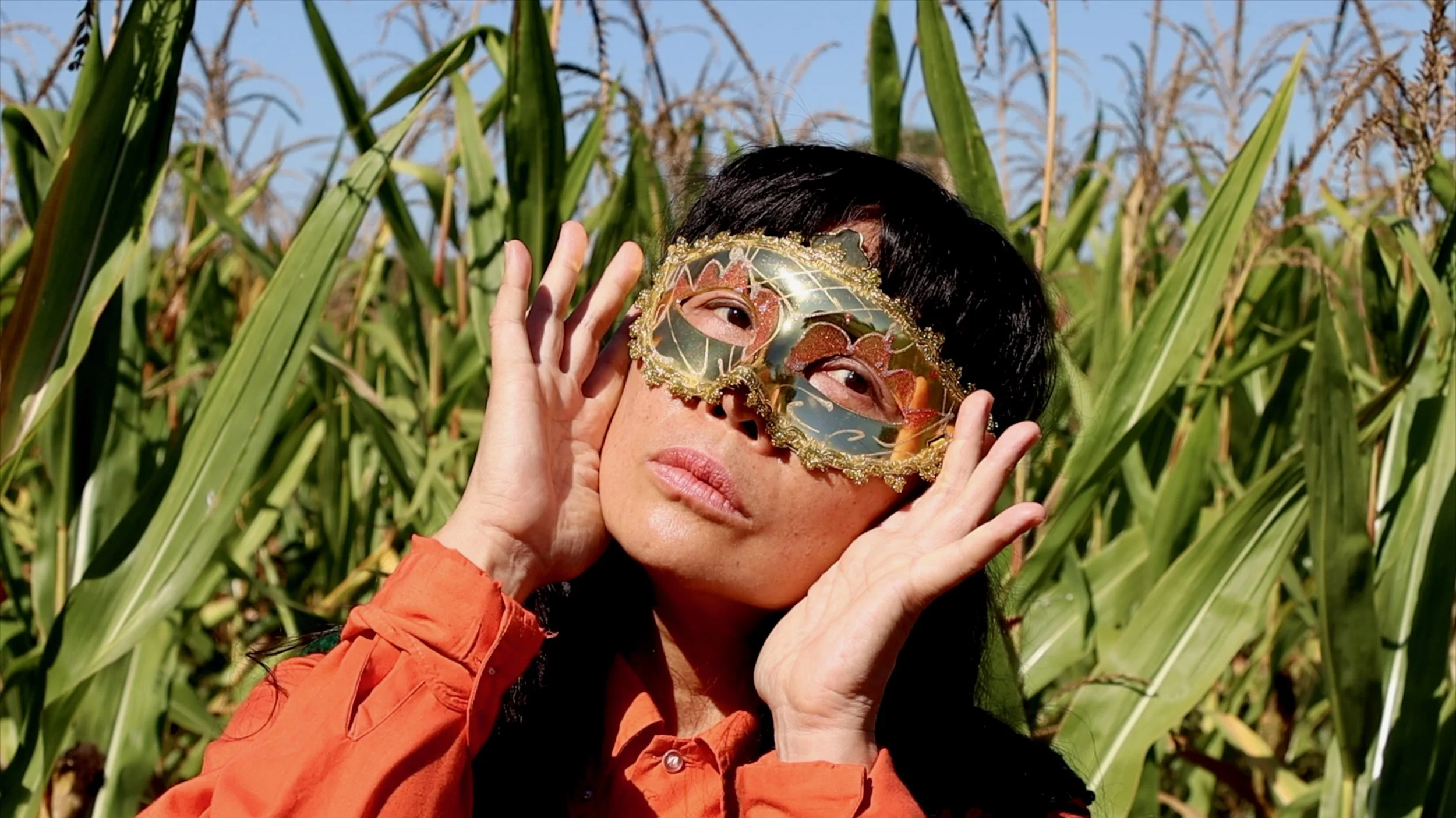
Photo credit: Dylan Gamble
Sook-Yin Lee has carved out an impactful place in Canada’s art history — from Vancouver art-punk circles and experimental collaborations to her era-defining work at MuchMusic, filmmaking and boundary-pushing performance practice. That multidisciplinary ethos pulses through her newest track “Mending Wall.” Premiering today via REVERIE Magazine, “Mending Wall” offers a portal into a sound unafraid to encourage feelings of motion. Built within the conceptual framework of her forthcoming album 72RHR — each song written at a meditative 72 beats per minute — the track and music video balances propulsion and poise, carrying pop hooks through currents of transformation as we accompany her on towering rooftops and the bustling streets of Toronto. Read our Q&A with the artist down below and watch “Mending Wall” here.
REVERIE: 72RHR is built around the concept of a resting heart rate, yet the record seems to hold tension and release. How did that conceptual constraint of 72 BPM shape the emotional architecture of the album?
Years ago, in the midst of a mental breakdown, I discovered a meditation practice that helped put me back together again. I had never meditated and assumed that it was a sublime and peaceful experience, which it wasn’t. Sitting cross-legged on my butt for hours in silence lasting for days was tough and painful. Meditation offered tangible tools to observe and abide by these conflicting states in my body. For the album, I set out to create songs all written at 72 beats per minute, your resting heart rate, 72RHR, the pulse when you are relaxed. I wanted to challenge that notion by embracing a full spectrum of emotions and feelings that mirrored the intensity of a meditation experience. We’re living in a time of chaos and confusion. Some argue that the world has always been on fire, only now it’s streaming on our devices. With 72RHR, I wanted to offer a key to how to cope. Care is the key.
REVERIE: There’s something fascinating in using repetition and uniform tempo not as limitation, but as a framework for discovery. What did working within that pulse unlock for you creatively?
I enjoy working within obstructions, limitations, and constraints, like George Harrison understood when he sang, “Without going out of my door, I can know all things on Earth, Without looking out of my window, I could know the ways of Heaven. The farther one travels the less one knows." Composing within a set tempo involving repetition was a framework to explore sounds and feelings and subconscious musical flow without losing the plot or direction.
REVERIE: What drew you to release“Locked Boy” and “Mending Wall”as the first two singles?
“Locked Boy” was the first single from 72RHR. The second is “Mending Wall”, which also kicks off the album. I wanted to begin with anthemic bangers. These songs are full of hooks and pop melodies. My aim was to offer an accessible entry point before diving into uncharted waters and adventurous sounds. I want listeners to feel welcome and supported because the album goes to some challenging places, sonically and emotionally.
REVERIE: I’ve heard the echoes of Berlin-era David Bowie and Brian Eno mentioned in the press materials, but were there any other reference points that were guiding you while making this record?
Mostly, the conceptual limitations offered a musical direction that freed me to respond with intuitive vocal melodies and lyrics. I’m a big proponent of letting my subconscious lead the way. My initial response was to improvise, and gradually, I sculpted the songs. In addition to Brian Eno and David Bowie, I’m inspired by Can, Holger Czukay, Yellow Magic Orchestra, Massive Attack, Marianne Faithfull, Kate Bush, Laurie Anderson, Togawa Jun, Nina Simone, and Delia Derbyshire.
REVERIE: You’ve worked across music, film, radio, performance and theatre, often blurring the boundaries between disciplines. Did your work as a filmmaker or storyteller feed into how you approached songwriting on 72RHR?
I work in many media: visual art, film-making, broadcasting, theatre, dance, and music. I’m also a former competitive swimmer, which lends physical rigour, solitude, and discipline to art-making. All of these forms influence each other. Working remotely, I have learned how to realize an idea from start to finish. I understand the connection between what makes a good film edit and what makes a good song arrangement. My favourite films are of a time and place, and reflect some of the cultural concerns of when they were made. Similarly, this series of songs arose in a certain period, and together they follow a movement or transformation, much like a film or story, but through expressionism and poetry, not a literal narrative like most movies.
REVERIE: You composed, performed, engineered and produced the album yourself. What did total authorship offer this project? Was there anything you discovered about your artistic practice through this process?
I enjoy incorporating obsolete tech with noises I warp and stretch beyond recognition, that I combine with current tech, traditional instruments, field recordings, found objects, and earworms. I compare my music-making process to gardening. I take time, away from audiences and watchful eyes, monetary pressures and timelines, to putter around my sound garden and sing. Making music is an obsessive pleasure, playing with sounds, poking around with machines, laying down tracks and deleting them. I make music and film scores in my studio. 72RHR is my second album mixed by Steve Chahley, who I communicate with online. I may have met Steve once in person a long time ago. There is a chance that I have never met Steve in person! He is a good friend and our bond is music made at a distance. Steve is who I trust to mix the songs.
REVERIE: You came up through Vancouver’s art-punk scene and have moved through experimental and underground communities throughout your life. How would you describe the scene you’re situated in now? Are there local artists you are excited by currently?
Growing up as one of a few Asian kids in my neighbourhood, I felt like an outsider. I like to tap into a variety of “scenes” and communities, while maintaining a strong solitude. I came up in Vancouver in a community of poets, dancers, punks, visual artists, and activists who worked together. Today, my art peers and extended family in Toronto include cartoonist Chester Brown, musician/artist Dylan Gamble, and author/artist Jillian Tamaki. I have fun visits with David Cronenberg, who is full of insight and I enjoy wild movie nights with filmmakers Karim Hussain and Brandon Cronenberg. Karaoke Queen, Sarah Kilpack, and dancer/artist Ronnie Clarke join me and Dylan to perform live in an anti-band. My film-making and music communities intersect: JL Whitecrow from the band Slutcode, Dusty Lee from Slash Need, Des Das Gupta from Kali Horse. My neighbours include elder Chinatown busker Tak Chan, leathersmith Al Alkayet, Mother Maggie Helwig at St. Stephens in the Field, and animator Seth Scriver, his wife Koko and their kids are anchors in my life. The Toronto psych music scene is generous and supportive, with bands like Mother Tongues and Hot Garbage. Lee Paradise, Moon King and Cadence Weapon are remixing some of my songs. Local up and coming artists who excite me are filmmakers Kalil Haddad, Daphné Xu, Lea Rose Sebastianis, and musician Bridge of Sand in addition to Karen Ng, and New Chance.
REVERIE: You’ve said achieving calm balance can be challenging, which feels almost like the thesis of the album. After living inside this record, has your own understanding of “rest” changed?
You have brilliantly distilled the thesis of the album! Well done Jess! “Rest” is still elusive to me, though I enjoy conking out for a long time and I know I ought to go swimming.