

Tender Loving Care is a Fitting Capstone For Mike Leigh’s Career
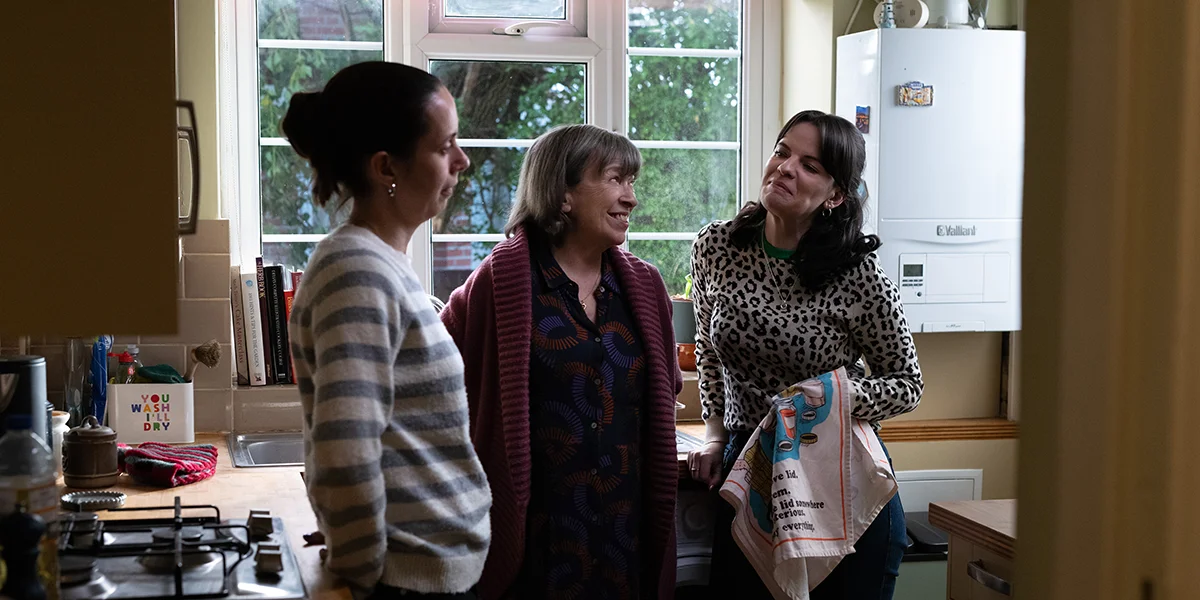
Still from Tender Loving Care. Photo courtesy of the Calgary International Film Festival.
I have always loved the way Mike Leigh has titled his films. They are either matter-of-fact (Another Year is in fact a movie that takes place over the span of a year, Career Girls is about two women who meet at uni, Happy-Go-Lucky is about an endlessly positive protagonist) or mention the themes of the film in a direct manner (Leigh’s first film is titled Bleak Moments and it is hard to argue with the title. Secrets & Lies indeed delves into secrets and lies that people tell themselves). This continues with Leigh’s latest, Tender Loving Care, which is about Amy (played by Kate O’Flynn, a recent Emmy winner for the Apple series Widow’s Bay), a government child protection worker, and her best friend Rosie (played by Alice Bailey Johnson), a social services officer, who take care of others in their daily life, which includes Amy’s family (played by Marion Bailey and Paul Jesson). The title Tender Loving Care really lays the themes bare, in a really beautifully honest way, which can also describe the work of Mike Leigh writ large.
Tender Loving Care continues the trademark Mike Leigh slice-of-life structure, of where you follow these characters going about their lives (for Amy and Rosie, there are vignettes that show them at work taking care of others), but a throughline is bubbling underneath the surface, before it knocks you for an emotional wallop. The emotional core of the film is doubly resonant, as 83-year-old Mike Leigh has been diagnosed with myositis, an autoimmune disease that causes chronic muscle inflammation and affects mobility, so there’s a very good chance Tender Loving Care ends up being Leigh’s final film. Going into the screening with that information, and knowing that the stars of the film are Marion Bailey (not just a long-time collaborator of Leigh’s, going back to 1983’s Meantime, but romantic partners since the ’80s) and Alice Bailey Johnson (Marion Bailey’s real-life daughter from a previous relationship), it makes the themes of taking care of family members as they are ailing hit even harder.
I will note though, like all Mike Leigh films, do not expect a depressing dirge (even Bleak Moments had some laughs!), as there are tons of really hilarious and charming moments throughout the film. Tender Loving Care also continues Leigh’s streak of being among the best at displaying female friendship on screen, as some of the most joyful moments of Tender Loving Care are when Amy and Rosie are dancing, singing and having wine after a long day at their emotionally draining jobs. Some of the moments that made me tear up in the film were not just the sad moments showcasing failing health as people get older, but also just witnessing such kindness and people treating each other nicely on screen.
As a long-time devoted fan of Mike Leigh’s work, the idea that Tender Loving Care might be the end is truly crushing, as there are so many things that Leigh does that he continues to be the very best at. His mix of comedy and drama continues to be unparalleled, where one moment you are laughing hard and the next you are sobbing. His films being about contemporary issues people are currently going through is no small thing either, as even at age 83, Leigh finds a way to work in a reference to RAYE’s 2025 song “Where Is My Husband!” during Tender Loving Care, while a lot of directors half his age seem avoidant to making anything contemporary at all and would rather make period pieces.
Above all, the performances of his actors is what sets Leigh’s work apart. Through Leigh’s trademark rehearsal process, where actors come up with their own characters over the span of months, which Leigh then writes those moments into the final screenplay, the actors have a deep ownership with each Leigh film. This is why I feel most of the best film acting of the last fifty years has been in Mike Leigh movies, as no one is being handed to memorize. Instead, the actors created these characters themselves and it’s why everyone feels like a living, breathing human being, and not a collection of tropes. I can’t think of a writer/director who has done more to elevate and empower actors more than Leigh has.
Going back to Tender Loving Care, while it is very sad this might be the end of Leigh’s career, i can’t think of a more fitting capstone to a career than Tender Loving Care, a beautifully empathetic look at the cycle of taking care of others and then needing someone to take care of you. For one of the great humanists in cinema history, this is as fitting of an end as it gets.