

Discovering Wes Anderson Through the Lens of Robert Yeoman
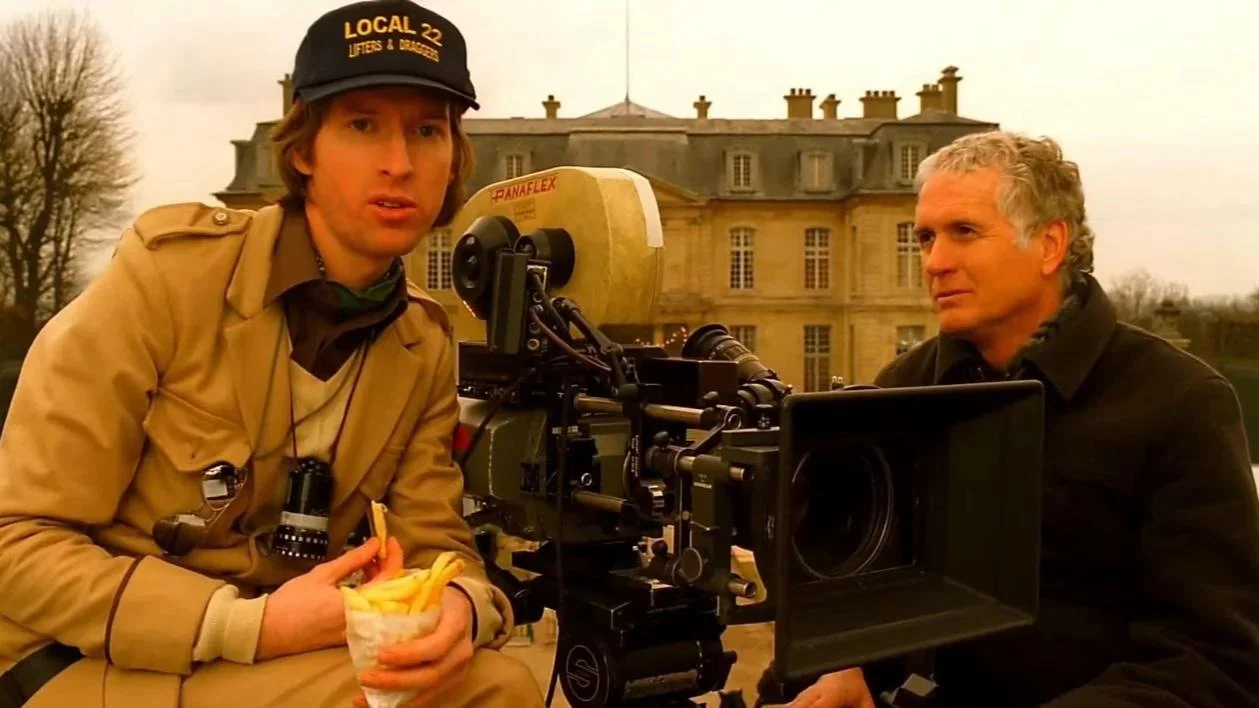
Wes Anderson is one of my favourite directors working today. One of the first films of his I watched was about ten years ago, and was The Grand Budapest Hotel, which was, for the longest time, my all-time favourite movie. Since then, especially in the past five years, Anderson has become one of my favourite directors, with many of the films forever ingrained in my mind. Even though I love the witty deadpan humour, the gorgeous sets, and the highly memorable characters, one thing that always sticks with me long after the films are over is the cinematography, especially in The Grand Budapest Hotel, The Darjeeling Limited, and The Life Aquatic With Steve Zissou. Recently, I reached out to Anderson's longtime cinematographer, Robert Yeoman, to chat about some of his most iconic shots, his experience working with Anderson, favourite memories, and more.
How The Collaboration Between Anderson and Yeoman Started:
Yeoman first collaborated with Anderson on Anderson's directorial debut, Bottle Rocket. Anderson wrote this film with his friend Owen Wilson. Both were massive fans of a film Yeoman shot called Drugstore Cowboy and really wanted him to shoot Bottle Rocket. “Wes sent me a letter which I still have, just saying ‘Hey, would you be interested in collaborating on this movie we have?’” Yeoman reflects. “They sent me the script, and I thought the script was great, unusual, and different Wes and I were from a little bit different generations, but we hit it off immediately… and then we did the movie together, and the rest is history. It’s been quite a great collaboration.”
What exactly does the collaboration process between Anderson and Yeoman look like? “With Wes, he’s got a very specific idea for what he’s looking for, and it’s my job to just get inside his head to see what he’s looking for and then somehow help him get that on screen,” Yeoman says. “It is so carefully planned out beforehand. We’ve been to the location beforehand, figured out exactly what it is we exactly want to do, and it is very orchestrated around that plan. We almost never vary from the plan. Sometimes we are forced to just because of the physical limitations of the location, or if an actor is supposed to run up the stairs and he can’t run up in time to deliver a piece of dialogue. Then we have to make some sort of change. But generally, we shoot exactly what we thought about beforehand.”
Utilizing Slow Motion Shots and Having Characters in the Center Frame:
One of Anderson’s signature trademarks in his films is the slow-motion shot. Some examples include the dance sequence at the end of Rushmore, the Whitman brothers (played by Owen Wilson, Jason Schwartzman, and Adrien Brody) chasing down the train in The Darjeeling Limited, Richie Tenenbaum (played by Luke Wilson) seeing Margot Tenenbaum (played by Gwenyth Paltrow) getting off the bus in The Royal Tenenbaums, and when Dignan (played by Owen Wilson) heads off to jail at the end of Bottle Rocket. “When you do that, I think it creates a different reality in a way,” Yeoman reflects. “When we did the scene of Gwenyth Paltrow getting off the bus and seeing Luke Wilson sitting there waiting for her, it just gave it this dreamlike quality, and that’s what Wes was going for. She is just walking in slow motion towards him, and he hasn’t seen her in a while, and it's really slowed down, making it kind of a dream somehow… It calls attention to itself in a lot of ways. It certainly takes what happens in a finite period of time and extends that so that you’re really getting a different feeling.”
Symmetrical staging is another notable trademark of Anderson's films. One example of this is having characters positioned near the center of the frame, often looking directly at the lens, which creates a very intimate and powerful connection with the viewer. “You really get to feel the emotion that they are going through,” Yeoman states. “We can manipulate the lighting so if it is a sad moment, we might be able to put some contrast into it, or if it’s a light, happy moment, we can do things with the lighting that will give the feeling of that emotion. When Luke Wilson [Richie Tenebaum] is about to kill himself in The Royal Tenenbaums, we have that tight close-up of his face staring right in on the camera, and he’s looking in the mirror. You really felt what was going through his head, and something bad was about to happen. That is one thing that Wes does, and I like to do as well is in those heavy emotional moments is to really get in there and see what the character is feeling.”
Distinct Colour Palettes and Helping Bring Anderson’s Unique Worlds to Life:
All of Anderson's films have very distinct colour palettes, for example, the heavy emphasis on yellow in Moonrise Kingdom or pink in The Grand Budapest Hotel. “Wes certainly has ideas coming in for what colours he is looking for… and we do a lot of extensive testing, and that would be the production designer, Adam Stockhausen [production designer] and Milena Canonero [costume designer], who both bring in potential colours,” Yeoman shares. From here, they shoot different options for elements like the costumes and walls and arrive at what they believe is the best fit. “It’s a collaboration between the four of us, and then we have a much better idea which direction to go, ‘cause Milena and her crew still have to make the costumes, and Adam and his crew have to build the sets and paint them.”
Although Yeoman highlights the colours they used for The Grand Budapest Hotel as a personal favourite, he is incredibly proud of them all. “Each one has its own unique look, and there are certain characteristics and visual things that Wes does in all of his movies, but I think that each is its own little adventure,” Yeoman says. “Going to India for Darjeeling Limited was an experience. We were trying to capture the colours of India, and that was guiding us through that. Certainly, in The Life Aquatic With Steve Zissou, it was based on Jacques Cousteau, with the hats, gloves, and everything else. That was the basis of how we started, and of course, Wes put his own personal stamp on it.”
When Anderson started out his career, there were not near as many awe-inspiring sets in the films as there are now. Films like The Grand Budapest Hotel and The French Dispatch have some breathtakingly dazzling sets that will stay with the viewer forever. Yeoman shares that Anderson has utilized more sets as it allows him more control. “If you’re in a normal house and the rooms are small, you may not be able to get the cameras where you want them to be. Whereas if you build the sets to accommodate the camera, which is what he does, you have a lot more control. You can be more precise in composition and lighting.”
An example of being in more control of the sets is in the "Revisions to a Manifesto" segment in The French Dispatch. “They built the Le Sans Blague on stage, and we went to look at it before shooting just to get the final approval, and Wes is like, ‘Hey, wouldn’t it be cool if this little wall just could open up, and we reveal it like that,’” Yeoman recalls. “It was kind of a bookends thing because at the beginning, you see the wall open, and you bring the camera in with the Sans Blague. Then, at the end, when Timothée Chalamet [Zeffirelli] and Lyna Khoudri [Juliette] are up against that jukebox, we open the walls, and then the motor scooters go driving by. I love doing those kinds of shots. It is very challenging, lighting can change, and it's very theatrical. But as I’ve gone on with Wes, we do more theatrical-type lighting with dimming lights within the shots, whereas before you just light it and just let the actors inhabit that world. Now we are actively changing the mood of the story by moving lights and dimming them up and down within a shot.”
Even though they still "strive to put everything on camera," Yeoman shares that Anderson's experience directing animated films, such as Fantastic Mr. Fox, has influenced his desire to incorporate new tools into live-action films. “After Wes started doing the animated films, he started to take advantage of some of those techniques to tell a story. We used miniatures, forced perspectives, and visual effects occasionally – Just different elements that we would combine in post to create that world. In The Grand Budapest Hotel, the hotel exterior was a combination of several things; an actual exterior, but then there were the miniatures they used as well.”
Filming Challenging Shots:
Dealing with the challenges of filming difficult shots and figuring them out as a team is something Yeoman always enjoys. “Wes will describe what he wants to do, and I’ll think in my head, ‘Well, that’s impossible,’ but then we usually find a way to do it,” he says. Yeoman shares that the opening sequence in The Darjeeling Limited, where Peter Whitman (played by Adrien Brody) is running with his suitcases to catch the train, was quite a complex thing to film, but that it is also one of his favourite scenes he has ever filmed. “I am sitting in a Rickshaw, and our key grip, Sanjay Sami, who was on the Indian rugby team, would be running and pulling the Rickshaw, and I would be sitting there with a camera, and it had a lot of frenetic energy by doing it that way. I think visually it added a lot to the story, just showing Adrien running and Bill Murray [The Businessman] trying to catch up with him.”
One of the hardest shots Yeoman has ever had to pull off was the shootout scene in The Grand Budapest Hotel. In this scene, he had to do a ton of whip pans and constantly switch from one character to the next at very precise moments. “I am doing a 360 pan, so the grips built me this scaffold that I was on top of, and I was five floors up,” Yeoman shares. “As I’m moving around, the whole scaffold starts shaking ‘cause it is so high up there. I don’t have a lot of time, as the actors are starting to arrive on set. I am like, ‘How am I gonna do this without the whole thing shaking?’ I got a laser pointer and put it on the tripod, and I just made little marks on the floor of the scaffold. I just stood still and moved the camera around to 1, then 2, then 3, then 4, and so on. I was just looking at the mark to make sure it was hitting it, and that way I wasn’t shaking the whole thing, and we got the shot.”
Filming the boats in The Life Aquatic With Steve Zissou was another challenge. “[It was] always difficult getting them in proper positions and oftentimes they’d drift,” Yeoman says. “We didn’t want to see the land because they’re supposed to be out in the middle of the ocean somewhere, so sometimes as we are doing a take, it drifts and all of a sudden, we are seeing this land behind them… That movie was not easy, I remember saying to Wes one day after we’d been there for several months, ‘Are we gonna have any easy days on this movie?’”
Working With the Actors and Actresses:
Being the cinematographer for several of Anderson's films has allowed Yeoman to work alongside some very talented actors and actresses, including Bill Murray, Gene Hackman, Ralph Fiennes, Tilda Swinton, Frances McDormand, and Willem Dafoe. “I have a front row seat as I’m operating the camera and I’m right there and I can hear all the conversations going on and for me it’s very rewarding,” Yeoman states. An example of this is working on Rushmore, which Yeoman says was a "total blast" to work on. “None of us had worked with Bill Murray before, and Bill brings a whole energy to the set. He is constantly dancing with the extras or cracking jokes. Max Fischer, the character that Jason Schwartzman plays, wasn’t exactly a positive character. There was a lot of kind of weirdness about it, and I was always a little bit nervous that people wouldn’t relate to this character, but as we filmed and things went on, I really thought Jason was doing a great job… It was fun to watch him grow as an actor, and he had been a big Bill Murray fan, and I enjoyed seeing the two of them working together as much as they did.”
Concluding Comments:
Yeoman has loved working together with everyone involved in Anderson's movies. "I've learned so much being around these people," he says. Travelling around the world and experiencing different cultures is another thing that has stuck with Yeoman forever. “You really get exposed to who these people really are. It has changed my perspective on the world.”