

Inside the Making of Matt and Mara with Nikolay Michaylov
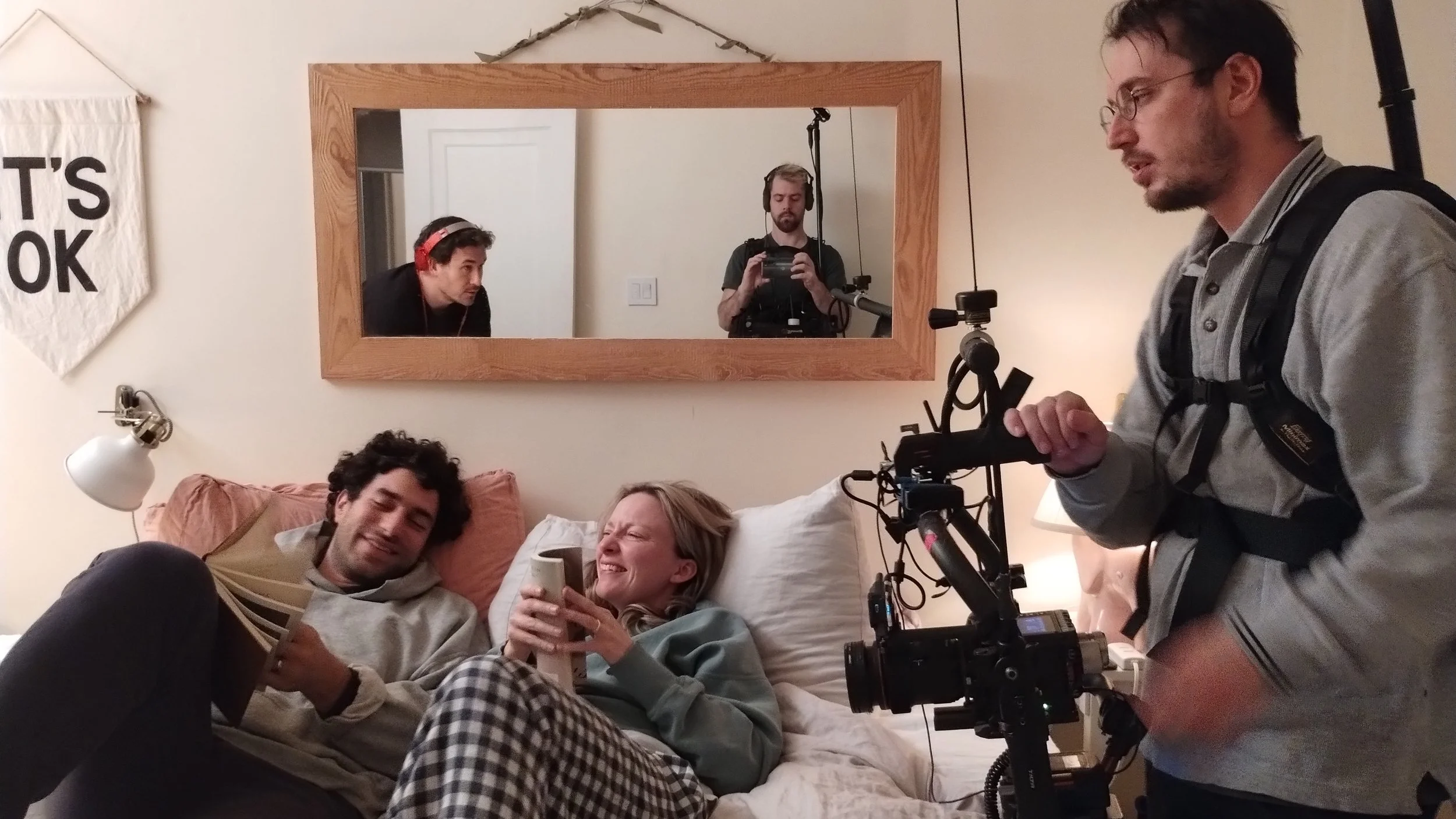
Photo credit: Ian Reynolds
Kazik Radwanski’s fourth feature film, Matt and Mara, follows Mara (played by Deragh Campbell), a creative writing professor dealing with troubles in her marriage to Samir (played by Mounir Al Shami), a musician. Mara unexpectedly reunites with a friend from her past, an author named Matt (played by Matt Johnson), sparking a connection that leads to them spending countless hours together, joking around, talking about art and life, and bonding over shared interests.
Featuring undeniable onscreen chemistry between Campbell and Johnson, thought-provoking musings on art, amusing naturalistic dialogue, and gorgeously striking cinematography, Matt and Mara is a great addition to the mumblecore genre that has tons of rewatch value.
Recently, REVERIE chatted with cinematographer Nikolay Michaylov about Matt and Mara.
“Matt and Mara is a project that we made between very close collaborators who have all worked together before… and making a movie with your friends is super special,” Michaylov smiles. Radwanski and Campbell are two close friends with whom Michaylov has collaborated with on various projects throughout the years. “Whenever Kaz has a new idea, even before I hear it, I’m going to be keen on the collaboration. If it wasn’t for his trust on his second feature [How Heavy This Hammer], which was my first feature, I wouldn’t have a career… Deragh is one of my most frequent collaborators… and I’m really grateful for my friendship with her because it’s just made making movies with her so easy, and I know she’ll always deliver.”
Another thing Michaylov really enjoyed about working on Matt and Mara is the freedom and time it allowed everyone on set to learn new things and practice their art. “What Kaz has mastered, even before our collaborations together, is leaving room for everybody involved to make discoveries together,” Michaylov shares. “I really enjoy about making films with Kaz because we can take our time and find the scene. We can shoot for as long as we need. Typically, we are able to accomplish what we wanted to do, and we don’t stop shooting until we’re happy, but in the rare instance we don’t accomplish our goals, we can always return and go back to that location with the cameras, actors, and crew, and try again.”
Going into Matt and Mara Michaylov and Radwanski realized they needed to change their camera setup. Radwanski’s previous film Anne at 13,000 Ft. was shot on a 1080p resolution camera called the Canon C300 Mark 1. “We were completely satisfied with the images from that film, but later, we were at a party where those images were projected on an 8K screen and we made the conclusion that the work wasn’t translating into spaces like this,” Michaylov reflects.
Finding a new camera setup that allowed Matt and Mara to stay true to the DIY self-sufficiency ethos of Radwanski’s films was important. Michaylov decided to shoot Matt and Mara using a lightweight RED KOMODO camera setup, which enhanced the film's resolution. “We recognized that in order for our films to survive the growing landscape of cinema, we needed to upgrade the way we shoot the film,” Michaylov says. “What didn’t change was the fact that we needed a lightweight camera that allowed me to be relatively self-sufficient and allowed me to continue to shoot off the cuff. We recognized the resolution of the camera needed to increase, so we opted for a 6K camera, which is roughly six times the resolution of Anne at 13,000 Ft.. The way we shot the movie didn’t change all too much, but the technology did.”
One significant change for Matt and Mara is that it is not a solitary character study like Anne at 13,000 Ft., which posed a new challenge for Michaylov and Radwanski. “When shooting Anne at 13,000 Ft., we had a probing camera on one character that was kind of suffocating,” Michaylov comments. “For Matt and Mara, the challenge was figuring out how to balance two characters who couldn’t be more different, yet whose collision drives the emotional core of the film.”
How exactly did Michaylov and Radwanski go about filming two different characters? “During my first collaboration with Kaz, the only note I ever got was ‘I want to be closer. I want the lens to be tighter. I want to be in the character's face,' and for Matt and Mara, we still accomplished that, but we took a slightly different approach compared to our previous films,” Michaylov states. “Kaz approached me and said, ‘I want to be just as close to our characters, but I want a wider field of view. Can we shoot this movie on a 35 mm lens?’ With Matt and Mara, not only do we have to consider the fact that we were capturing two characters, but we also wanted more context. That didn’t mean abandoning his instinct or changing the way we shoot our movies. They’re all shot in a similar way. It meant getting a handle on the tools at our disposal, thinking about form in a more elevated way, and treating it with that new confidence. It was a new treatment of our process, while not abandoning the fundamentals of what we do best, which is staying close, working with a minimal crew, keeping things seeming like a documentary, allowing room for improvisation for myself and the actors, and just being open.”
Staying close to characters' faces (extreme close-ups) is a trademark of Radwanski's films. By doing this, viewers can really feel the emotion of the characters. “My impression after working with him for so many years is that he just loves that intimacy and immediacy,” Michaylov says. “I think it can be a really claustrophobic experience when you’re sitting 90 minutes with a character and don’t see much of anything else. Those kinds of things, when you effectively execute them, can make a viewer feel different ways; uncomfortable, euphoric, happy, or it can allow you to help you understand the character a bit more.”
Similar to Radwanski’s previous films, Matt and Mara feels like a documentary. Michaylov shares that shooting it like anything else “tends to stifle the performances,” whereas a verité-style approach gives the actors and actresses more room to breathe. “It sounds so rudimentary or simple, but allowing the actors not to think about the camera allows them to express themselves even more,” he explains. “Because we use a single camera, sometimes I’m unable to anticipate certain movements, or I am only focused on one character and miss some of the performance. In those instances, everyone on the team grouped together and we figured out how we can best capture the sequence, so that we can preserve performance and accomplish the scene effectively… That’s where something that feels a bit more improvised or free-flowing begins to tighten up a bit. It’s still improvised because the dialogue and movement would change from take to take, but we made these micro rules, gestures, and suggestions. Half the time, Matt and Deragh would remember or follow through, and for the other half where they didn’t, I would improvise in a way that supported the actors’ instinct, and we would make even more discoveries.”
An example of this is the Niagara Falls sequence. Michaylov shares that this was a rare instance in Matt and Mara where more preparation was needed. However, there was still room for improvisation. “James Salmon [camera assistant] and I conspired to safely capture the sequence down there, knowing we were going to get as close to the falls as possible. What we didn’t know, which is true to form on a Kaz film, is how close we would get, what we’d be allowed to do, how far we’d get, and what interactions we would have. We didn’t know we were going to get right under the falls. We were hoping to do that, and so that’s what we prepared for. The type of preparation needed included waterproofing a camera with a number of accessories on a gimbal, and making sure the images weren’t obscured by the water droplets on the lens. All of the Niagara Falls stuff really was improvised. The kiss wasn’t planned, and I think we were all hoping something magical like that would happen… That’s a good example of Matt winging it, Deragh winging it, and me winging it. No one knew it was going to happen, but it really worked on screen. You can’t really replicate that by being overly meticulous.”
Michaylov's time working on Radwanski's films provided him with valuable experience when he joined Nirvanna the Band the Show the Movie, where he worked on the second unit and operated the second camera for Jared Raab, who was the main director of photography. Matt and Mara and Nirvanna the Band the Show the Movie share many similarities, including a camera that responds to real life, a documentary-like feel, and a heavy emphasis on improvisation. Michaylov shares that there are a few significant differences as well. “While shooting Nirvanna the Band the Show the Movie, you rarely get a second take. Preparation meant spending hours upon hours of brainstorming the best possible approach to each narrative situation. The team often had clear goals and specific plot points they needed to hit, but they also had to MacGyver their way through real life by coaxing reactions or dialogue from unsuspecting people while Matt [Johnson] and Jay [McCarrol] stayed fully in character… Nirvanna The Band The Show The Movie had to operate with absolute perfection, or everything would fall apart. And it often did. There were countless missed opportunities and failures. But like every Kaz film, every collapse became an opportunity to reapproach it and do it better.”
Overall, Michaylov had a wonderful time working on Matt and Mara. One of his favourite scenes is when Matt and Mara hug at the funeral home. “Ironically, it was one of the most frustrating scenes for me,” Michaylov says. “Kaz, out of nowhere, asked me to shoot in an unscouted hallway with terrible lighting, and I really pushed back. What I didn’t realize – because I was operating the camera, not the mic – was that when they hug, you can actually hear Deragh’s heart beating. It’s so beautiful. Visually, it was a scene I initially rejected, but when I saw it in the edit, I thought, ‘Wow, this is amazing.’ People aren’t paying attention to aesthetic qualities that typically bother a cinematographer. They’re focused on the emotion of the moment, and that moment was truly special.”