Michael Maxxis’ unconventional portrait of an Our Lady Peace superfan in ‘Gail’
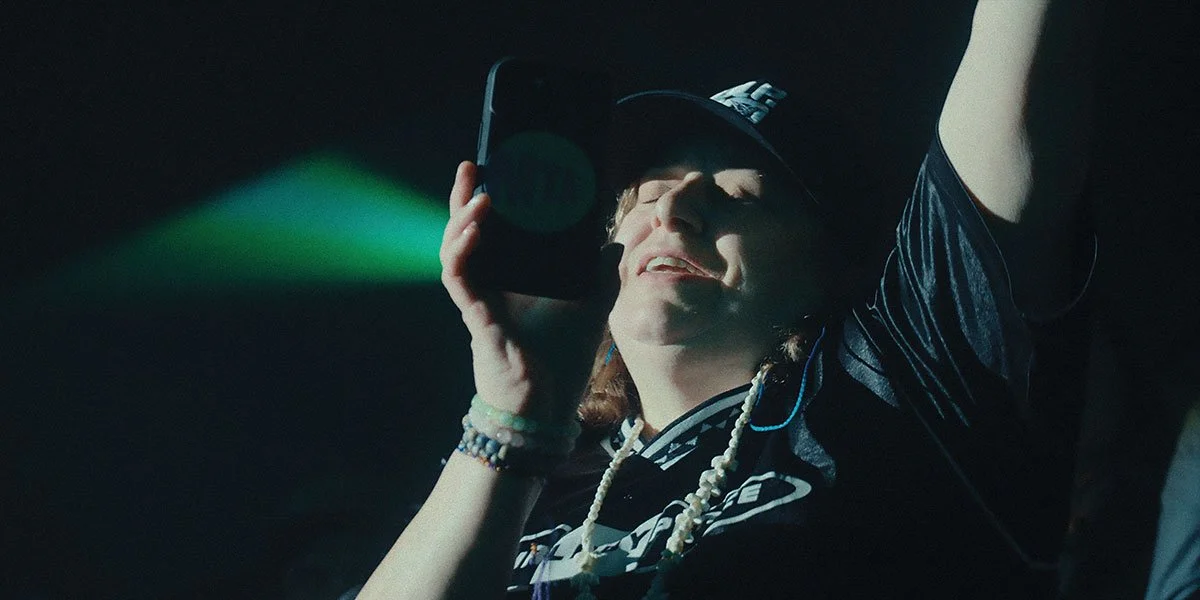
The Edmonton-raised filmmaker traces his DIY beginnings, decades spent directing music videos, and the Our Lady Peace superfan who inspired his new documentary, Premiering at Calgary International Film Festival September 27, 2026.
Following its world premiere at the Toronto International Film Festival, Michael Maxxis’ Gail will make its Alberta premiere at the Calgary International Film Festival on September 27. The documentary follows Gail Lichtman, a Bronx subway station agent who has spent nearly every spare dollar and vacation day following Canadian alternative rock band Our Lady Peace, attending more than 150 performances around the world.
For Maxxis, bringing the film to Calgary marks a homecoming of sorts. Raised in Edmonton, the filmmaker spent years in the punk music scene, developing his craft in the city before eventually establishing himself in Los Angeles. “I was always very inspired by the people, the location, the kind of banality of it, the dreary bleakness,” he says. “The wide roads, the dust, the light—the idiosyncrasies of the people and different cultural elements were always inspiring to me.”
That environment also fostered the scrappy ethos that has followed Maxxis throughout his career. At 20, he dropped out of business school and decided to pursue filmmaking without any existing connections to the arts. Inspired by directors including David Fincher, Spike Jonze and Michel Gondry, he noticed that many filmmakers he admired had begun their careers making music videos.
His response was characteristically direct: he went to London Drugs, bought a camcorder and began approaching local bars. “I said, ‘Can I film the house band for free?’” he recalls. “I’d film it, meet them and edit the concerts together.”
Before long, Alberta bands were bringing him on the road through Grande Prairie, Lloydminster and Medicine Hat to create promotional footage. At 24, Maxxis self-funded his first proper music video for Edmonton punk band Murder City Sparrows, shooting it on 16mm film at Fort Edmonton Park. The video entered rotation on MuchMusic and caught the attention of production company Revolver. Within a few years, he was directing approximately 25 music videos annually.
That career would eventually include work with Billy Talent, Alexisonfire, City and Colour, Bedouin Soundclash, Mother Mother, and Empire of the Sun to name a few. Though the scale of the productions grew, Maxxis maintained an approach rooted in the resourcefulness of his earliest work that included gathering the right people, stretching limited resources, and forcing ambitious ideas into existence. “I think one of my strengths is my will and just the force of being able to make big, over-the-top productions happen,” he says.
That punk-minded determination remains central to Gail, even as the documentary represents a departure from the heightened short intensity of his music videos and his narrative feature debut, Puppy Love. The idea originated with Our Lady Peace frontman Raine Maida, who approached Maxxis after the band was asked to commemorate its thirtieth anniversary.
“They weren’t interested in the traditional kind of tribute documentary,” Maxxis explains. “Raine said, ‘We have this fan, and she lives in the Bronx. She’s really interesting. She’s been to, like, 150 shows, and I think you’ll find her inspiring.’”
Their first video call with Lichtman confirmed that instinct immediately. During the conversation, she cried, yelled at a passing neighbour and repeatedly changed her mind about participating. When she explained that she needed time to prepare for the tour, Maxxis became curious. “She said, ‘I’ve got to get my nails done. I get them a custom colour for each tour. I’ve got to get my hair done. I’ve got to wash all my OLP jerseys. I have to go to physiotherapy. I have to get a flu shot because it’s cold up there, and I have to get two teeth pulled,’” he remembers. “I thought, ‘This is great…can we film that?’”
The crew travelled to New York to document her preparations before following her across Canada during Our Lady Peace’s anniversary tour. Travelling by bus, train and ferry through the Canadian winter, Lichtman encounters delays, exhaustion, bad weather and a rivalry with another devoted fan. What began as a portrait of seemingly extreme fandom gradually became a more intimate story about purpose, identity and the structures people build to give their lives meaning. For Maxxis, Lichtman quickly exceeded every expectation.
“She was way more fascinating, inspiring, interesting, wise and unique than I ever would have suspected,” he says. “She possesses all the qualities you need for interesting drama. She’s unpredictable, strong-willed and determined, and she creates conflict. You’re in a state of tension regularly around her. But she’s also so loving, compassionate, sincere and real.”
Her candour was essential. Despite the involvement of her favourite band, Lichtman made little effort to reshape herself for the camera or to flatter Our Lady Peace. “She is not performative,” Maxxis says. “She doesn’t go on her best behaviour because it’s her favourite band and this is a documentary about her. Even in how she critiques the band’s music and the concerts, she literally just tells it the way it is.”
The level of honesty in the film gives Gail room to challenge the condescension often directed toward fandom, particularly when that devotion belongs to a woman. Rather than reduce Lichtman to an eccentric superfan, Maxxis approaches her as the hero of her own journey and an outsider pursuing something with complete conviction.
He sees a connection between Lichtman and the subject of Puppy Love, which was inspired by his cousin Morgan. Both reflect Maxxis’ fascination with outsiders in periods of self-discovery, transformation and purpose-seeking. “There’s something that draws me to this innocent outsider who is in pursuit of something and following a passion with their whole heart,” he explains. “I’m fascinated by people. There’s something simple about following a protagonist as they pursue a goal that I really relate to.”
Maxxis likens that structure to fantasy films such as The NeverEnding Story, Willow, Labyrinth and Hayao Miyazaki’s Spirited Away. In Gail, however, the quest unfolds across subway platforms, highways, concert venues and frozen Canadian streets. The filmmakers carried that narrative sensibility into the documentary’s music as well. Composer Lesley Barber created an original score, while Eric Rosse and Maida developed orchestral interpretations of several Our Lady Peace songs. The team wanted to uncover the emotional scale beneath Lichtman’s journey, rather than rely on the hits. “We approached this movie like a narrative film,” Maxxis says. “There was a sophistication, depth and complexity that felt so in sync and alive with classical music.”
The film’s wider team includes cinematographer and producer Morgan Gold, editor Cole Grom and producers Shane Reid, Natalie Allan Reid, Duncan Coutts, Jason Murray, Maida and Maxxis. Jason Reitman, known for his work in renowned-favourites like Juno and Young Adult, and Jason Blumenfeld joined Our Lady Peace as executive producers, bringing additional filmmaking weight to the project.
Maxxis credits the band and its management for staying true to obscurity rather than retreating toward a safer anniversary film. “They never wilted,” he says. “They never strayed from the bold vision we started with. I really have to applaud them for maintaining their integrity and their willingness to do something really different.”
That difference rests with Lichtman, who allowed the filmmakers to capture moments Maxxis acknowledges were difficult for her to revisit. After watching the completed film, she ultimately understood why they needed to remain. “She bares her soul in this film,” he says. “She becomes very vulnerable, and she trusts us entirely. There were a couple of moments she said were hard to watch, but she knows they’re important to the film. She’s willing to share them with people because it’s the truth.”
Maxxis entered the industry when music videos still required large crews, film stock, loaders and heavy lighting equipment. He has since watched affordable cameras, digital effects, AI and programs such as Unreal Engine radically change who can create films and how much of them can be made. “There’s just an incredible amount of content,” he says. “Where does it go? Who watches it? Bands are questioning the value of it, so how do you get funding for it?”
For emerging filmmakers, the tools may be more accessible, but being noticed has become considerably harder. Still, Maxxis believes the foundation of filmmaking remains stubbornly unchanged. “It’s still the same model,” he says. “Go get a camera, write a story, find the right people to be in it, shoot it and edit it. Now you just need less money, and there are more people doing it.” Maxxis remains drawn to independent films that feel “organic,” “tactile,” “poignant” and “uncompromising” – qualities he sees continuing through contemporary filmmakers such as Sean Baker and Harmony Korine. “You have to follow the trends, you have to follow your heart and you have to be yourself,” he says. “Focus on being an interesting person, and that essence will find form in your art.”
Gail screens at the Calgary International Film Festival on September 27 at 6 p.m. at Globe Cinema, with Maxxis and members of the Edmonton-based crew expected to attend. Tickets and additional information are available through the CIFF website.