

Director Guillaume Carlier Finds the Magic in Short Film Lube City
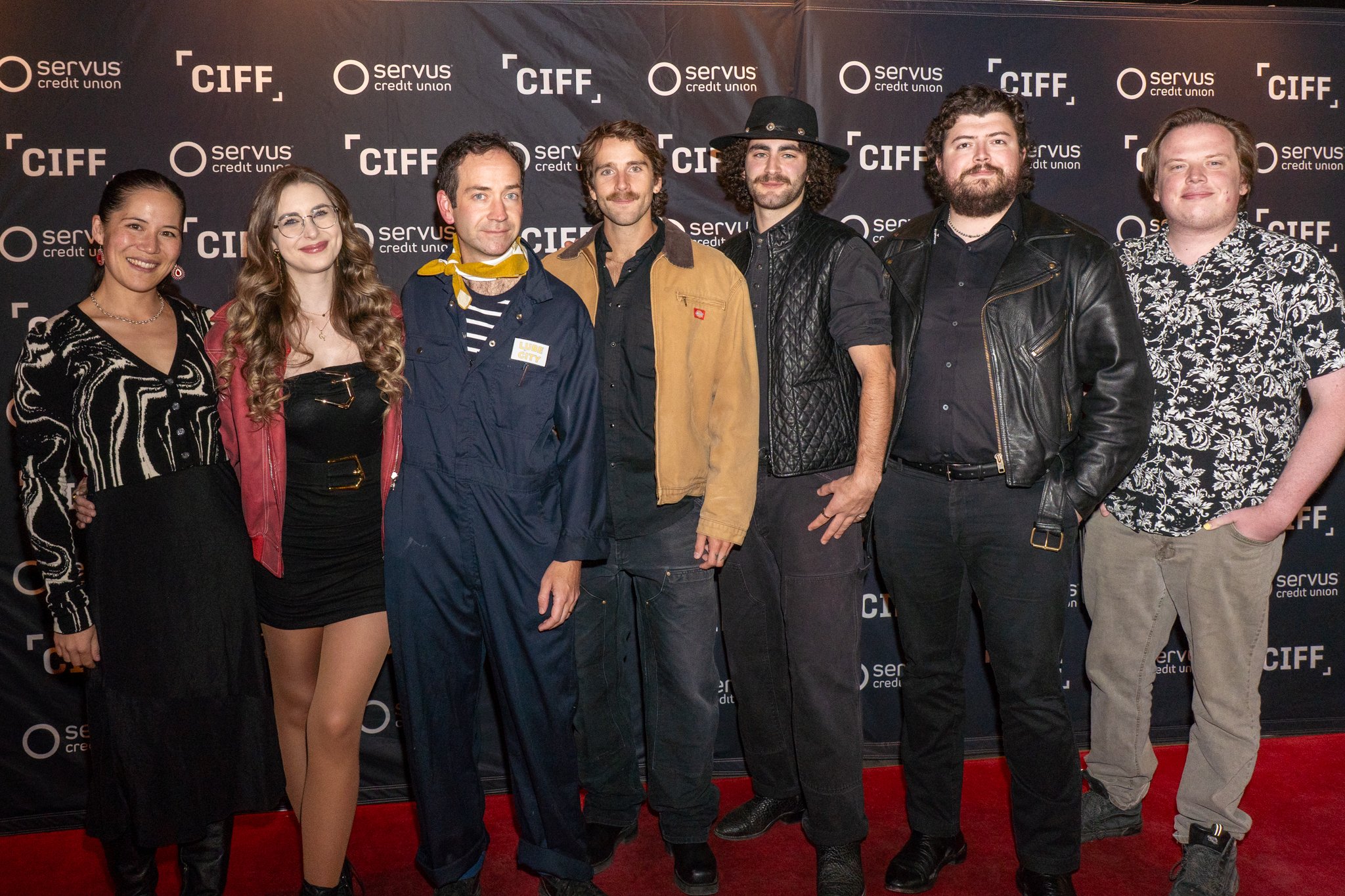
Lube City cast and crew on the Calgary International Film Festival red carpet. Photo credit: Blake McLeod.
Lube City is a 2026 short film by director Guillaume Carlier and writer Gillian McKercher. The film follows the character of Sarah (Adélaïade Schoofs), on her first day on the job at a local car mechanic garage, having recently moved from Montréal to Calgary with her family.
Set locally, and filmed in a mechanic’s shop in the community of Ogden, the film’s uniquely Francophone perspective on blue collar work in Alberta poignantly nods to our cultural similarities. Highlighting the fleeting stories and people you meet working in this field, Sarah discovers a “strange kind of magic” in this work.
I had a chance to interview director Guillaume Carlier on red carpet before the film’s screening as part of Alberta Shorts Night 2, where his Lube City uniform spoke for itself.
REVERIE: I was reading about Lube City on the CIFF shorts lineup and I was really taken by the idea. Before we get into it though, I have to tell you that I love your coveralls.
GUILLAUME CARLIER: [Laughs] I know, I came in character.
REVERIE: Could tell me a little about the initial idea for the film and your experience making it?
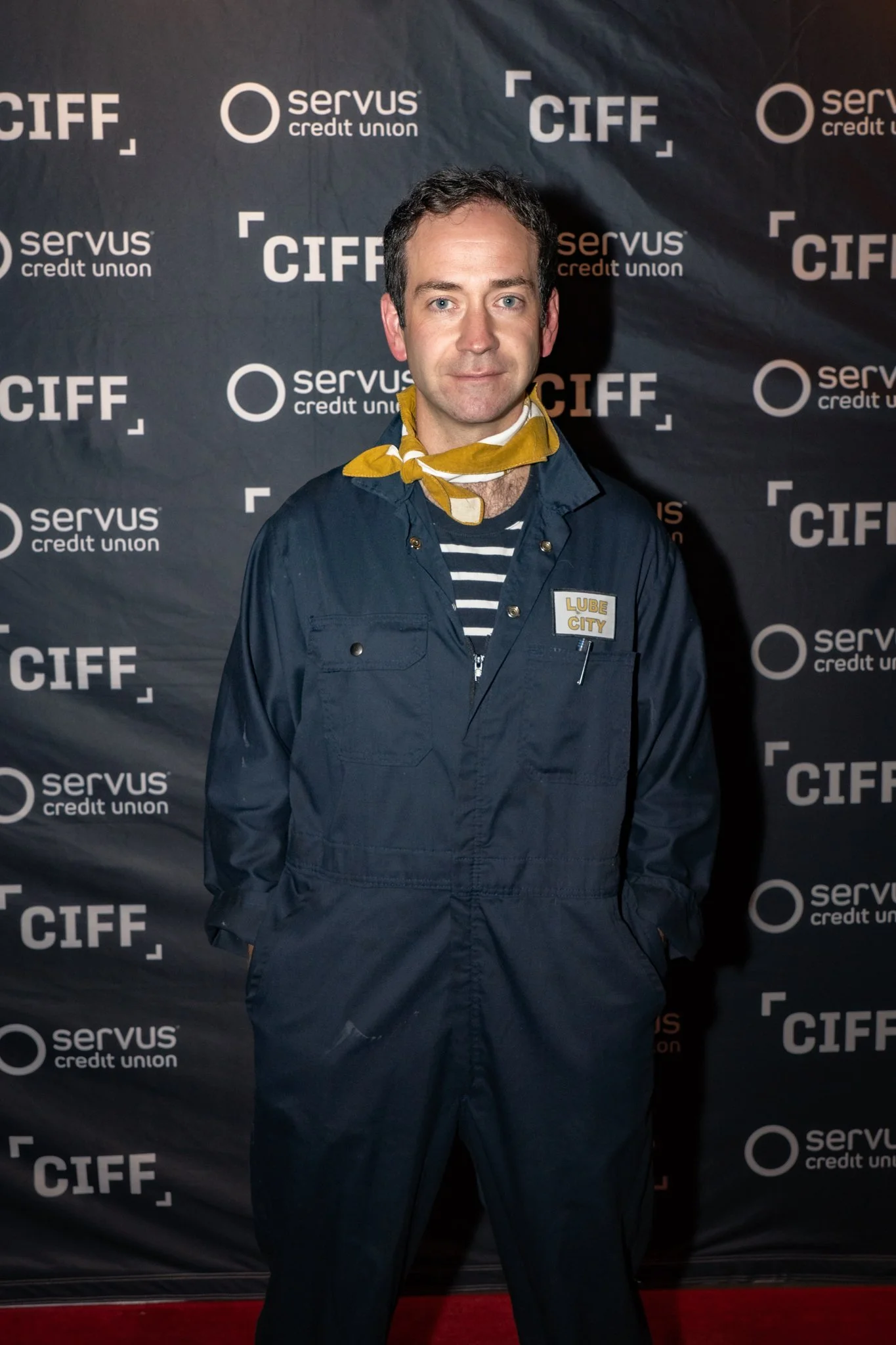
Director Guillaume Carlier. Photo credit: Blake McLeod.
CARLIER: I got the idea when I was at Mr. Lube. It was just, the hood’s open, these guys are all in your junk, and they're fixing you up and everything – it's rather invasive and intimate. I was just watching these young guys working on cars and thought, that’s such a cool job. I wish that I was their age working on cars too, it feels AI proof. It just got me thinking that there's something beautiful about young men working on cars. Things changed a little bit once we cast our Quebecois actress, where at that point it became even more interesting to have a young woman working on cars. It was just a natural progression from there.
REVERIE: You were born in Montréal and raised in Calgary, an experience you share with the film’s main character, Sarah, who has just moved to the city with her family from Montréal. What did you hope to convey about this culture shift that comes with moving to the prairies?
CARLIER: I would say that if there's one big event in my life, it's the move. I've lived in between Calgary and Montréal pretty much my whole life. I’ve actually gone back to Montréal and then back to Calgary, so I've always observed the two cultures. I like to tell Albertans and Quebecers that they're actually more alike than they realize. For good or for bad, you know? It's just a complicated relationship. I actually think that both of the provinces admire each other in weird ways. Recently I was working on a project in Montréal and all these Quebecois producers were like, so, are you guys gonna finish what we started? They were excited about separation, for better or for worse.
REVERIE: I love that sentiment of the two provinces being more alike than we think. As someone who was born in Calgary and grew up in the prairies, I really value stories that are based here, as well as stories that work to bridge these gaps between us and different parts of the country. There can be a lot of broad assumptions that people make about the prairies. What do you think made Calgary the ideal setting for the film?
CARLIER: [Car maintenance] is physical work, it's blue collar work. At the end of the day, there's this openness to Albertan culture, which is, in a sentence, “get ‘er done.” It doesn't matter where you're from or what you look like, as long as you “get ‘er done,” people will accept you, in my experience. I think that Montréal also has a similar appreciation for this idea. In a more universal way, what I'm trying to say is that most people will get along just fine if we all have a good task at hand.
REVERIE: You spoke a bit about this already, but I'm curious about your relationship to the setting of the car mechanic garage before making the film,. Was there anything that changed about this during or after the process?
CARLIER: Getting that garage was a miracle. I do have to give a shout out to Ash from Progressive Auto. I had been driving around the city looking for a garage that was closed on the weekends, and it was tough. Many garages were either open on the weekends, or they didn't want us to shoot there. When we found [Progressive Auto], I was like, oh, why not? I'll give it a try. It was the last one of the day. So I went in and gave my pitch, “hey, do you want to allow us to film a movie here?” He said yes instantly, without even asking any questions. So in that moment, there was this Albertan beauty about just, “Yes, of course I'll help you. Why not?” And it couldn't have come together better because, that area in Ogden that looks over the city, it's so beautiful.
REVERIE: I love Ogden! It’s a really interesting setting. So industrial and yet very homey.
CARLIER: It's a bit of forgotten Calgary. Overlooked I'd say.
REVERIE: I would say so as well. Actually, this conversation is reminding me of my experience working in the visual arts. I find that from the outside, there can be this assumption that blue collar work is a totally different world than working as an artist. But I’ve found that there are more similarities between us than people think. Is this something you've experienced?
CARLIER: Yeah, totally. I mean, we're both working with our bodies and our hands and our minds, right? It's not just a desk job all the time. You're actually, at the end of the day, trying to produce something physical. So, yeah, there's overlap for sure. The problem, though, is that sometimes people in the trades and in the arts, get too much in their own little camp and their bubble that they forget to breathe a bit more.
REVERIE: I agree. It’s so heartwarming to hear about the excitement from the folks you worked with in the trades to be involved in this project. In my experience, I found that to be more often the case, right? Especially tradespeople’s excitement towards artists, and sometimes less towards people working in the trades, which is unfortunate I think. But it seems like this film is doing a really good job of bridging some of that gap.
CARLIER: Yeah, that was the goal.
REVERIE: I have one more question for you. The writeup about the film describes the way that the main character “discovers a strange kind of magic in this world” despite her circumstances. Where have you been finding this strange kind of magic lately?
CARLIER: Calgary is full of strange magic, and it's a sad kind of magic, you know? There's a sort of sadness about this place. Maybe because we fucked it up and maybe because it's actually working. I don't know. I think that with Sarah’s character, the whole film is actually from a Francophone perspective looking at Calgary, but in the end, there's a little bit of Calgary’s magic that comes through to her. And I think it comes through the garage.