

Swimming Through the Current: How Julián Reflects the Power of Self-Expression
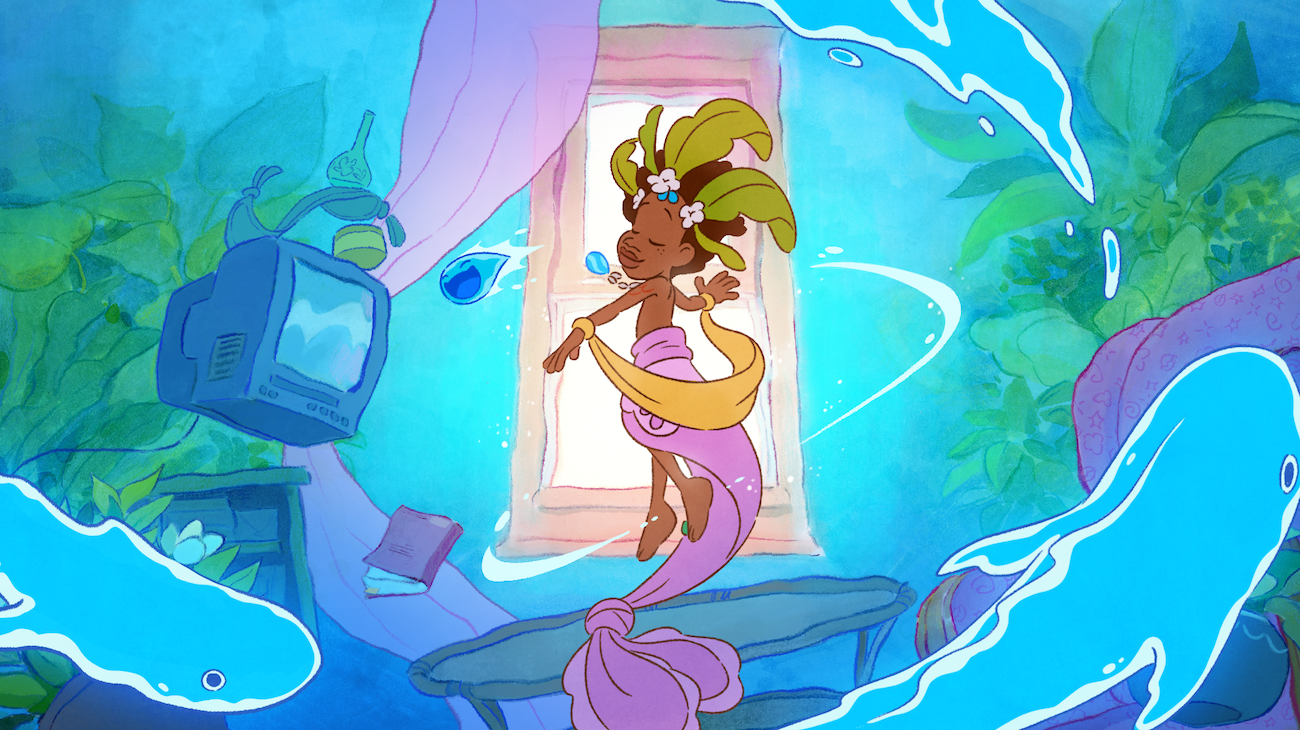
Still from Julián. Photo courtesy of the Calgary International Film Festival.
I was sitting in my leather, upholstered theatre seat when I heard a child whisper to his mother in his mightiest voice: “Is he dressing up as a mermaid?” I knew at that moment that Julián, Louise Bagnall’s animated coming-of-age film based on Jessica Love’s picture book Julián Is a Mermaid, perfectly encompassed the nature of self-expression and the child-like gaze at its core, through the imaginative brilliance of child drawings and vibrant colours depicting a child’s dream of becoming a mermaid.
The film begins with a Black, afro-haired boy named Julián, who is ecstatically drawing away with felt markers and a sheet of paper, a picture of his grandmother as a giant, glittery sunfish with puckered lips. Besides the sunfish, he draws himself as a plankton, relating his love and excitement for his sojourn at his grandmother’s to his keen interest in the ocean. Julián talks at great length to his father, Javi, about his eagerness to make a good first impression on his grandmother. This scene reflects the boy’s creativity and establishes his initial view of his grandmother, which is tested as the film progresses.
His grandmother, Carmela, claims that she will introduce Julián to “el barrio,” where they stumble upon the local neighbourhood grannies playing dominoes. As soon as they see Julián, they smother him with questions, actively recalling how they knew him when he was younger —an experience that a majority of us can relate to— and so, Carmela decides to play the game with them. Julián unknowingly reveals his abuelita’s dominoes, to which she replies in embarrassment that he should “play with the boys.” While observing the boys playing basketball, Julián discovers a group of girls (Kiki, Yeslyn and Amanda) drawing mermaids and sea creatures on the pavement with chalk. The next couple of scenes establish a generational contrast between the grannies’ reactions and the reaction from the girls.
I realized that their behaviour comes from a place of concern about people not being willing to accept something “different,” rather than disgust at the boy’s desire to become a mermaid. The girls, on the other hand, do not accept him at first because they think that Julián has vandalized their drawings as a way of taunting their interests, but as soon as Kiki, Yeslyn and Amanda realize that Julián’s interest is genuine, they decide to invite him into the group for the Mermaid Parade.
Carmela’s insecurities about leaving her “tierra,” which she redirects at her grandson who does not fit into society’s predetermined lens of masculinity, begin to unfurl as soon as one of the neighbourhood grannies make a comment about the boy’s hair, which prompts her to act. Back home, Julián requests his grandmother to make his hair as long as a mermaid’s —envisioning beautiful braids — to which she agrees, but cuts it short instead. After she is done, Julián looks at his hair in resentment, wondering why Carmela has done what she has done. Her intention is to make him “handsome” and by cutting his hair, she is attempting to define his masculine features. After a couple of days, Carmela realizes the consequences of her actions and attempts to repair the strained relationship by working with Julián on the costume that will be worn at the Mermaid Parade. This effort is reinforced when she gives Julián a traditional campesina from her homeland to use in his costume.
The turning point of this film is the pool scene, in which Julián has finally convinced his abuela to get into the water after years of restraining herself because it serves as a reminder of her homeland, and is able to test out his handmade costume in water. However, the external societal gaze has begun to pierce through the innocent self-expression that Julián possesses. The boys at the pool centre not only tell him that “boys are not allowed to wear dresses,” but they also tear open his beloved tail. A detail that I found interesting about this scene is that when a fish has a broken tail, it loses control, which I think acts as an intentional metaphor for the damage to Julian’s self-perception. On the train home, the distraught Julián attempts to find a glimmer of hope from his own imagination, but is not able to produce any of his drawings to life.
Despite the immediate sting of the torn tail, the Mermaid Parade functions as the antidote to this societal policing. It proves that the relentless effort to conform — by adhering to gender norms or restricting your cultural expression — is a losing battle against those who may never understand you anyway. When Julián arrives at the parade, the earlier comments made by the boys fade into the background, replaced by the vibrant solidarity of Kiki, Yeslyn, Amanda and a newly transformed Carmela. This shift made me realize that self-expression is not about draining your own ocean to make others comfortable; it is about finding the community that is willing to dive in with you. In the presence of those who truly see and celebrate his uniqueness, Julián’s broken tail is no longer a symbol of a damaged self-perception, but a badge of resilience.