Edie Arnold Is a Loser: A Punk-Rock Victory for Losers Everywhere
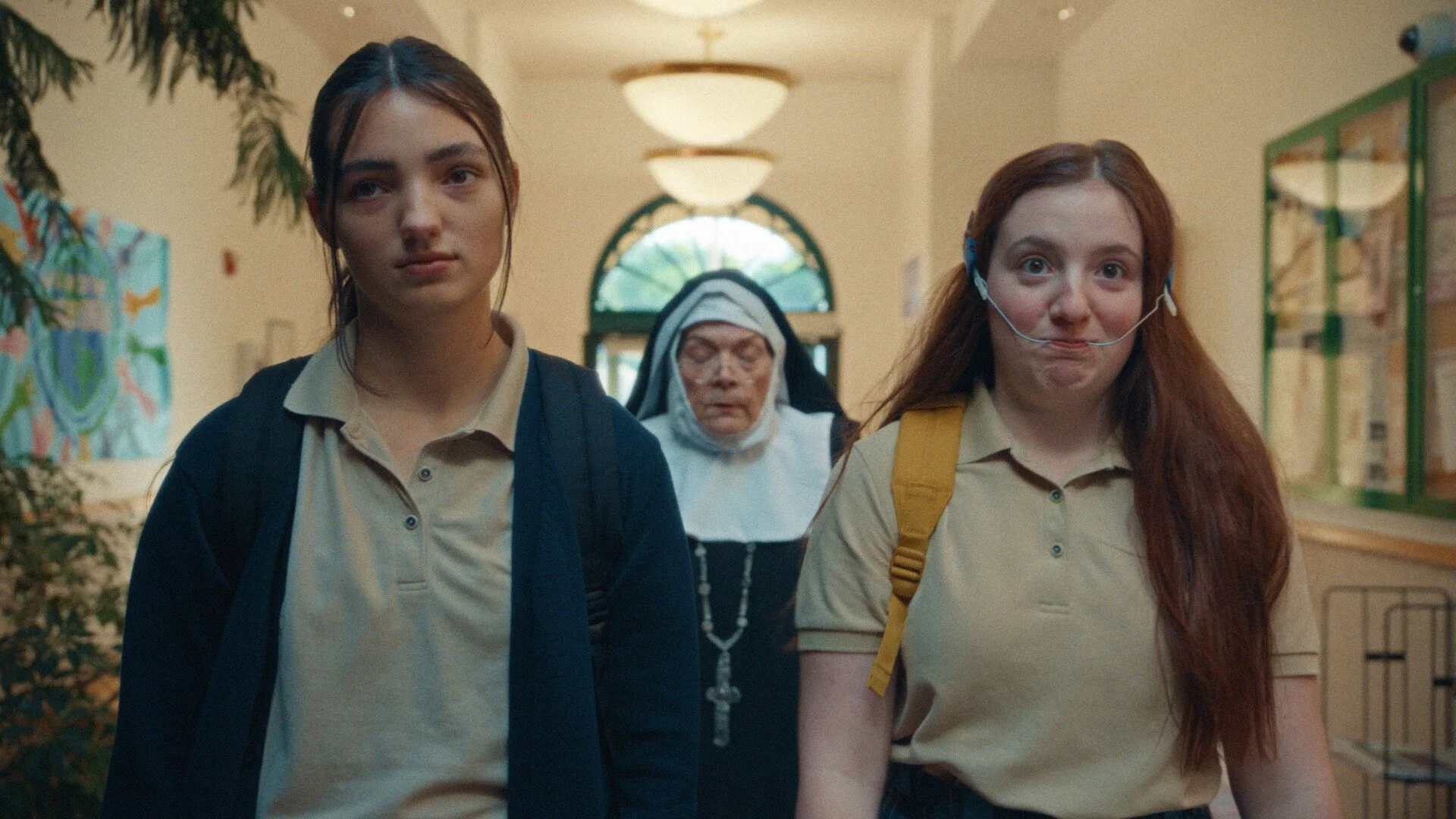
Filmmakers Megan Rico and Kade Atwood discuss turning Catholic-school alienation into punk-rock Rebellion, making their first feature on a DIY budget and reclaiming the word “loser.”
Before co-directors Megan Rico and Kade Atwood transformed Edie Arnold Is a Loser into a scrappy, high-energy feature, Rico’s first screenplay spent nearly a decade tucked away. Written in college, it drew from her adolescence in South Florida, where she attended an all-girls Catholic school and found kinship with a collection of “weird little friends.”
“Because it was the first one, I pulled a lot of it from my life,” Rico explains. Still, its central fantasy belonged to the life she wished she had lived: “I wasn’t in a punk band—but boy, oh boy, I wish I could have been.”
That wish becomes reality for Edie Arnold, a timid Catholic-school outsider who is dragged to a punk show and unexpectedly discovers a natural ability behind the drums. With encouragement from her best friend Frances, she forms The NunDead, finding a louder and less apologetic version of herself in the process. Following its SXSW premiere, the film now makes its international premiere at the Calgary International Film Festival.
Rico and Atwood first worked together on the sketch-comedy series Studio C, but Edie Arnold Is a Loser marks their first feature as a directing duo. It emerged after another project repeatedly stalled. Tired of waiting for talent, financing and permission to align, Atwood asked Rico whether she had something they could make themselves. She sent him Edie and he read it in one sitting.
“I felt like I had grown up with these girls—like they were my friends in high school—but I had never really seen them portrayed onscreen in this way,” he says. His response was immediate: they should direct it together and make it within months. “When he realized this was worth making, it was very much like, ‘Why wait? Let’s go,’” Rico says. There was also a practical deadline: winter was approaching, and Salt Lake City needed to pass for South Florida.
The filmmakers committed to making a feature regardless of how much money they could raise by their start date. Production became an act of problem-solving that echoed punk’s DIY principles. Atwood and producer Bryson Alejandro went door-to-door asking residents to use their homes and buildings. “This thing needs to get done today, so that’s what we’re doing,” Atwood says.
Their limitations also reshaped the film’s music. Early versions imagined the teenage band covering recognizable songs by acts such as the Ramones, but licensing them was far beyond the production’s means. Instead, Rico’s cousin, musician Nikolas Balseiro, helped create original material. Rico and Atwood could explain what each song needed to accomplish narratively, even if neither could explain how to write it. The challenge was making the songs catchy while keeping them believable as the work of teenagers forming their first band.
For Rico, punk initially functioned as a foil to the rigidity she experienced within Catholic education: one world governed by discipline and repetition, the other offering permission to become loud, emotional and expressive. “There is something about coming together with people, with community, and sharing in an almost ecstatic experience that Mass and a punk show can be very similar,” she says. “At their core, they kind of do the same thing—just through very different methods.”
That collision arrives with the exaggerated feeling of adolescence. Animation, heightened sound effects and comic-book flourishes create what the directors call a “live-action cartoon” in the vein of Scott Pilgrim. More importantly, Rico says, strict realism could not express the emotional truth of being a teenager, when embarrassment, desire and rejection all seem enormous.
Rather than casting adults as teenagers, they sought actors who genuinely looked the characters’ ages—an approach that led them to young talent often overlooked by conventional productions. It also created a responsibility to establish a safe environment during a compressed ten-day shoot.
“We wanted to give them a baseline experience they can point to as they move through the industry and say, ‘This feels fucked up, and I know it doesn’t have to be like this,’” Rico says. That meant avoiding overtime, protecting turnaround time and ensuring the young performers knew they could advocate for themselves.
At the centre of it all is a word both directors know well. To Atwood, “loser” once meant existing outside popularity, but the outsiders frequently had stronger taste and a clearer sense of themselves. For Rico, it means being unable to fit a prescribed mould despite genuinely trying. That failure is a gift.
“Because you can’t fit in, you’re forced to stay true to yourself and the things you value,” she says. “It’s a transient label. It’s based more on the people around you than the person you are.”
The film’s message, then, is not that Edie must change herself enough to earn acceptance. It is that she must find the surroundings—and the people—that allow her to exist fully. At recent screenings, younger viewers have emerged wanting to start bands of their own. For Atwood, those reactions justify every improvised location, impossible deadline and unaffordable Ramones song.
“Don’t conform to any standard or expectation,” he says. “Go find a space where you can exist for who you are. If we can inspire even one kid to do that, then it will have been worth making this movie.”
Edie Arnold Is a Loser screens September 27 at 12:15 p.m. at Cineplex Chinook and October 2 at 6:45 p.m. at Globe Cinema as part of the 2026 Calgary International Film Festival.