Phoebe Bridgers invites Vancouver to look up and feel the moment
Credit: Matt Grubb / Instagram: @mattgrubb.americas.waffle
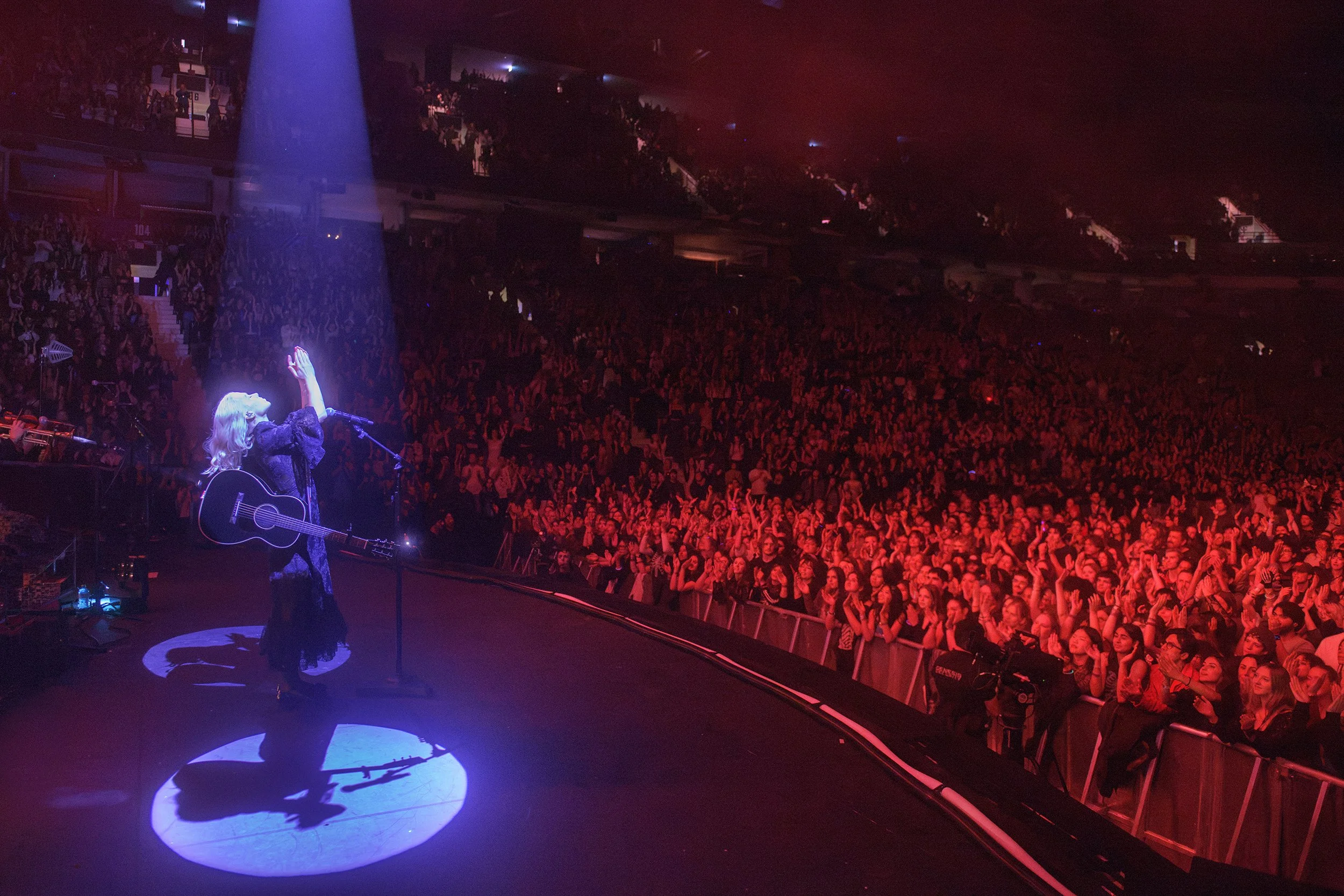
At Vancouver’s sold-out Rogers Arena, the closing refrain of Phoebe Bridgers’ “Scott Street” travelled through a sea of waving hands, unusually, raised in pairs. With phones locked inside Yondr pouches that fans kept with them throughout the evening, there was nothing to hold overhead except their own open palms. I came across a few Instagram stories post-show expressing the same sentiment: “best show of my life; you’ll have to believe me, because I have no footage to prove it.” There was something funny and revealing about it — as though an experience needs to be witnessed online before it counts. But the phone-free evening also gave us something to keep sacred. I’d walked in without having seen clips of the production or what would be considered big moments, and felt the rare pleasure of discovering a show as it unfolded free of expectations. I felt a sense of ease around me, without the pressure to capture every moment or the awareness that someone else might be recording their experience, screaming along to every word (we all remember this specific trend that went viral…not for a good reason).
After the rush inside to the photobooth, the only way to really capture a selfie to remember that you were at the show, it began with opener Alex G. Playing on the smaller B-stage opening with “Gretel,” from 2019’s underrated House of Sugar, his band immediately demonstrated arena-sized chemistry. Their voices met at the chorus, their descending guitar line drawing the bandmates towards one another. Despite their growing viral popularity, I heard a younger attendee behind me whisper: “Who the fucks is Alex G”. I heard her laughing at the occasional odd joke Alex threw out and surely, she was expressing how she left a converted fan by the end of it.
While banter is typically sparse at an Alex G show, he is known for taking a wonderfully ridiculous mid-set detour. Alex repeatedly asked whether his friend “The Edge” was present, clarified that this was his family-given name, sang a fragment of “Sunday Bloody Sunday,” and introduced himself as Bono. Apparently, he had spent the day thinking about what to say onstage, and this was what he had landed on. “Life is a puzzle,” he kept announcing. The routine’s appeal lay partly in its refusal to become any clearer. It did make an appropriate introduction to “Blessing,” whose sinister rhythm eventually gave way to a heavy, exploratory jam session. Whatever prompted the U2 routine, arena decorum never stood much chance against Alex’s willingness to commit to an absurd bit.
*Editors note: it has now been brought to our attention by a reader that U2 often uses Rogers Arena and Pacific Coliseum as a practice space for their tours…perhaps Alex G was calling out to The Edge’s lingering presence somewhere in the rafters.
Credit: Wes Ellis / Instagram: @atwes
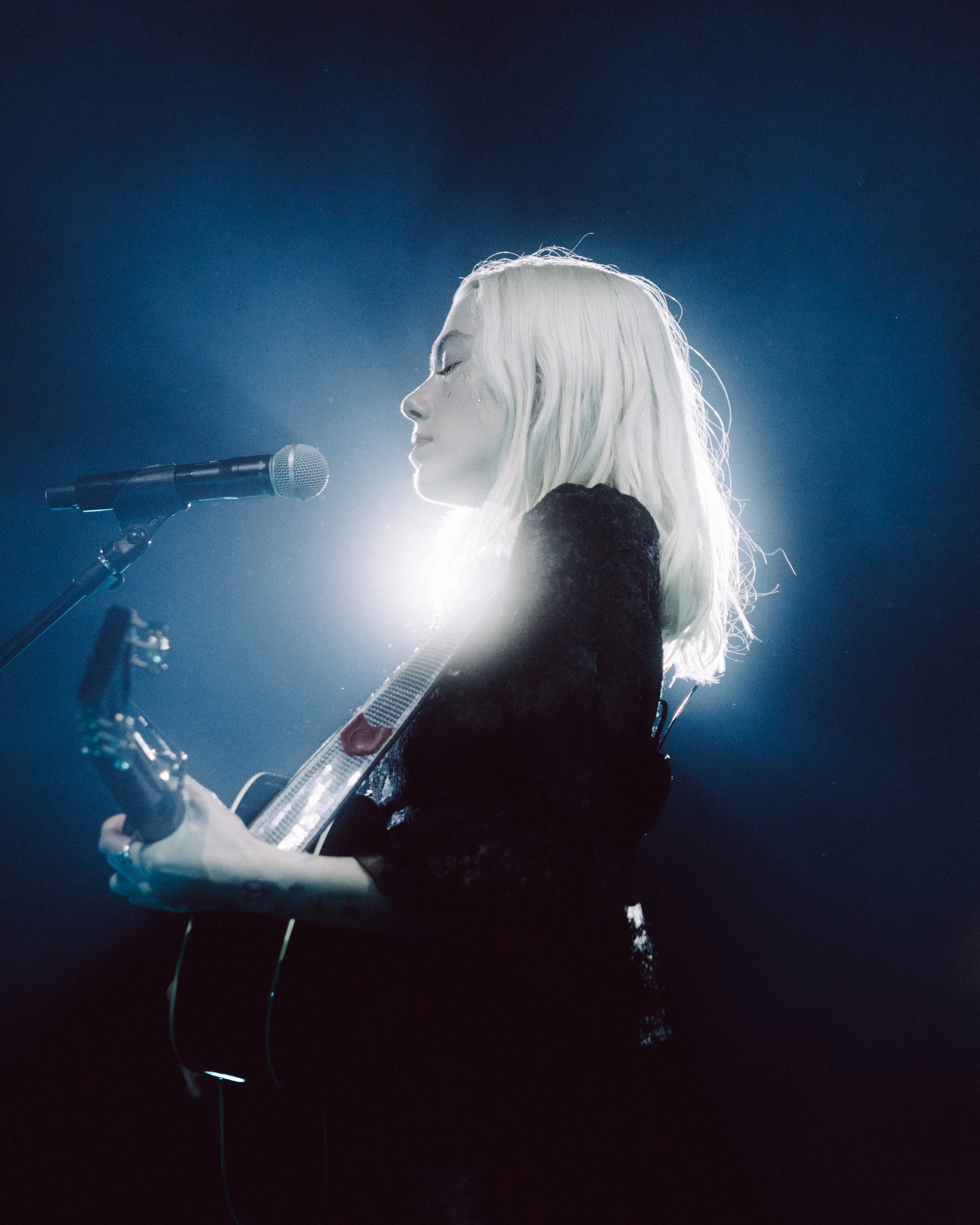
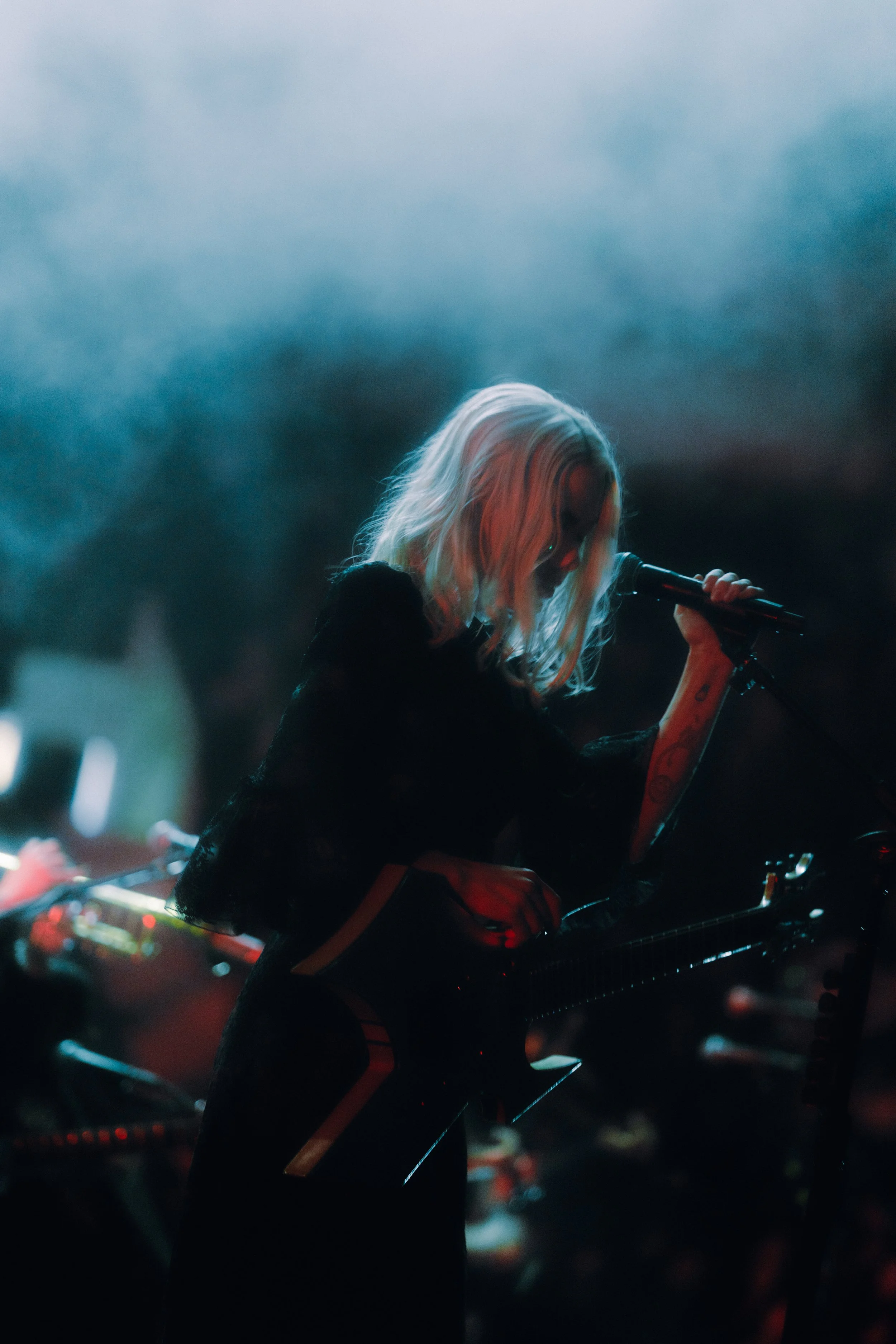
Then came the moment fans were really there for. Phoebe Bridgers’ production offered another kind of strangeness that paired well with Alex G, who is her close friend and collaborator having recently worked on her album as a producer, in particular the lead single from Lost Weekend, “Lost Boys”, as well as Bridgers having released a cover of Alex G's song "Powerful Man" from his 2017 album, Rocket. A giant orb hovered overhead, which sparked my curiosity earlier as it lay flat on the stage looking like an igloo before revealing the band underneath. The production could suggest both shelter and exposure when it permits. Projections and beams of light transformed the space around her. Fog caught in the lighting like suspended snow. Below, the audience supplied its own glowing constellation for the evening. Fans had queued for hours for glow-in-the-dark merchandise from glow-sticks to t-shirts, with lines still curling around the concourse during her performance.
The watchfulness of the staging took on another meaning when Bridgers spoke about surveillance and the way phones encourage people to perform it on themselves. In a room where devices had been locked away, the observation felt unusually tangible. There was no immediate outlet for posting a reaction or turning the evening into a sequence of clips. Instead, friends danced together. They cried and tenderly held one another through it. Hands stayed raised, lighters in the air, because they wanted to participate. Watching those small exchanges accumulate across an entire arena was unexpectedly moving and reactions that I often miss during a typical show or question…"are they doing this for the gram?”
Bridgers also worked to distribute that feeling of closeness. Returning several times to the B-stage where Alex G had performed, she brought different sections of the audience into her immediate orbit, playing more of the intimate tracks from her new record, like “As Above”. Where the mainstage sequences moved with the precision of a carefully timed production, these stretches also felt more loose and personal, recalling the smaller rooms she once played. It remains difficult to reconcile the scale of her success with how private a relationship her songs can make you feel. Even surrounded by thousands of fans, there were moments when her music still felt like something I had found and kept for myself.
The most affecting introduction came before “Still Standing.” Beginning with an emphatic “fuck the country I live in,” Bridgers moved from her frustration with American politics to the comparison of a country behaving like an abusive parent — something, she acknowledged, she knew a thing or two about. What followed allowed the contradictions of her relationship with her father to remain unresolved. She spoke about the difficulty of loving someone who was not hurtful all the time, about the political convictions she admired in him, and about the shock of his death despite believing she had already reached some kind of resolution. She prompted the audience to scream if they had a dead dad, with many voices echoing the arena in agreement. Others held their fathers close. “Still Standing” gave those responses time and space, without requiring anyone to explain them, but I could tell it was a turning point of the show that hit people in various ways — whether that was through feeling Bridgers’ pain or their own amidst singing about “Angel in the Snow” in reference to Elliot Smith, whose death anniversary was a mere few days ago.
Credit: Wes Ellis / Instagram: @atwes
That willingness to let an audience feel things together carried through the evening’s lighter moments too. Bridgers gave the audience the option to choose between “Georgia” and “Waiting Room”, as the sound tech monitored the volume of screams. Vancouver opted for the latter, I was personally overjoyed. A solo rendition of boygenius’ “Revolution 0” offered another standout, bringing a song associated with her collaborative work into the night’s intimate exchange that she hadn’t played live since 2023.
During “I Know the End,” Bridgers invited the room into its cathartic scream. There was something beautiful about being surrounded by femmes in my section during an evening that had made room for grief, tenderness and political anger. The sound felt earned. People had been given permission to confront what they were carrying and Bridgers offered somewhere to put it.
As remarkable as the production was, the night’s most powerful sight remained its audience. I found it challenging to take my eyes off of the collective joy, but also confusion of how to act. In between the sets, we couldn’t resort to co-existing on our cellphones together. People were talking with each other at times, or maybe finding ways to enjoy each other in the uncomfortable silence. Concert memorabilia was swapped and new friends were made. Bridgers thanked the audience for embracing the phone-free experience, acknowledging the difference it made to the night they were sharing, despite the people around her who said it wouldn’t work. For roughly three and a half hours, an arena accustomed to constant documentation had become a place to pay attention and getting an entire arena to put away its phones and still achieve a sold-out tour is not something to take lightly. What Bridgers made possible in their absence was something people could carry home: the memory of being fully there and of feeling it alongside everyone else. All I can say is: you just had to be there.