

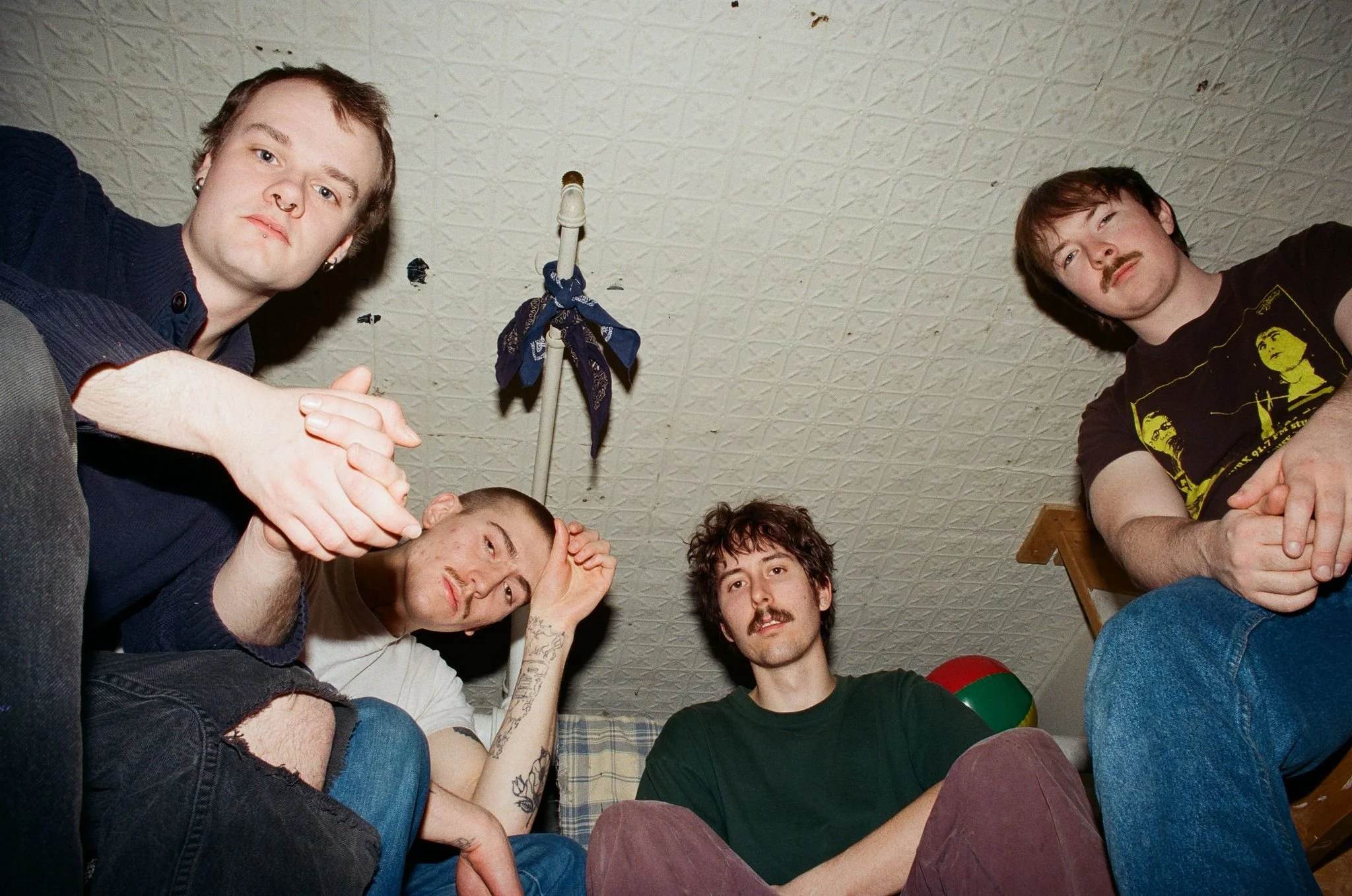
Photo credit: Matthew Van Dystadt-Aguiar
By way of Alberta, the now Montréal-based band Truck Violence have been carving a place for themselves through their brazen yet smashingly hardcore punk and folk sound.
My first introduction to them was their 2024 release Violence, as it was released on one of my favourite Canadian labels, Mothland. I saw them live in 2025 during Calgary’s coveted Sled Island Arts and Music Festival and now, they are about to embark on a Canada-wide tour on November 13th, in Vancouver and ending on December 12th in Québec City.
I chatted with co-founder of the band, Karsyn Henderson. We chatted about what he considered “Truck Violence,” the Boston Molasses Flood of 1919, and his thoughts on roadside art installations.
REVERIE: Who is Truck Violence? What’s your elevator pitch for the band?
TV: We are heavy metal music for people who like that kind of stuff. I don’t have an elevator pitch for the band. If I did, it would be horrible. I would just say it’s weird stuff. That’s the best I can give.
REVERIE: What does The weathervane is my body mean to you?
TV: To put it bluntly, it is an album that puts its hands up and illustrates all the feelings that are felt within the body. All of the elements that compose the human experience, what is fleshy and material… strange, confusing, and messy.
REVERIE: Is the body something that you think gets pushed around a lot by outside forces?
TV: Yeah of course. I think there is a lot of work that goes into coming into terms with that and the malleability of it.
REVERIE: Are the lyrics in your songs about specific events or about moods or feelings or like a combination of both?
TV: It is all of those things. Some of them piggyback off of a particular moment or impression that you gather that have some sort of logical trueness to them. The poems themselves are not a one-to-one recreation of an event, but they are more trying to capture a distillation of feelings regarding an event. Whether that is sensory processes within the body or disputes between the mind and the body. Stuff like that.
REVERIE: Your debut Violence was released in 2024. What has changed between the debut and this record?
TV: Not that much. I think they are pretty much two records doing a similar thing or asking similar questions. The core of them are similar, but the way they ask the questions or how these answers to the questions are approached are different. I think that Violence was a lot more juvenile and a lot more self-interested. It’s young and it says “this is how I feel and that sucks.” Whereas The weathervane is my body is on another layer in terms of abstraction. It says “this is how I feel and it’s really confusing. It inches closer to a sort-of conclusion even though it doesn’t derive it. At its core though it is very similar.
REVERIE: You guys were recently signed to The Flenser, a label based in San Francisco's Bay Area. How are you feeling about that?
TV: Pretty good, very grateful. We didn’t think that we’d get there and think that people would like to work with us and they are great people. We’re incredibly grateful.
REVERIE: Y’all have been on tour since September and you’re kicking it back up in November. What’s been your favourite city to play in and why?
TV: Montréal. To me, that is just an easy slam dunk – doesn’t require any thought. It is such an amazing city. It is incredibly hospitable, cheap, and has a strong sense of community between the residents and the music community. It feels like a very earnest scene. A lot of people love hearing weird music and they love to experience something new and confront something that might be alien or foreign to them. Montréal was kind-of an easy answer, so outside of it, it would be Boston. Boston’s sick. I love the buildings.
REVERIE: Have you ever heard about the Boston Molasses flood? (Gabrielle’s note: this is my favourite fact to bring up regarding Boston. Anyone who has been to Boston, I drop this fact).
TV: No? What is that?
REVERIE: Early 1900s in Boston a crap-ton of molasses flooded the streets of Boston. Like, a few million gallons at like 56 kilometers an hour.
TV: That is fucked up. What the hell.
REVERIE: You and Paul were raised in rural Alberta. How do you feel about coming back to Alberta for the tour?
TV: We played Calgary once before and it was fantastic. I don’t know what to expect since I’ve been away from Alberta for a while. I have a feeling that it will be a really fun time. Edmonton is technically my home city – we grew up like three hours away in the Plamondon/Lac La Biche area. I don’t really know what’s going on in the scenes there. I did when I was 16, we were playing shows in Edmonton but the scene was small, like incredibly small. I was doing a bit of research but it seems like there is a lot more than what I remember. The scene seems more active than what I remember but to be fair, when I was playing there it was pre-Covid, if not the middle of Covid. That was not a great time for music. I am excited to go back and play in front of old friends and family, even though there might be a little more pressure. I love Alberta, so I am happy to spend time there!
REVERIE: What’s your favourite place to hit up when you’re in Alberta. Calgary, Edmonton, Red Deer, Lac La Biche, give me a list!
TV: If I am going to Edmonton and it is with someone who has never been there… I am taking them to West Edmonton Mall.
REVERIE: Galaxyland or the waterpark, which one is better?
TV: Galaxyland, way more hype and way less gross. I know that the waterpark is chlorinated but it doesn’t sit right with me. I like mini golf and I like H&M. Not that I am buying shit from there but if your mall doesn’t have an H&M it ain’t a big Canadian mall. Do you know what I mean? It’s shit. For the rest of Edmonton though, the obvious answer is the river valley or the one walkable street in Edmonton, which I guess is Whyte Ave. For Calgary, I like the sheet metal, the radio tower, the big red sheet metal radio tower in Calgary.
REVERIE: What sheet metal? Are you talking about the blue ring? Have they taken you to the blue ring?
TV: What do you mean, you live there?
REVERIE: Oh… the Calgary Tower…
TV: Yeah, that one. It is smaller than the CN Tower but I respect it. The reason why I like the Calgary Tower is because when I picture the CN tower, I can’t help but picture Drake sitting on it and that ruins it for me. I don’t get that same feeling with the Calgary Tower. What the hell is the blue ring?
REVERIE: It is on one of the highways in Calgary and it is just a gigantic blue ring.
TV: Tax dollars well spent. I will say some of the roadside art installations in Alberta… we do not have the greatest track record with those. Edmonton has those huge metal balls but I appreciate the attempt in making the dreary, spaghetti highways a bit nicer to look at even though they aren’t the best. Everyone complains about how “the city doesn’t look beautiful!” and “they don’t have beautiful architecture!” but at least someone is trying! You guys have something. Something is there!
In Lac La Biche, Churchill Park was a staple for me. There are also hundreds of fast food joints ravaging the city all of a sudden.
REVERIE: What’s your favourite fast food joint?
TV: I’m not really eating fast food like that, but if I had to pick it would be A&W. Paul’s mom said that they used to serve moose burgers at her local A&W.
REVERIE: Your shows are described as an expression of pain rather than a concert where tears are shed and blood is spilled, but the community response is incredibly positive. How do you keep that balance at your shows?
TV: It depends on the way you intend to suffer. Do you intend to suffer and have a collective solidarity in your suffering? Is it a breakdown of the partition and reaching out for connection? Or is it an individual thing? Is it a projection of one’s anger and hatred onto everyone else and anything? That’s the stereotype for people who are into heavier music. When people think of heavy music, they think of “I hate everything. I hate you. Everyone is a poser,” and that isn’t productive in any way. Shows feel like an earnest connection in a way that I can’t get in real life. I am not a social person. I don’t get a lot of social interaction so music and shows are a way to find that connection with strangers that I feel like I don’t get otherwise. To me, why would you want to push people away? There is a universality in knowing that we suffer as a collective.
REVERIE: How do you get to your song titles?
TV: I base them off of personal experience or a summary of a poem I am writing. It is a sort of “trying to complement the poem through some sort of personal experience that is striking.”
REVERIE: I read in an interview that your favourite movie was Meet the Fockers, are you excited for the new Meet the Fockers called Fockers In-Law starring Ariana Grande? Or was that answer a troll?
TV: Oh shit, there’s a new one? That answer was a troll. Well, fuck me, fuck focker in-law, fuck meet the fockers. I am not going to be watching that.
REVERIE: There is no shot this heavy ass band that makes heavy ass music says “I love this shitty ass comedy!”
TV: You’re right. I don’t love it, but you know what? I will watch it. I’ll drag Paul. We will watch it together.
REVERIE: What is your favourite move that isn’t a troll? What would your Letterboxd top four look like?
TV: I like The Seventh Seal, I like anything by Kaufman so I really enjoyed Adaptation and Synedoche, New York. This movie isn’t a favourite but I watched Time Bandits recently and I thought it was hilarious. That was really good. I also thoroughly enjoyed Brazil – it was really fun.
REVERIE: Outside of music, what has been inspiring you?
TV: Whatever I am reading inspires me. I can’t share too much since that might be the basis of the next thing I plan on writing but I’ve been reading a lot of Søren Kierkegaard, James Joyce, Virginia Woolf… I always find myself going back to John Milton just because I love him.
REVERIE: If someone were to only listen to one track by truck violence, what should it be and why?
TV: Either “The gash” or “Undressed you layn’t before.” I think those two tracks are sludgy in a way that I love, melodic in a way that I love. I love Paul’s guitar on them and I think his guitar is what makes the band. I love everything he does so I think that he really shines on those two tracks. I don’t think my lyrics are the best – like my poems aren’t the best but I think that they are earnest and honest. I really like that.
REVERIE: What do you hope people feel in your record?
TV: I hope that people feel compelled to be honest with themselves and the people around them and engage in earnest with the world and their human experience. Reach out and touch things.