

One Leg One Eye Reimagine Irish Tradition Through Powerful Noise
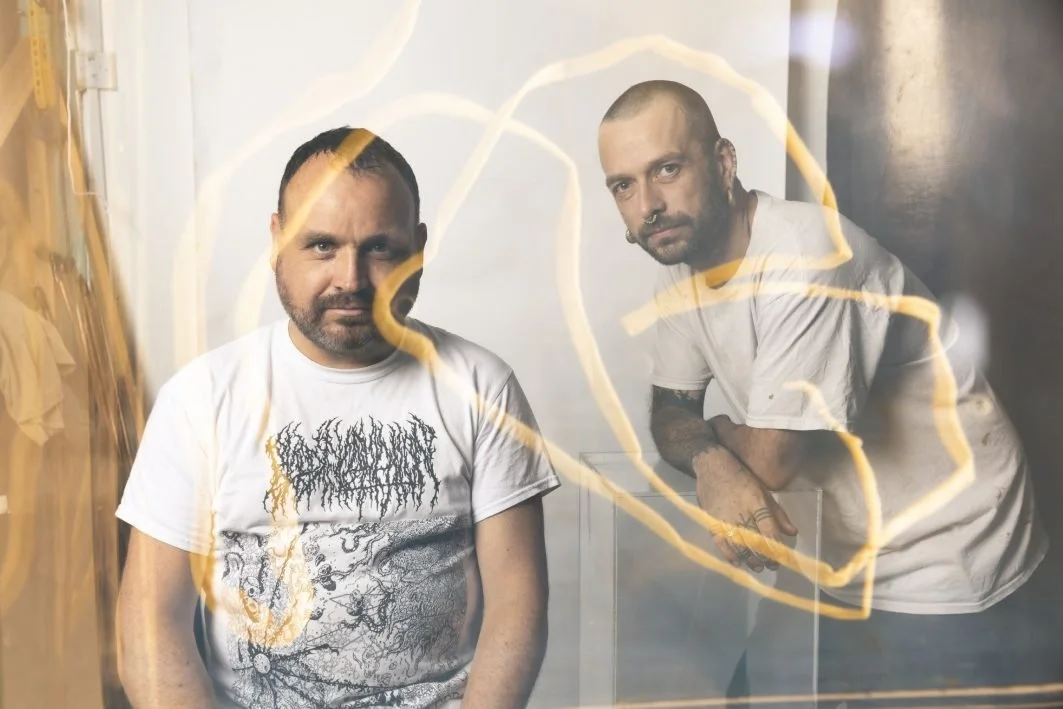
One Leg One Eye. Photo courtesy of the artists.
One Leg One Eye, the project of Ian Lynch, a founding member of Lankum, recently performed at High Line Brewing in Calgary. This performance I had most been looking forward to, especially after speaking with Ian and George beforehand about how they weave Irish mythology and history into their music. Their set was unlike anything I had experienced before, merging traditional Irish instrumentation with the raw power of noise, drone, and metal.
On stage, George performed on the keyboard, creating intricate layers of atmospheric sound, while Ian played the Uilleann pipes, their deep, resonant tones filling the room with a haunting beauty. Both artists seemed completely absorbed in their performance, lost in a state of flow that drew the audience in with them. It was not just a concert; it was a ritual. Ian even lit sage during the performance, adding to the feeling that something spiritual was unfolding.
As the pipes began to play, it felt as though time itself was shifting. The music carried us backward, away from the present and into an ancient world. Vocal recordings evoking pre-Christian Irish mythology played softly beneath the live sound, grounding the performance in a sense of history and mysticism. The effect was transformative, pulling the listener into a space that felt both sacred and cinematic.
Ian’s vocals were unlike anything I had heard before, raw, textured, and deeply evocative. It was clear that an immense amount of knowledge, intention, and care went into creating this music. The production was complex, yet the emotional weight felt effortless.
Even for someone unfamiliar with this genre, it was impossible not to be captivated. Watching Ian and George perform, you could feel their gratitude and passion radiate from the stage. Their sound is the kind that belongs in film, the kind that turns a scene into an experience.
One Leg One Eye delivered a performance that was not only impressive but transformative. It was a reminder that music can serve as both history and spell work, and that artists like Ian and George are keeping ancient stories alive through sound. This is a duo you will not want to miss the next time they are in town.
Read REVERIE’s conversation with One Leg One Eye below.
REVERIE: So, tell me a bit about yourselves. How long have you two been making music together?
Ian: We’ve known each other for years. We’d always end up chatting late at night saying, “We have to do something together.” We both come from Dublin’s DIY hardcore scene, but we went in different directions, I got into traditional and folk music, and George went into electronic and hip-hop.
George: Yeah, we kind of drifted in different directions but stayed in touch. We always said we’d do something eventually.
Ian: Then during lockdown, I started working on this project by myself — it wasn’t supposed to be a live act, just a personal outlet. But then I got asked to play CTM Festival in Berlin, and I thought, “Alright, let’s see what happens if we take this live.” I asked George to join me, and from that moment, it just worked.
REVERIE: That’s such a great story. Did you expect it to take off the way it did?
Ian: Not at all. That was about two years ago, and since then we’ve played festivals all over Europe, and now here we are in Canada. It’s been a bit surreal, honestly.
REVERIE: That’s amazing. What’s it like working together now that you’ve found this rhythm?
George: It’s great. We get along really well, and we both approach music with curiosity instead of ego. We’re older now, we’ve been through the early-band chaos. At this point, we just want to make something that feels true to us.
Ian: Yeah, we’re lucky to still be doing this. There’s something special about collaborating with someone who gets it, you don’t have to explain much, you just play and it clicks.
REVERIE: Let’s talk about the name One Leg One Eye. It’s really striking, what’s the story behind it?
Ian: It comes from early Irish mythology. There was a stance that poets used to take when placing curses or composing satire against unjust rulers. They would stand on one leg, raise one hand, and close one eye, symbolizing that they had one foot in this world and one in the other. It represented the poet’s power to speak truth to power.
REVERIE: That’s fascinating. Does that connection to folklore and mythology carry into your own lives and music?
Ian: Definitely. We both have a deep interest in pre-Christian Irish mythology and pagan traditions. It’s a big influence on what we do.
George: Ireland’s a Catholic country on the surface, but those older pagan roots are still there. You see it in the rituals, the holy wells, they were sacred sites long before Christianity. That sense of magic and duality runs through our culture and our music.
REVERIE: Tell me about your creative process. How do you approach making music?
George: On our next record, we’re experimenting with recording traditional instruments like pipes in ways that haven’t really been done before. I manipulate them electronically, sampling and layering them into something that feels organic but still otherworldly.
Ian: When I was learning to play the pipes, my teachers would say, “Don’t do that, that sound is wrong.” But those “wrong” sounds were the ones that fascinated me most. They had personality. So, we started embracing them, finding the beauty in the imperfection.
REVERIE: That’s such a creative way to approach it. How did you first learn the pipes?
Ian: Through an organization in Dublin called Na Píobairí Uilleann, “The Uilleann Pipers.” They promote the instrument, teach lessons, and even lend out practice sets to students since they’re so hard to get and expensive. I got completely obsessed — just practicing for hours every day, listening to old recordings, trying to understand the instrument’s soul.
REVERIE: Moving into live performances, have you had a particular show or audience moment that really stuck with you?
Ian: I love when people come up after a show and tell me they were crying. That’s the greatest compliment. Music should be cathartic; it’s about release and connection.
George: Yeah, sometimes everything aligns, we’re in the zone, the crowd feels it, and there’s this shared energy. Especially in times like these, when people are going through so much, it feels meaningful to offer something healing.
REVERIE: That’s such a powerful way to describe it.
Ian: Even if the music sounds heavy or unsettling, it’s about releasing pain, not amplifying it. It’s about putting something good back into the world.
REVERIE: That’s beautiful. Thank you both for sharing so openly. Any last words for your fans or new listeners?
Ian: Free Palestine.