

Godspell Documentary Shines Light on Toronto’s Ties to Comedy History
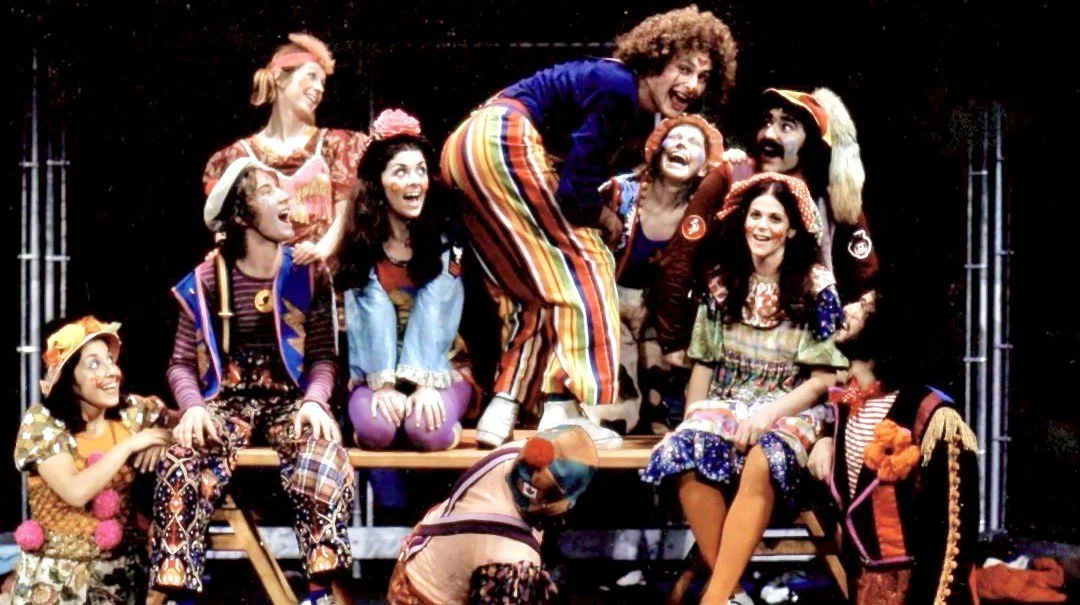
Still from You Had To Be There: How the Toronto Godspell Ignited the Comedy Revolution, Spread Love & Overalls, and Created a Community That Changed the World (In a Canadian Kind of Way).
We have long known that Canadians are the funniest and most talented people on the planet, but did you know that a 1972 production of the Stephen Schwartz/John-Michael Tebelak show Godspell in Toronto were the first professional jobs for a lot of the all-time comedic greats? That is what director Nick Davis explores in his wonderful new documentary You Had To Be There: How the Toronto Godspell Ignited the Comedy Revolution, Spread Love & Overalls, and Created a Community That Changed the World (In a Canadian Kind of Way) which is making its Alberta premiere as part of the 2026 Calgary International Film Festival on Monday September 28th at 1 p.m. at The Plaza, with an additional screening on Thursday October 1st at 9 p.m. at Cineplex Chinook. The film is a life-long dream for comedy nerds, to finally understand what it was about this production of Godspell that formed the nucleus that would later bring the Second City theatre to Toronto, inspire Lorne Michaels (a Canadian himself) to hire Gilda Radner to join his new show Saturday Night Live, and also form the bedrock that would later become SCTV, arguably the greatest sketch comedy show to ever exist. I had the pleasure of speaking with Nick Davis where I got into some of these origin questions, in addition to diving in what makes You Had To Be There such a feel-good film that all audiences should appreciate and enjoy.
REVERIE: As a life-long Canadian comedy nerd, this Toronto production of Godspell has been something I have heard and read about most of my life, so I am so thankful you made this film, which I not only found entertaining and funny, but deeply moving as we’ll discuss. How did this idea cross your path?
NICK DAVIS: Like you, I am a deep comedy nerd and had always known about the ’72 Toronto Godspell. To me, it made no sense because I am not a theatre guy, so I didn’t really know Godspell and all I knew was an incorrect image of Godspell of a goofy, hippy-dippy, somewhat saccharine, kind of Kumbaya, with Jesus and his disciples dancing around. So to me, it made no sense because it was the kind of thing, in my mind, that SCTV would have mocked. Then I went to college, helped form an improv group, would hang out with my improv friends, and think to myself “maybe we’re like the ’72 Toronto Godspell?” Same when I did improv in New York for a few years, it was always there in the back of my mind.
Years and years later, I was reading Martin Short’s memoir, I Must Say: My Life as a Humble Comedy Legend, and I was with my wife, and she did not know about the ’72 Toronto Godspell and she was really interested and then I got to the part in the book that I did not know: that Marty and Gilda had dated for two years during this time. That really set us off. My wife (Jane Mendelsohn, co-writer/executive producer of You Had To Be There) is a really big Gilda Radner fan, so we thought, what is going on here? What was this really like? We then thought, maybe we could really get to the bottom of this question of why Godspell? Was it the craziest coincidence of all-time or was there something meaningful about it? So that’s what brought us to the project.
REVERIE: This is a deeply Canadian film, and one of the parts of the film that I related to being from Calgary is the aspect of looking out at America, or rather the Canadian and American divide. The people in Toronto talk about watching the Buffalo TV channels, Paul Shaffer talks about listening to the Chicagoland radio stations from Thunder Bay, and us in Calgary, we have the Spokane Washington TV stations here. Relating to these Canadians now dominating the American entertainment and comedy scenes, you have the Paul Shaffer line, of him being the first Canadian to make the trek over to America, of when he is doing the Doug Henning show, of when he calls Marty and Gilda saying, “all of you are just as talented than anyone I have seen in America.”
DAVIS: Marty and Gilda didn’t believe him! Marty Short gives the example of Canadians feeling like the middle child. You’re not the older child, England, that is all beautiful and composed, and you’re not the hot, younger sister America. You’re sort of the middle child, where you don’t realize how great you are. You’re also the outsider, where you get all of your entertainment from America, which means Canadians can be really funny about American pop culture. Before the wall broke down between Canada and the U.S., there just weren't a lot of Canadians in show business, the occasional Christopher Plummer notwithstanding.
You’ve got all of this comedic talent bubbling up out of Toronto, and then this show comes to Toronto, Godspell. This then answered my earlier question, that it was not a coincidence, as in the script, John-Michael Tebelak said “Jesus and his disciples were clowns.” It’s written in the script! Because they must have been really funny and entertaining, or they wouldn’t have become so popular and their stories wouldn’t have caught on! So all of this comedic talent is attracted to it, composer Stephen Schwartz with a brilliant eye and unbelievable songs cast the funniest people to come to that room and the comedy explosion is on, though none of them realize it at the time. It then becomes a big hit, Chicago then brings the Second City to Toronto, realizing “maybe we could open a branch here?” and steal practically the entire cast of Toronto’s Godspell, then Lorne Michaels gets a big job and he’s going to start a new TV show in New York, and he picks, as his first hire, the woman he saw in Godspell, Gilda Radner, so Saturday Night Live becomes a hit. So then Second City Toronto says “hey, you’re stealing my cast!” which inspires them to do their own tv show, SCTV, and there you go. It all starts with Godspell.
REVERIE: To me, the funniest and most talented man to ever live is Martin Short. I have heard these bits from his origin story before like in his memoir, about the talk shows he produced as a child in his attic, his dreams of getting into show business, but your film does the best job I have ever seen of showing them, including using Marty’s own audio of him singing Sinatra, leading up to Godspell, of him covertly recording that Godspell show, and through that show he would meet his wife Nancy Dolman. Talk about working with Marty in the film and his part in the story.
DAVIS: Working with Marty is one of the great joys of anyone’s life who gets to work with Marty. He is one of a kind. It was fantastic and a privilege to be able to work with him. One of the interesting things about this story is that it’s an ensemble. Marty was really insistent on that. He was the first person I reached out to. I remember at our first lunch he said, “don’t elevate me over anyone else. Eugene Levy is amazing, Andrea Martin is amazing, and no one was more talented than Avril Chown. Victor Garber has the greatest voice! Rudy Webb, my god, the voice on Rudy!”
They are all so talented and Godspell is an ensemble. Yes, there’s Jesus, but it’s an ensemble cast where each person is encouraged, because of John-Michael Tebelak’s concept, to bring their best version of themselves for their roles. So it’s a total ensemble. It was great to work with Marty but it was equally great to work with all of them.
REVERIE: I am so glad you mentioned Avril Chown, as I wanted to focus on her next. I had no idea who she was before watching You Had To Be There and she is SUCH a talent and deservedly one of the main focuses of the film. Her story, which she reveals for the first time, really broke my heart. She is such a talent. You are giving her flowers while she’s still with us, which I love. Talk a bit about Avril Chown.
DAVIS: She was amazing. She is the one from the cast who dropped off the radar, so the rest of the Godspell cast didn’t know where she was. They asked me “have you found Avril? Do you know where she is?” It took us some time to find her and then we did. I was poking around in the interview, we had a wonderful interview. She was feeling relaxed and I think it had gone on long enough, so I asked “let’s get back to this idea. Some of them have gone on and you didn’t. Is there resentment?” So she said, “I might as well tell you.” She just told her story and it was such a gift. It felt honest and real, and explained the mystery of what happened to her. It was heartbreaking and made you realize about women in this business, in any business, it’s that much harder. We knew going in that it was not going to be all pizza and unicorns.
Gilda passed away very early, there’s so much heartbreak in this story. Not everyone in show business gets to become world famous. What also struck me was that this group of people had their heads screwed on right. They knew just because one person goes on to fame and fortune and the other doesn’t, that doesn’t make one any better than anyone else. There’s that wonderful story Dave Thomas tells in the film, when Marty is obsessing over what part he should take, and Dave responds “Marty, in the year 2500, all of show business is going to be one paragraph and a picture of John Wayne. What do you care?” It’s so good. They all have that awareness and humanity, which is what we wanted to show in the film and why it was such a gift for Avril to share that part of her story and for us to share it with the world.
REVERIE: Since so little footage exists of the show, you instead have this incredible animation. I see a lot of animation in documentaries, some better than others, but yours is genuinely among the very best I have seen. It fits the time period, it is comedic, and does a brilliant job of illustrating these Godspell numbers, of placing you in the time of the show. Talk about the animation process.
DAVIS: We knew going in that we had to animate, because there’s no footage, so let’s lean in to that! It’s the early ’70s, so I went to animators and said Scooby-Doo meets Yellow Submarine. I met with three different animation teams and one just got it, they totally understood. A guy named Richard O’Connor and his animation company Ace and Son were just on it and totally understood it. Other influences started to creep in, you felt MAD Magazine, you felt Peanuts, other sort of early ’70s vibes, they did a magnificent job. It is hard! They did the old fashioned way, hand-drawn, cell by cell. It got hairy at times, as animation always takes longer than you want it to, and we are changing things in the editing room! If you say, “that isn’t going to work, can you have them roll a window shade that wraps up?” and then you think, that’s going to be another two and a half days of work for them, are you sure this is the idea you want? I knew you had to feel it, you want to feel like this is an undiscovered artifact from 1972, a Saturday morning cartoon starring all of these guys.
REVERIE: It was so worth the effort, as it’s some of the best animation I have ever seen in a documentary. It’s so comedic and fun. Going back to the film as a whole, I found it so deeply moving, the ending had me full on tearing up. Seeing the entire Godspell cast reunite in that same house, 1063 Avenue Road in Toronto, which Dan Aykroyd says in your film that house should be deemed a historical landmark for all that it has meant for comedy history. I was so moved, seeing these people, some of whom are A-List award winning comedy stars, all reverting back to their formative early twenty something days, singing songs and telling stories. It reminded me of a comedic version of Michael Apted’s 7 Up films. Talk about filming this reunion.
DAVIS: To be honest, I don’t like those kinds of things. When I watch a documentary and it’s a rock group driving around London, saying “Oh, we did that” I have a hard time if it doesn’t feel organic. However, as soon as we started the interviews, even some of them started to say “could we get together again?” It felt like, “Oh, we have to end this way.” When the time came to shoot it, we realized that they were going to have such a good time. I told the camera man, make sure the lens caps are off and it is in focus and we’ll be fine. What they did, we had no idea. I knew Marty had always said “every time we get together, we start singing,” but we didn’t realize they were going to go instantly to the piano and just start running the entire show with every song! It was incredible. It was a joy to be there and a wonderful night. As you say, they reverted back and instantly started chit-chatting and making each other laugh and all of that stuff just happened.
REVERIE: As this film is screening as part of the Calgary International Film Festival, give one last sales pitch for the film.
DAVIS: We need the joy. the love, the spirit and the energy of the 1972 Toronto production of Godspell. I feel like this is a really good time for this film. It’s really fun to see in a theatre, because it brings you into a community and you get to feel like you are there and you are certainly surrounded by a great loving spirit.
You Had To Be There: How the Toronto Godspell Ignited the Comedy Revolution, Spread Love & Overalls, and Created a Community That Changed the World (In a Canadian Kind of Way) is making its Alberta premiere as part of the 2026 Calgary International Film Festival on Monday September 28th at 1 p.m. at The Plaza, with an additional screening on Thursday October 1st at 9 p.m. at Cineplex Chinook.