

The Rescue Dog and Muse behind Ben Petrie’s The Heirloom
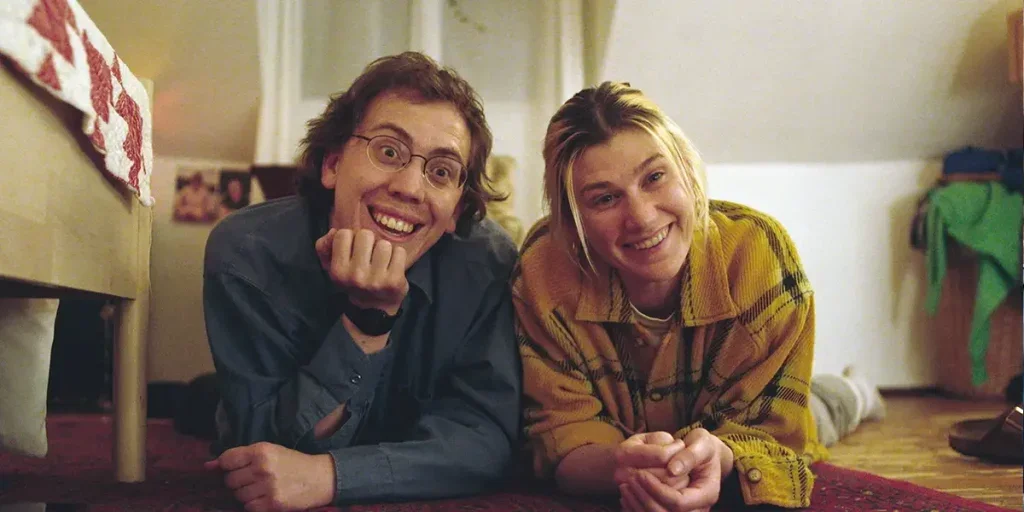
Ben Petrie's 2024 feature film directorial debut, The Heirloom, is one of my favourite movies of the decade and has been on my mind ever since I watched it for the first time this year. It spoke to the artistic side of me, fuelling me with tons of creativity and igniting a desire in me to hopefully make a movie of my own one day. It also reminded me of how significant a pet can be in your life, making me think and get emotional about the love I have for my cat and how much he means to me.
The Heirloom draws from Petrie and his wife, Grace Glowicki's, real-life relationship and their experience of adopting their rescue dog, Dilly. Set during the pandemic, the film follows Eric (Petrie) and Allie (Glowicki), a couple whose relationship is brought to the edge when they adopt a traumatized rescue dog named Milly. Eric, a filmmaker, has been struggling mightily with writer's block and can't seem to finish the screenplay for his movie. Eric becomes inspired to write a new screenplay about adopting Milly and starts turning their lives into a movie.
The original film Petrie was working on was sort of an expansion of a short film he and Glowicki made back in 2016 called Her Friend Adam. Petrie's plan was to make a feature-length film about two characters in an apartment having a big sprawling conversation. “The whole process became less about the storytelling, characters, and emotion, and more about trying to make something perfect, and that just killed the lifeforce driving the creative process,” he says. “I had been working on this thing for so long, and I didn’t really have the internal electricity exciting me about it anymore.”
Once Petrie and Glowicki adopted Dilly, a new creative spark awoke in Petrie. Although he was already financed for the original project he was working on, Telefilm Canada was granting filmmakers a lot of flexibility because of the pandemic, allowing him to switch it up and make a movie about the experience of adopting Dilly and the impact she had on their lives. “I just started to feel this gush of emotion that was really enlivening,” he says. “I was feeling a huge amount of love, tenderness, and recognition of our dog's vulnerability. She was like a quivering leaf when she came into our lives… The new feeling that she awoke in me was something to replace my dead inspiration with.”
Glowicki was instrumental in helping Petrie with the devising of the story and offered a lot of support. “When Dilly came into our life, and I had this thunderstorm of feelings that I was just dashing down a million things in my notebook, and I was too scared to even endeavour those many different fragments of ideas into my screenplay because I had been so burned by my own experience trying to write this previous screenplay,” Petrie shares. “Grace just sat me down in the living room and took out a huge pile of cue cards and said, ‘Just read out every idea, [line of dialogue, or broad story gesture] that is in your notebook, and I’ll write it on a cue card.’” They ended up with a huge pile of cue cards and then went through them all until they were left with the best ones. “[We were] getting rid of anything that didn't feel like the most distilled syrup of the movie.”
Petrie shares that The Heirloom is pretty close to the reality of what happened. An example of this is at the beginning of the film, when Allie and Eric are arguing about whether they’re going to get a dog. “It’s really a total recreation of what our actual bickers were like,” he says. One scene in particular really stands out to Petrie, though. “A scene that is meaningful to me is where Grace is picking through the bag of dog stool near the end [of the film], and we have our sweaters over our noses. I remember that happening in our real life and looking at Grace in that moment in feeling so in love with her as she had her nose in this dog stool, and picking through it so unselfconsciously.”
One of the few things that happens in The Heirloom that is not true is that they never lost Dilly. However, Dilly did have a sickness, but its cause was different than what is shown in the film. “She came from the Dominican Republic, like in the movie, and she started to have really bad gastrointestinal problems a week after having her,” Petrie recalls. “There was a little plastic water bottle in the crate coming over in the plane, and she was so anxious and nervous that she had chewed the whole thing up and swallowed it.”
Deciding to make a movie about their life with Dilly was incredibly interesting and exciting, but also somewhat surreal for Petrie. “I would just be looking at moments in our life, and at first it was so exciting because everything felt so beautiful that I felt like ‘God, people need to see how beautiful our dog is. Like this is going to blow people’s fucking mind how beautiful this creature is,’” he reflects. “Our dog would just be taking a shit, and I would be seeing it in 70 mm IMAX in my head and just thinking it is the most glorious thing. Over time, it shifted and started to become more of a possessive psychological dynamic where I couldn’t escape that point of view. The life we were living started to become eclipsed by the perspective of how it could be cinematized.”
Going back and forth between their actual dog, Dilly, and filming with a dog they called Milly was weird for Petrie. The Heirloom was filmed in an apartment that he and Glowicki rented. They moved all their furniture from their actual apartment into the rented apartment, creating a stage version of their home. “I would really cringe when we would go home, and I would accidentally call Dilly Milly,” he says. “I felt bad throughout significant parts of the process about the extent to which my attention had gone, which was originally these feelings of love towards our dog. By making a movie about her, so much of my attention had actually been distracted from our actual dog and gone towards creating this bejewelled version of that experience. It was confusing and often painful trying to toggle back and forth, especially once my energy had fully been directed towards the obsession of a moviemaking process.”
The Heirloom instantly reminded me of the movie Adaptation. Adaptation was a little on Petrie’s mind while working on The Heirloom, but he was trying hard not to draw from it. “I don’t have the brain for the metafictional kaleidoscopes that Charlie Kaufman has,” he says. “I was trying to avoid it becoming metafictional at every turn, but it just felt like an inevitable part of the project… I was just drawing from the reality [of our life], and the reality was that I was blundering my life to make a movie. I tried not to go full Kaufman... I just drew from the feeling of how making a movie about my life was ruining our life.”
In many scenes in The Heirloom, when Eric is working on his film, there is a deep voice constantly saying things like ‘Bad,’ ‘Failure,’ and ‘Dumbass,’ symbolizing the inner turmoil, self-doubt, lack of confidence, and writer's block that he is experiencing. Petrie also experienced the same negative self-talk while working on his original project and The Heirloom. “Much like Eric in the movie, I had fallen under the spell of this dog training philosophy that dogs were so sensitive to your pheromones that they could detect your feelings and your thoughts,” Petrie says. “I would feel our dog’s presence like an eye of Sauron in the room, that could penetrate my skull and sense what I was thinking and feeling.”
Petrie shares that this is where many of the metafictional elements came into play. “[It] added a meta-cognitive awareness of what was going on in my own mind. At first, what was revealed to me was all of the loving feelings that I was having towards this creature. That watchful eye continued to watch unblinkingly as the thoughts going across my mind started to regress towards a lot more of the perfectionist, negative, overly pressurized self-talk that defined my experience working on my screenplay… If those negative thoughts are starting to happen in relation to the movie I'm making about my life, it's hard to keep the lines clean, and you start to put that pressure on your life, your dog, and your partner. It just becomes this whole negative self-talk psychological cave.”
The most challenging aspect of The Heirloom was how triggering the material was. “It was so anxiety-inducing to look at hours and hours and hours and hours of this improvised footage of moments of our relationship and try to find our way through some deeply imperfect material because of it being improvised, and to try and craft not that fictionalized version of it,” he says. “I was basically trying to craft a portrait of our relationship that I wouldn’t feel was rendering it as something I wouldn’t want to share with the world, let alone with Grace, let alone with our potential children if it’s a fucking heirloom. It was really difficult engaging with the material in a way that wasn’t blinded by anxiety.”
The Heirloom marks Petrie’s first time working with a composer as a director. He says working with Casey was a “dream collaboration.” He knew he wanted Casey to be the composer as he loved the score Casey did for Glowicki’s film Tito. Petrie did not show Casey the film to begin with; instead, he sent him word combinations, or what the two of them called inspiration keys. “They were evocative of a tone in my body that I wanted to get across in the movie,” Petrie explains. Some of these tone cues include: the haunting look of trauma in the eyes of a newborn baby, the romance of heartbreak, and the heartbreak of romance. “Off of those tone cues, he produced long spools of music, just improvising without a picture, and he would try different themes with a variety of instruments. I would take that into the editing room and DJ with it, splice it up, and try it in different places. It informed so many breakthroughs in the picture edit. Then I would send that back to him, and he would do a pass on that. We worked together concurrently with the editing process over the course of about a year..”
Petrie's close friend, Matt Johnson, has a small voice role in The Heirloom as a vet. “I actually texted him the night before the shoot,” Petrie explains. “I had a feeling that that would be the way to ask him to do it. It was about one in the morning. I texted him and said ‘Matt, I would love for you to play a blustering veterinarian. This is what your character is like.’ He responded right away, saying, ‘Sounds good. You mean right now?’ He was ready to go right away… The only problem with the footage is that about 95% of it was unusable because Grace and I couldn’t stop laughing at his improvisations.”
As for his second feature film, Petrie is still generating ideas, but his intention is to stay true to Eric's pledge at the end of The Heirloom. “Everything in our life will make its way into the next thing I make, but it will be fictionalized a hell of a lot more,” he says.