

How Caught Stealing Became Darren Aronofsky’s Love Letter to 90’s New York with Mark Friedberg
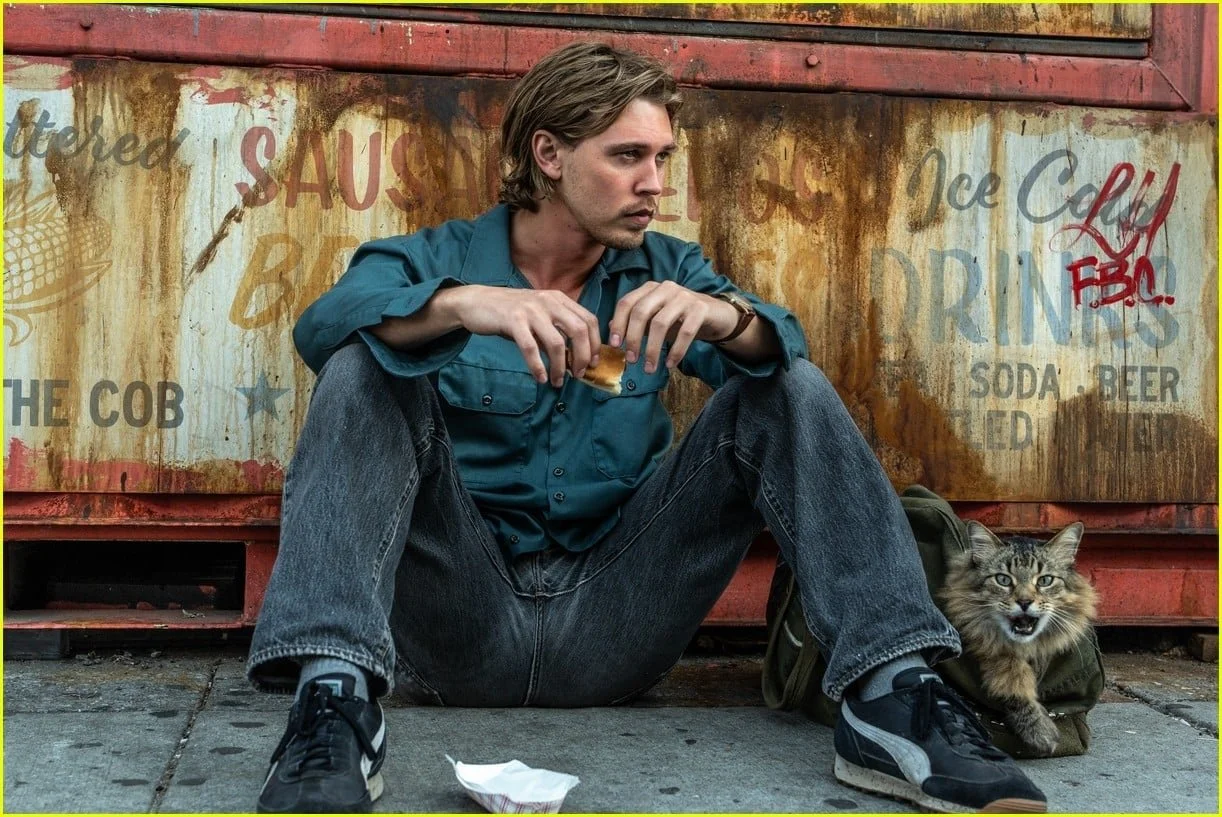
Photo credit: Sony Pictures
Darren Aronofsky, known for directing films such as the disturbingly harrowing and deeply upsetting Requiem For A Dream, the ambitiously surreal The Fountain, and the anxiety-inducing Black Swan, has delivered his most accessible film to date, Caught Stealing, an incredibly entertaining throwback to pulpy 90s thrillers, with plenty of good laughs and exciting action to go around. Caught Stealing is adapted from Charlie Huston’s 2004 novel of the same name (Huston also wrote the film’s screenplay). It is a nice tonal departure for Aronofsky, as it is much more lighthearted than his previous films and is by far the funniest film he has ever made. Even though it is quite a different kind of film for him, it still feels very much like an ‘Aronofsky’ film.
Set in 1998, Caught Stealing follows Hank Thompson (Austin Butler), a former high school baseball phenom who now works as a bartender in New York City. After agreeing to cat-sit for his neighbour, Russ (Matt Smith), Hank is suddenly pulled into a criminal underworld, with no idea why all these dangerous gangsters are threatening his life. Now, along with taking care of the cat, he needs to figure out what these gangsters want, as his life depends on it.
Recently, REVERIE chatted with production designer Mark Friedberg about his role in Caught Stealing.
Caught Stealing marks the third collaboration between Friedberg and Aronofsky. They previously worked together on Noah and The Whale. “There is a lot of synergy there,” Friedberg says. “Darren is incredibly rigorous and specific to his credit. It’s more about workshopping general ideas into specific and he is a very specific director. There is very specific information he wants to convey in very specific ways. He has shots that are very important to him that we’ll be setting up shots that he’ll do later in the film, and the sets have to accommodate those.”
Friedberg explains that Caught Stealing felt like a very personal project for many of the people who worked on it. “This is a movie set in New York at a particular time, and many of us were about the age of Hank and living in New York at that time,” he states. “Darren referred to it as a love letter to New York. Caught Stealing is set in neighbourhoods and realms… “[It’s] a journey movie. It is a madcap run. At a certain point, [Hank] leaves his apartment, and he is on the run… You move from one realm to another. You go from East Village to Chinatown, to Brighton Beach, to Flushing. It’s all of that fun New York City exploration. In fact, when we were scouting for the Russian club, the place where the explosion happens, it was important to Darren to shoot it in Brighton Beach, and Brighton Beach is not an easy place to work. It’s very busy. But it’s also very close to where he grew up in Manhattan Beach. He knew all the streets, and he knew all the places. He really wanted it to be this fancy club under a subway.”
Caught Stealing would make a great double feature with After Hours. Both are highly energetic, frantic, madcap dark comedy films set in New York, in which the main character gets caught up in bizarre and life-threatening situations. Plus, Griffin Dunne is in both films. Although Caught Stealing does have an After Hours quality to it (and Friedberg also mentioned Caught Stealing was somewhat influenced by the film), for the most part, they were not really drawing from other movies. “It was personal for a lot of us, so I think rather than drawing from other movies, we drew from our lives,” he states. “I know every block and every street in New York City. I spent my life driving around New York City. I am originally from New York, and I am still here. That certainly informed some decisions… I love all these neighbourhoods… We did a lot of work to make Hank’s apartment, and it had some influences from apartments that I lived in.”
There were a couple of things done in Caught Stealing to distinguish the different neighbourhoods of New York City and to bring the 90s era to life. “The East Village is the one that gets the most energy with the bar, [Hank’s] apartment, and the neighbourhood itself,” Friedberg explains. “I liked the idea that there was sort of the sense that people were using the city itself as the canvas for their expression: painting murals, writing graffiti, painting on walls…There really is almost graffiti and stickers everywhere you look on the walls and streets of New York. A lot of the graffiti we used was from that time, and in some cases, from very particular artists who worked back then.”
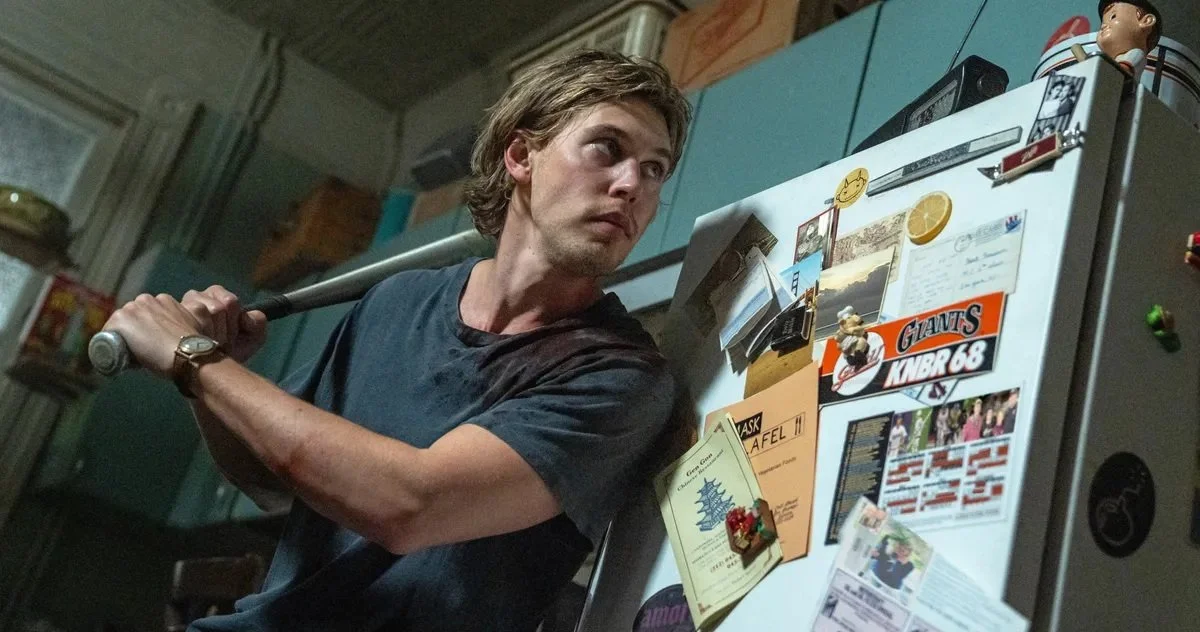
Photo credit: Sony Pictures
However, Friedberg also shares that the neighbourhoods also define themselves. “The thing about New York is that it originally was a city of immigrants, which was something that we used to be so proud of as a country, and now is something that we seem so terrified of,” he says. “These immigrants and communities, when they first land, go to the area where their people are, and from there, there is a diaspora. Brighton Beach is Russian and Ukrainian. Flushing was, and is, a place where a lot of Latino people hangout on weekends. [Both of those] are present in our film as well.”
Friedberg really enjoyed recreating many iconic East Village places, such as Benny’s Burritos and Kim’s Video and Music. “Having the old hippies who still live in the neighbourhood come by and be so excited to see these places again was fun,” he comments. There is also a little Easter egg to Aronofsky’s Pi hidden in Kim’s Video and Music. “The year Caught Stealing was set was also the year that Pi went to video and was in Kim’s Video. In fact, I don’t think you can really see it in the movie; maybe if you blow up the frame, you’d be able to forensically find it, but there is a little advertisement for Pi in the window. Darren said one of the great honours that he received as a filmmaker was to have his own section, ‘Aronofsky’ as Kim’s Video.”
Staging a wedding was one of the most challenging aspects of Friedberg’s role as the production designer. “[We did it] with six days' notice,” he comments. “That was a very late development that we went inside the wedding. “Darren was very specific about wanting an ice sculpture in this Russian wedding, which is not something you traditionally see in movies because ice and light don’t always go together. Also, finding someone at the last minute to make a giant ice sculpture was a challenge.”
One of Friedberg’s favourite jobs as a production designer is scouting. “I love to scout, to look around, and to find places,” he says. “It’s fun when you’re just driving around, and you realize that’s your job sometimes. What we do can be incredibly stressful. Sometimes it feels like you’re not getting paid enough to work 18 hours a day everyday all the time, and sometimes it feels like you shouldn’t even call it a job because it’s so exciting and fun.”
Overall, Friedberg had a fantastic time collaborating with many friends on Caught Stealing. “It was a bunch of friends coming together, having earned their expertise over many decades of doing dedicated work, and people who were connected personally to each other… [and] what a treat to share your life with people in this way,” Friedberg says. “[As I got ready to go to college], there was really a paradigm shift in the way people chose to live their lives, and I lost my mother right at the time you are supposed to make that decision. I was 18. It threw me off the course I was on, and it sent me on a course of weird artistic exploration and looking for meaning. I find it in telling stories, in collaboration, and in the fact that, with my job, no two days are ever the same… I love how my brain is stretched in these many different directions. But what I truly love most about working on a movie is that we get to do this together. We collaborate as a team and as a group, and Darren is extraordinary as a team leader.”