

Celebrating 20 Years of Hoodwinked!: Director Cory Edwards on Its Legacy

Photos Courtesy Of Cory Edwards
January 13th, 2026, will mark the 20th anniversary of the beloved cult classic film Hoodwinked! “When I run into college-age people and people in their late twenties, the affection they have for [Hoodwinked!] warms my heart,” says Cory Edwards, main director and co-writer of Hoodwinked! “Fans have made it last this long… Its legacy continues to grow, and I am very proud of it.”
Hoodwinked! was one of my favorite movies growing up and was very formative in shaping my love of cinema. I feel like my love of musicals, non-linear narratives, and subversive storytelling can be traced back to endlessly rewatching Hoodwinked! as a kid. It also introduced me to Ben Folds, who is one of my musical heroes. Ahead of the 20th anniversary of Hoodwinked!, I reached out to Edwards to chat about the film.
The Origins and Writing Process of Hoodwinked!
Initially, Edwards and his brother, Todd (co-writer and co-director), pitched several live-action crime films to investor Maurice Kanbar. Kanbar was more interested in animation. “We showed him an animated project that I had directed, and he said, ‘I love animation. I would love to invest in an animated movie,” Edwards recalls. “We didn’t have any scripts for an animated movie. We had not prepared ourselves for that. He said, ‘I'll give you 30 days, and I want to do what Disney did. Walt Disney made movies about commonly told stories. The audience already knows the story.’”
Edwards explains that they looked at Hans Christian Anderson fairy tales, Grimms’ Fairy Tales, and some lesser-known fairy tales to see which story they would want to adapt into a film. Little Red Riding Hood shot to the top of their list very quickly, largely due to the story's global appeal. “Not only does every living soul know the story of Little Red Riding Hood, but it’s told around the world in different cultures,” he states. “I just found it fascinating that, as a cautionary tale, especially for young girls, about avoiding strangers and being aware that you don’t know who someone is out in the woods of life, it is told as a version of Little Red Riding Hood in many, many countries.”
Additionally, expanding the story of Little Red Riding Hood into a feature length film was exciting for Edwards. “Todd called me one day and said, ‘What if we did it like a police procedural? What if we told this very short story four times from four different points of view?’” he says. “Not only was it something that would make a good movie, but I thought that it was a movie I wanted to see.” From here, the story branched out. “What is the most unpredictable, surprising day that we could create from all these perspectives? What don’t we expect Granny to do? What don’t we expect the Wolf to be as an identity? What is the least expected, most surprising backstory for the Woodsman?’”
Although Edwards enjoyed subverting the story of Little Red Riding Hood, he thinks it is vital that children read the actual story of Little Red Riding Hood first. “I will tell parents, please don’t let Hoodwinked! be their child’s first encounter with Little Red Riding Hood,” he explains. “The original story needs to be appreciated for what it is before you subvert it, especially with children.”
The premise of Hoodwinked! was heavily influenced by non-linear crime films of the ‘90s, such as Pulp Fiction and Run Lola Run. “We were fans of that storytelling style, but it was still very new and certainly wasn’t done in an animated kids movie,” Edwards says. He believed that kids were ready to be introduced to non-linear storytelling. “Kids were watching DVDs where they hop to their favourite chapter, or they’re playing video games where you’re heading one narrative direction, and you divert, and you play the game again, and something else happens. We use the repeated visual motif of the book flipping backwards because one thing I know that young kids say when you read them a bedtime story is, ‘Read it again. Read it again.’ So, kids would know we are going to read this story again and flip back to the first page.”
Hoodwinked! also took inspiration from Agatha Christie books and whodunit movies. “The best murder mysteries make you believe any one of these people in this room has a motive to commit the crime,” Edwards states. “We are trying to create an unexpected twist and turn so the audience doesn’t know who the goodie bandit is. It could have been any one of these people.”
The narrative structure of Hoodwinked! was the most challenging part of the writing process. Edwards shares that the process took many months to figure out. “Once you start retelling the same day and same events over and over, you kind of lose the three act structure… You lose the ups and downs of a regular movie. We discovered we could tell all our different stories at the kitchen table and get that done by the end of act two, and the final part of act two would be the revelation that Granny has been living the life Red has always wanted. She’s been living a life outside of the woods, living an exciting life, and Red feels kind of betrayed. We created that emotional brokenness to be fixed by the end of the movie, at the end of act two.”
One character Edwards really enjoyed creating was Wolf (Patrick Warburton). “We’re referencing an old Chevy Chase movie called Fletch, and if you know the reference, you are enjoying it with an extra layer of nostalgia,” he comments. “By being an undercover reporter in the woods, I could see him having many adventures. It’s always good when you create the life of a character that even after the movie, you think, ‘How many adventures has he had?’”
One of Edwards’ favourite scenes in Hoodwinked! is near the end of the movie when Twitchy (Cory Edwards) drinks coffee for the first time and is given a special job to go down the hill to warn the cops and to be ready. He describes the scene as a “happy accident we backed into at the last minute.” It was one of the last scenes that was added into the movie. “We made a joke earlier in the movie where Wolf is like, ‘You better switch to decaffeinated coffee,’ and Twitchy is like, ‘I don’t drink coffee,’” Edwards says. “There’s a reason for him to drink coffee. You can’t just put something in a movie because it’s funny. It also needs to have a narrative reason… Giving Twitchy coffee would give him some sort of superpower because he's already this twitchy and sped up, so to give him caffeine would do something extra… That continues to tell me to work on every little odd comment because it might birth something really beautiful and a little gem of comedy.”
Photos Courtesy Of Cory Edwards
The Voice Cast and Major Recasting
The original voice cast was much different from what it turned out to be. For example, Tara Strong was the original voice of Red, Sally Struthers voiced Granny, and Edwards’ close friend, Joel McCrary, voiced Chief Grizzly. Edwards shares that once The Weinstein Company was attached as the film's distributor, recasting began to bring in more household names, such as Glenn Close (Granny) and Anne Hathaway (Red). “The Weinstein Company marketed our movies as if we were Toy Story,” he says. “We got on a recasting train that I wanted to stop, and it didn’t stop… He was literally calling famous directors to voice Jimmy Lizard. He called Martin Scorsese, Spike Lee, and Quentin Tarantino. They all said no. My friend Josh Green remains the voice of Jimmy.”
Patrick Warburton (Wolf) was the first actor to come on board to do the movie. “Tony Leech [co-director and co-writer] was just crewing on an independent film that Patrick was doing a couple days on, and Tony had the audacity to say to Patrick, ‘Hey, my buddies and I are making an animated film. Would you want to do a voice in it?’” Edwards recalls. A few days later, Warburton agreed to do the film. “Patrick said, ‘Man, this script made me laugh so hard. I love what you guys are doing. I’m in.’”
The recasting process made it very difficult to record the actors and actresses. “The way you are supposed to record voices for an animated movie is you are supposed to hire the actors first, record them all, let them come up with ideas on the microphone apart from the script, and then animate it to that performance,” Edwards says. This is what was done with the original voice cast. However, once the recasting started, the movie was nearly finished. This caused some actors and actresses to get frustrated, as they were unable to bring their own ideas into the role or improvise lines, since they had to deliver lines in a similar way to match the timing of the original voice cast. Edwards mentions the process was very different, known as ADR (Automatic Dialogue Replacement). Someone who did not have trouble with this was Xzibit, who voices Chief Grizzly. “He would listen to the line and would almost close his eyes and not even look at the screen. He would listen to the rhythm of the line and say, ‘I got it,’ and he would nail it almost every time.”
One voice that Edwards wished he had fought harder to keep was Tom Kenny as Woolworth. Woolworth was eventually voiced by Chazz Palminteri. “In any film noir that we were trying to parody, [Woolworth] is the shoe shine boy, the street rat, or the informant that investigators and cops always go to,” he explains. “You’ve got Wolf, who has a deep voice and is a heavy-duty guy in our story. He’s big and viewed as bad, even though he is a bumbler. In that scene, he’s supposed to be the alpha… [Tom] played Woolworth like Steve Buscemi might play it. He played it really nervous. His high voice up against Patrick Warburton’s low voice was great and very funny… I love Chazz Palminteri… But now, as you watch that scene, it's two deep voices going back and forth. Now it's the wolf negotiating with another guy who feels like he is throwing his weight around a lot. Woolworth as a character changed, and the dynamics of the scene changed. I think we lost a lot of the comedy there.”
Although Edwards loves all the sarcastic one-liners Warburton delivers as Wolf, his favourite voice performance from the film is Andy Dick (Boingo), whom he calls a “treasure trove of comedy,” as Dick would come up with hilarious improvisations. “In the blink of an eye, he would do something, and we were like, ‘Let’s use that. That’s way funnier than what we just wrote all those months ago… [When] he just started rambling, it is the funniest stuff in the movie. He just goes on this rant in one part of the movie, and he ends up laughing and crying like he was insane.”
The Music of Hoodwinked!
One of my favourite things about Hoodwinked! is the soundtrack, which is loaded with tons of amazingly catchy songs. Edwards tells me that he, his brother Todd, and Leech were all big fans of The Muppets and classic Disney animated films, which were highly influential in shaping Hoodwinked! into a musical. “We thought maybe we could find ways for some of these characters to break into song, and then we can also make fun of that trope and even make fun of the fact that it’s a musical, and why somebody would sing created a whole character, Japeth the goat,” he states. Todd wrote nine original songs for the film. “Todd was like, ‘This soundtrack has got to have rock and roll, The Beatles, and Elton John influence, so grown-ups want to listen to it.’” One example of this is “Great Big World,” which Edwards says, “has a big chorus and a 70s rock vibe.” Another example is “Tree Critter,” a personal favourite of Edwards that was influenced by The Strokes and The White Stripes. On the other hand, there are some rap influences too in the soundtrack. “Bounce” and “The Real G" are two songs Edwards wrote. “I lived out my personal dream of being a rap star on those two.”
A fan-favourite song (and one of my favourite original songs from any animated movie) from the film “Red Is Blue” was performed by Ben Folds. Composer John Mark Painter is the one who managed to get Folds to do “Red is Blue.” “John knows everybody,” Edwards says. “John goes, ‘Ben Folds is gonna be in town in a week. I'm gonna ask him if he wants to do this ballad that you wrote, Todd. It feels like a Ben Folds song.’ Ben typically writes his own music, so that’s a huge testament to Todd’s songwriting that Ben was willing to sing a song that he didn’t write.”
In a rough draft of the ski sequence, Foo Fighters’ “All My Life” was used as a temp song, which almost made it into the actual movie. “When it gets to, ‘Done, done on to the next one,’ Tony had timed it, and we had cut it to that song, so the bad guys are coming after Granny, we get into the snowball fight, the hard rocking part of that song is really going, and the momentum really builds,” Edwards explains. “[The Foo Fighters] said, ‘We would love for you to use a song of ours. But that song has been used so much. We have a double album coming out this year. We want you to pick something from our double album.’ They sent us the double album before it had been released to the public.’” In the end, no Foo Fighters song was used. “Nothing on that double album hit quite as hard as ‘All My Life.’ We tried everything. At the end of the day, we looked at each other and said, ‘I can't believe we're going to turn down the Foo Fighters.’”
Animating Hoodwinked! and the Massive Challenges They Faced
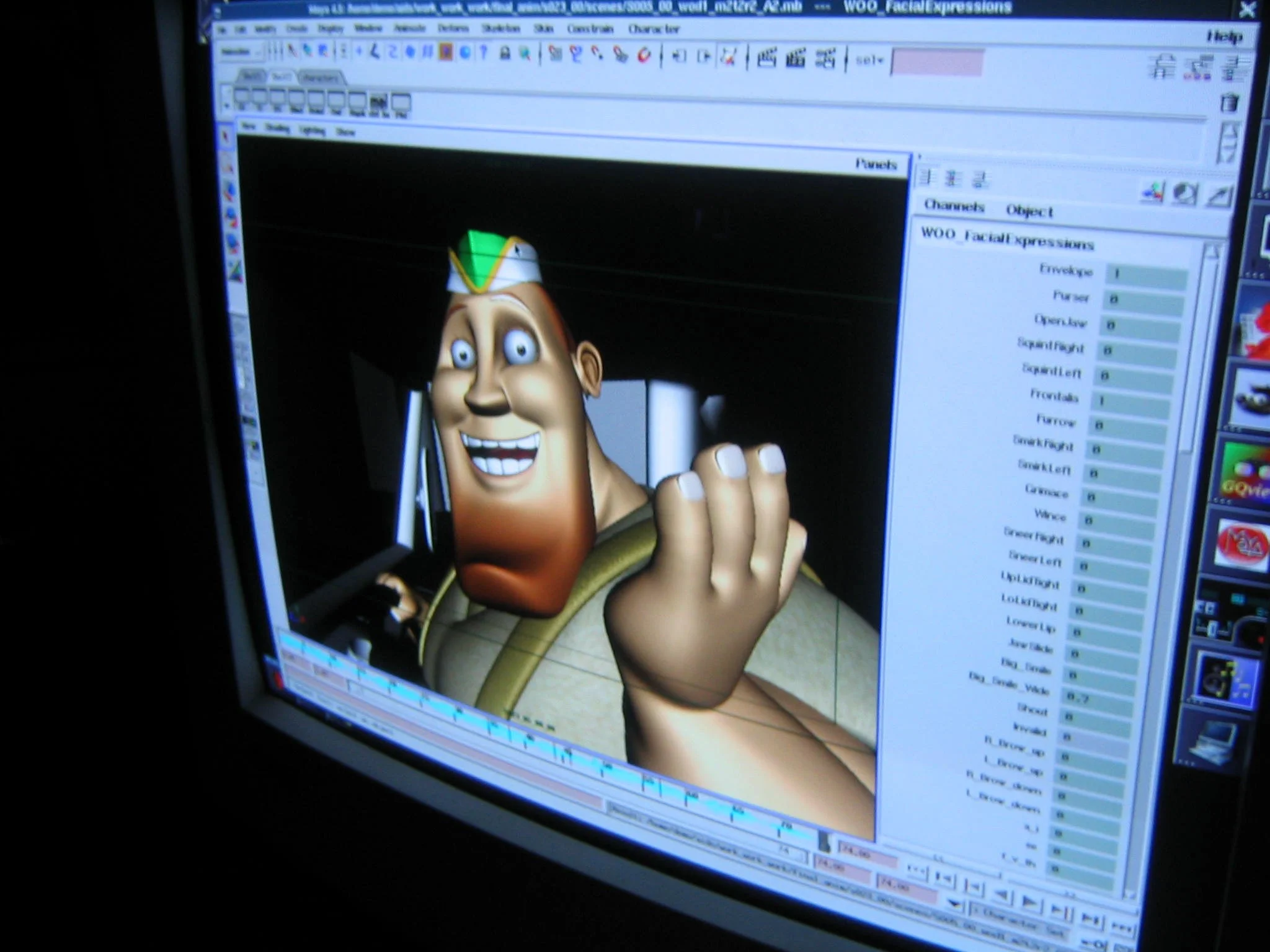
Hoodwinked! almost had an entirely different animation style. “If I had it my way, we would have done Hoodwinked! as stop motion,” Edwards states. However, he shares that working with a small budget, inexperience with stop-motion at a feature-film level, and a lack of connections in the stop-motion world, such as Aardman, led Hoodwinked! to be what he describes as an “uncanny valley between stop motion miniature look and traditional CGI look.” He shares a few ways in which this was achieved. “We tried to make it look like little miniature dolls photographed on miniature sets. Some shots are successful with that… I wanted Wolf to be made of felt, and you could see all the hinge points on him… Wolf does have fur on his face that looks good in closeup.”
One of the toughest challenges of Hoodwinked! was animating the movie. The film was produced in a big house in Manila, Philippines, with an original budget of two million dollars (in the end, the budget rose to eight million dollars). Even in the 2000s, making an animated film for less than ten million dollars was well below the average cost of an animated film. “If we had known what we knew at the end of the process, if we had known all that at the beginning, we may have never even started, as it might have been too daunting,” Edwards states. “The fact the movie even got done is amazing. There were points in this movie all along the way when me, some of the producers, Tony, and Todd, would sit out in this little yard outside the house in Manila, look at each other, and say, ‘I don’t know how this is gonna get done.’”
Hoodwinked! had many setbacks. “What was supposed to take 18 months took 3 years,” Edwards states. “The budget was eight million dollars. We probably burned one million of that on mistakes… There was a monsoon outside the house, and it almost erased half the movie on our server because things aren’t being properly backed up like they are at Pixar… 3 or 4 months into animating the movie, my animation supervisor sits down with me and says, ‘We just realized we don’t have enough computing power to render the whole movie. To render this movie in full colour 4k resolution, it will take us eight years to render this movie.’”
Eventually, Edwards says “heavy hitters from the animation world”, like Prana Studios, former Disney people, and former Pixar people, were brought in to offer advice and to help with the movie, which continuously increased the budget of the film but improved the quality of the animation.
Edwards explains that since Hoodwinked! was operating on such a small budget and many of the animators were still learning, it was hard to match the quality of animation other studios were putting out. “We knew while we were making it that we can't compete with Shrek, and we can't compete with Pixar,” he says. “I just kept saying to our animators, I know we don’t have the time or the money to make this look any better than this. At a certain point, we were like, ‘This is as good as this is gonna get, but we have a charming story, charming voices, and these are charming characters.’”
Ultimately, Hoodwinked! was completed after a lot of effort, help, patience, and love was put into the film by everyone. “We took our small toolbox of what we knew to do and just started on the film,” Edwards explains. “Once we got in over our heads, there were enough people to come alongside us and help us. God bless our investor, Maurice Kanbar, who kept giving us more money. By the time we were done, we had something that met industry standards and could be delivered to movie theatres.”
Photos Courtesy Of Cory Edwards
The Future of Hoodwinked!
Edwards would love to see a 20th-anniversary promotion or celebration for Hoodwinked!, but that’s now in the hands of Content Partners LLC, which recently acquired the rights to the movie. He is, though, incredibly excited about the prospect of potentially continuing the franchise. “People have been clamouring for a Hoodwinked! 3 for years,” he says. “People have been wanting a Hoodwinked! series for years. The new people who are controlling Hoodwinked! know where they can find me. I am very interested and open. I love these characters, and I would love for them to have a future.”