

Exploring the Supernatural in Calgary with Earth to Colby
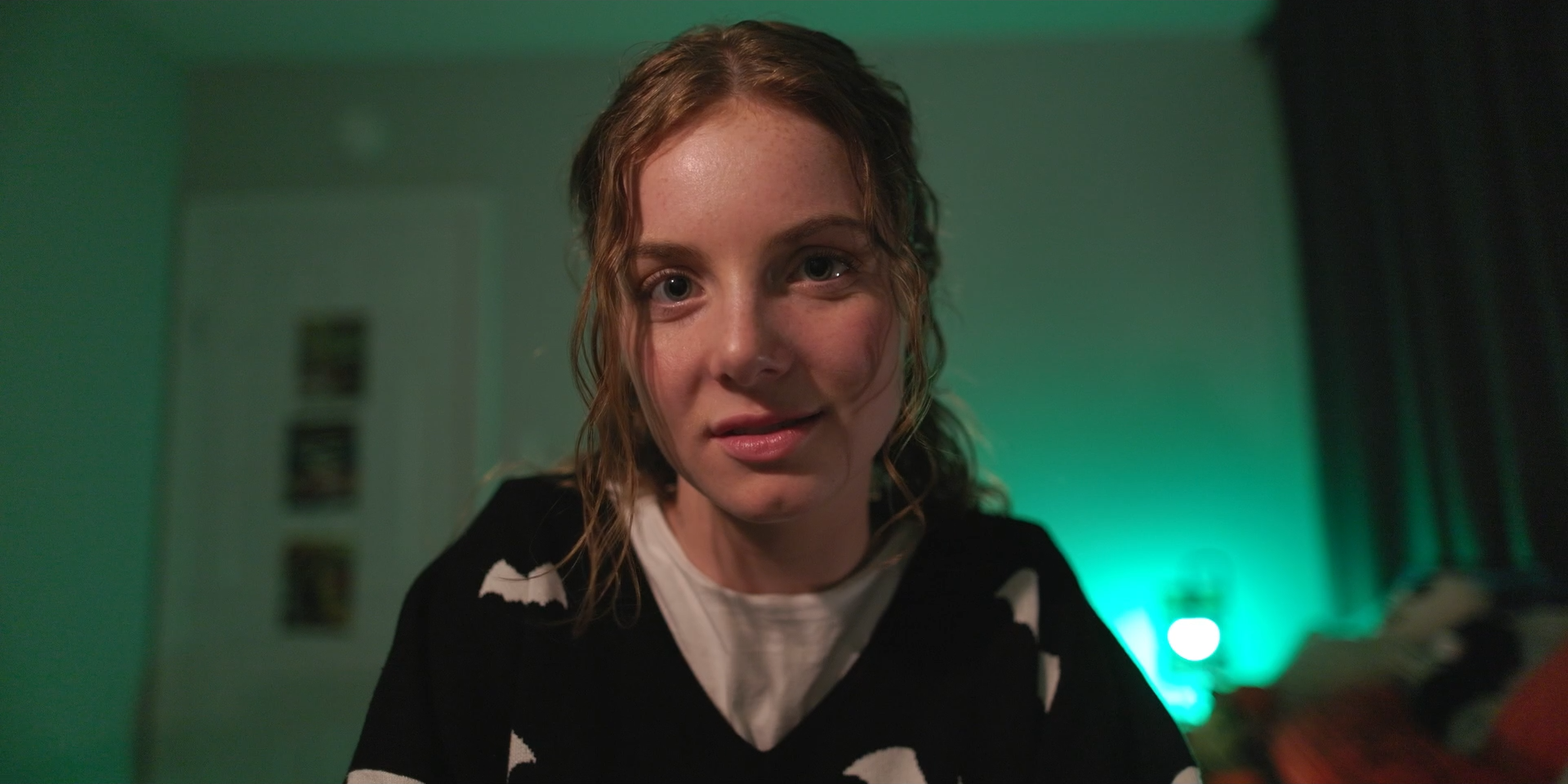
Still from Earth to Colby. Photo courtesy of the Calgary Underground Film Festival.
There’s something inherently heartwarming about seeing Canadian media that is so deeply rooted in the landscape and local culture of the places it’s made in. Earth to Colby, which had its world premiere at the Calgary Underground Film Festival, is part of the greater ‘identity renaissance’ in Canadian film.
Directed by Rino Mioc, the film follows Colby (Saylor McPherson) whose discovery of a mysterious notebook leads her deep into the supernatural history of her hometown, Calgary. The film unfolds through weaving a patchwork of recovered livestreams, vlogs and documentary interviews — a structure that builds gradual tension — Mioc describes it as a “gateway horror.” As Colby’s online following grows, so do the hauntings that surround her, ultimately culminating in her unexplained disappearance.
The homegrown found-footage driven plot for Earth to Colby is a celebration of Mioc’s childhood. “I wanted to harken back to the stuff that I grew up watching and the kind of youth targeted horror content that really moved me as a kid. And so in a way I wanted to revisit my childhood horror watching self through making this film,” said Mioc. “I use the found footage way of filmmaking as more of a style device and an intriguing way to like show less and let people use their imagination when watching the film.” The film is truly one of the loveliest additions to the found-footage genre. Throughout the film I found myself covering my eyes fearing a jumpscare, but instead the film built up an environment of anxiety. Many nails were bitten in the seats of the Globe Cinema during the screening.
A personal highlight was how intricately the film brings characters together through the common thread of Colby. Her mom, her best friend and her spiritual guide are interviewees for a documentary investigation of Colby’s disappearance. While the characters mostly never meet beyond the time they share in spaces with Colby, they feel so deeply connected to each other by their love for her. The same concerns and the same mistakes haunt their narratives as they all narrate parts of her story.
One of the main inspirations for the film is The Gideon Keys, a series of creepypastas found at the University of Calgary in 2009 outlining paranormal activity in Calgary. Colby finds a similar book, but it inherently has a much deeper connection with her. As her story progresses, she finds a connection with her late father through this book. On the paranormal in Calgary itself, Mioc references “ghost tours” that helped build the truly Calgarian iconography in the film — the Queen’s Park Cemetery being one of the more crucial landscapes. It’s spooky, but the film does an immense justice to its references, ringing in further discourse around a potential piece of lost media of Calgarian history.
One of the most notable — and my favourite — parts of the film is the “stuck house.” The stuck house is the largest portal Colby comes across in her exploration of Calgary’s supernatural. The house is a liminal, dreamlike location that becomes the emotional and thematic core of the story. Mioc says the idea “began as genuinely just kind of like an image, or like a dream,” but quickly it evolved into a metaphor for Colby’s internal state. “She herself is kind of lost between cultures and lost in limbo,” he explains. “By the end of the film, what she ends up doing is searching for a new home for herself, and this home might not be on our plane.”
What I find most interesting about the stuck house is that it’s shot at an airbnb in Strathmore, Alta., a small town east of Calgary. Like many rural towns on the Prairies, it carries its own sense of suspended time—quiet streets, aging houses, and a geography that can feel both familiar and slightly uncanny. On screen, the stuck house is a maze of intersecting timelines and overlapping realities. Mioc intercuts multiple characters exploring different rooms, creating what he calls “this drowning sense.” It’s the film’s most ambitious sequence and the one he’s proudest of. The location’s real‑world ordinariness contrasts sharply with the supernatural distortion happening inside it, grounding the fantasy in a recognizable Albertan landscape.
There’s a deep takeaway of obsession and grief with the films, Colby with this book — and the paranormal beyond — and her Mom and her Derrick’s obsession with attempts at trying to get Colby to fit in. Her fixation becomes a search for belonging, for connection and perhaps for a way back to the person she lost. But beyond that, Mioc says, “I want people to ultimately take away, in that sense, is just to like, be kind to your loved ones and to one another, and not push people away in that sense and try to hear out people and try to understand people who have differing approaches to life than you. It doesn't all have to be the same way.”
Earth to Colby is a film that understands the power of sincerity — of local stories and the emotional truths that genre can illuminate. If you have the chance to see it in a theatre, please do. As Mioc said, “You’ll have a good time. You’ll be a little scared … let’s all be scared in the theatre together.”
And truly, the theatre experience was a wonderful time.