

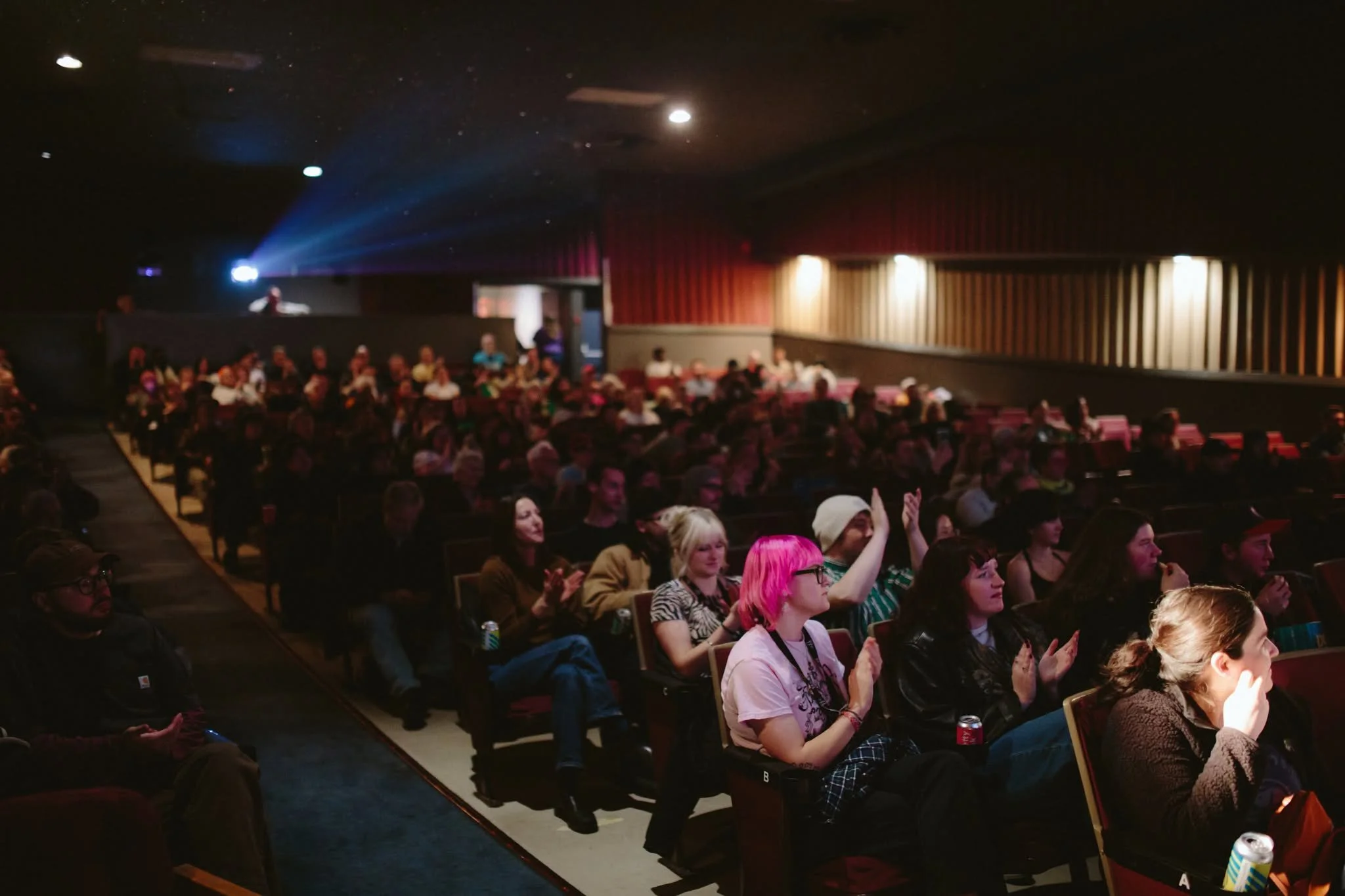
Photo courtesy of the Calgary Underground Film Festival Facebook page.
RUBBERHEAD: THE LIFE & MONSTERS OF STEVE JOHNSON
Steve Johnson is a special effects artist you might mistake for a retired rock star. You’ll definitely recognize his monsters, though! Johnson innovated the familiar face of Slimer from Ghostbusters, the iconic transformation scene in An American Werewolf in London, the iridescent creatures in The Abyss and many, many more. Johnson is shown as an Icarus-type character throughout this documentary. He flies too close to the sun and gets burned.
Viewers can identify easily with Johnson: he grew up a fan of horror movies and spent his youth recreating his favourite movie scenes on his camcorder around his hometown of Houston, Texas. This passion then led him to learn the secrets and techniques of the special effects artists ahead of him. As soon as he could, Johnson set off to Hollywood to continue mastering the craft– and in hopes of learning from the best.
And he did! On big-time sets and late-night benders, Johnson worked with crews and artists that he had worshipped. He also got introduced to the world of drugs. This documentary paints an image of Johnson working in perfect symmetry with a cocktail of drugs keeping him up all night and sculpting all day long. Johnson compares his special effects company to a working environment similar to Jordan Belfort’s office in The Wolf of Wall Street.
Years of partying and monsters gave way to the digital era. Johnson calls CGI and digital effects the enemy and blames this newcomer for his career ending. The audience realizes, though, that the truth might be too tough for Johnson to swallow.
Johnson is a charming, happy-go-lucky artist. He charms the audience and goes about his life with a relaxed, joyful aura. This is what makes the documentary so effortlessly heartbreaking in the end. He accepts his fate as he made it. Johnson is all too happy to have melted away in the sun.
— Lucy Beauregard
Captain Newfoundland
Did you know that on Canada’s East Coast, a cloaked superhero roams late-night television screens? The masked figure, whose body appears transparent against a grainy green-screen, uses his powers of spiritualism to encourage viewers to “open their minds.” Filmmakers Jamie Miller and Mike Feehan recall this unlikely hero in the documentary Captain Newfoundland, proving that his powers lie far beyond the late night broadcast.
Primarily, this documentary recalls the life of Geoff Sterling, eccentric media mogul who pioneered broadcasting in the province. His television station NTV, became the first ever to 24-Hour broadcast in the world. A figure described in the film as “eccentric” “brazen” and “unpredictable” Sterling used the station’s late-night hours as his personal playground, creating and starring as Captain Newfoundland.
Through the lens of Sterling’s work, the documentary quickly became more than just a story about local legend, but rather, a work that documents a strong sense of regional culture and identity. This begins all the way at Newfoundland and Labrador’s confederation, an act that Sterling was staunchly against. The documentary recalls his disappointment with this decision, and how he felt that Canadians from other provinces didn’t know about or understand the people or culture.
Captain Newfoundland also recalls some of the mythology surrounding Sterling, and celebrates his oddities, such as what became an infamous phone-call in which he demanded the station immediately play Inspector Gadget, overlaying the visuals over the audio from a live news broadcast. Sterling also became quite fond of Indian spiritual practices and meditation, often airing interviews with Swami’s and spiritual guides. This also informed his portrayal of Captain Newfoundland, and his 3am “transmissions from the tip of Atlantis.”
Of the many unforgettable stories shared, but the most poignant through line was Sterling’s deep unwavering love for the land and people of Newfoundland and Labrador. As one interviewee shared “Geoff thought that everybody had something in them that was extraordinary.”
This documentary archives not only Captain Newfoundland’s transmissions, but also the longevity of this character’s impact. Despite his unconventional powers as a superhero, Captain Newfoundland even went on to be portrayed in a successful comic series, still known by Newfoundlander’s today. The character is so embedded into the collective consciousness that even today’s youth, who never witnessed these transmissions live, are shown honouring the character as a counterculture icon in the lyrics of a punk song.
As an inlander born and raised in Alberta, I had never heard of this character, and had no idea about the scale of his influence. I’m fond of the documentary’s format in demonstrating this impact, one which blended the storytelling of Sterling’s life with the very mysticism that enticed Newfoundlanders to their screens.
Being an Albertan, I am no stranger to stereotypes from those elsewhere in the country (something I’m sure people from many provinces will similarly claim). One of the reasons I found Captain Newfoundland so touching, was its desire to share a story of regional pride, through all of its loving oddities.
— Levin Ifko
Wild Inside
I first discovered the work of director Penny Lane when she was a guest on my favourite radio show, The Best Show with Tom Scharpling on WFMU, in 2013. She was on to promote her first documentary film Our Nixon, which is built entirely around super-8 home movies shot during the Richard Nixon’s White House administration. Her pitch of Our Nixon convinced me to check it out and she’s been one of my favourite documentary filmmakers ever since. The subjects of her documentary films, whether it’s about Kenny G, the children’s music industry or the Satanic Temple, are always subjects that are investigated in a playful but illuminating way. Her films, like her subjects, are never conventional and always entertain and inform in equal measure.
With Penny Lane’s latest film, Wild Inside, this New York-based filmmaker has made a great film about the biggest New York folk hero of the 2020’s next to Jaylen Brunson: Flaco,the Eurasian Eagle-Owl. In February 2023, a mystery person cut the protective netting in Flaco’s enclosure at the Central Park Zoo, moving directly to Central Park proper, becoming a real media sensation. In the wild, Flaco learned how to do things on his own for the first time and captivated the New York bird community, as well as onlookers who were charmed by having an owl flying around. You have people in Wild Inside making comments saying “I went to see Flaco twice” like it’s a Broadway show like Oh, Mary. Everyone brings a different perspective to Flaco, like he’s a living painting and Central Park is his museum, and you hear viewpoints from barbers to street vendors to artists of how much Flaco’s existence touched them.
Wild Inside is the ultimate urban nature film, with Penny Lane sourcing much of the footage from the New York birder community, giving you jaw-dropping footage of Flaco living his life in the wild. You also get different viewpoints, like all of the best documentaries give you, where some people love having him out in the wild and hate that he lived in a small zoo enclosure, while others argue that is the only way Flaco can survive. Everyone’s viewpoints are so well argued and it creates the tapestry, this salon of ideas, about the purpose of zoos and enclosures as a whole.
Wild Inside has it all: it is funny, it will move you, and it will leave you with a lot of questions and stuff to discuss after it ends. Penny Lane takes what on the surface was just a 2023 social media/human interest (or rather animal interest) story and digs into what it means for an owl like Flaco to live in the wild after spending his life up to that point in a small enclosure. It’s another sterling addition to one of the best filmographies in 21st century documentary filmmaking.
— Ben Goodman