

Director Brandon Christensen Takes Audiences Into a Terrifying, Twisted Reality in His New Film Bodycam
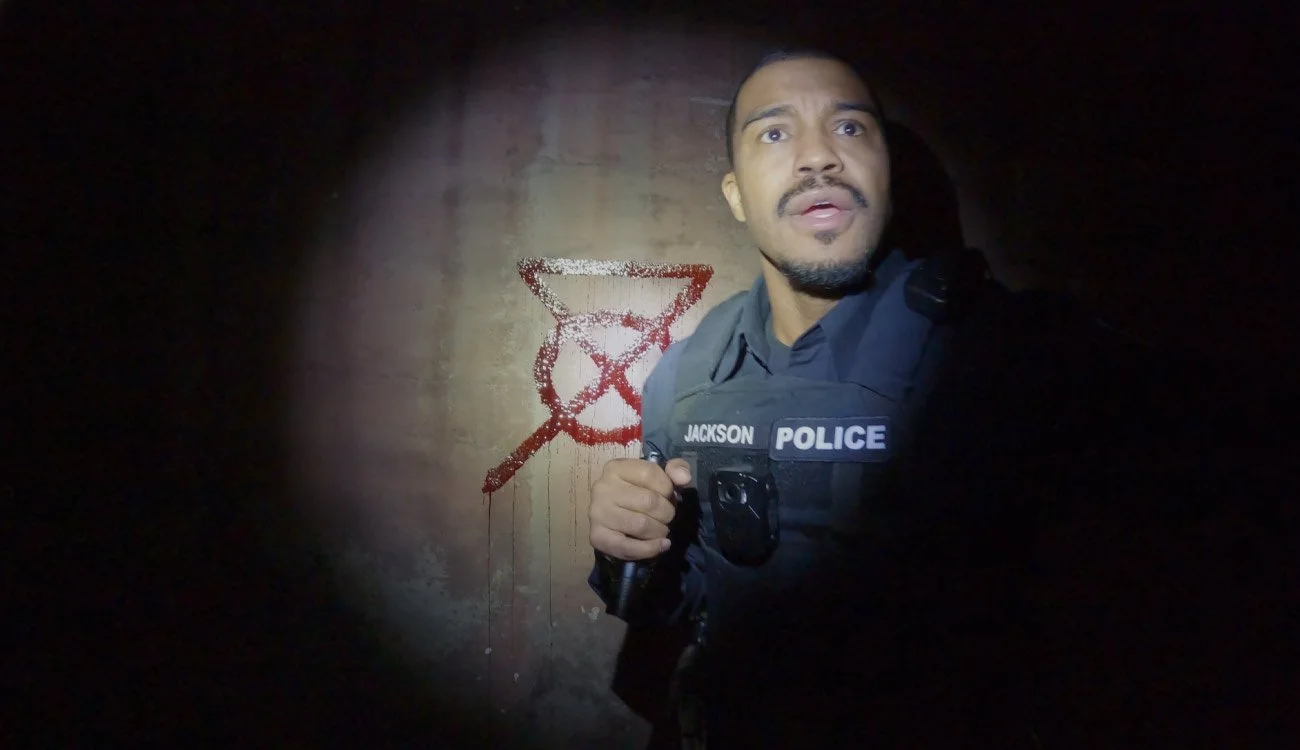
Still from Bodycam.
For horror movie fans looking for a new found footage flick to return to time and time again, Brandon Christensen’s Bodycam is the movie for you. Bodycam marks exciting new territory for Christensen, who says, “I have never done a strictly found footage film before.” As with Night Of The Reaper, he co-wrote Bodycam with his brother Ryan.
The film follows two police officers (Sean Rogerson and Jaime M. Callica) who find themselves trapped in an inescapable nightmare as they investigate what appears to be a routine domestic disturbance that quickly spirals into a tragedy. Over the course of the night, as the two try to cover up what happened, their bodycams capture a terrifying, twisted reality and a harrowing descent into the unknown. Bodycam is one of the best found footage horror films of the decade, and is destined to become a cult classic.
Ahead of the Calgary Underground Film Festival: Off the CUFF March 4th screening of Bodycam, REVERIE chatted with director/co-writer Brandon Christensen about the making of the film.
The bodycam and true crime footage that Christensen saw on YouTube were a big influence on Bodycam. “Every time I watched it, I was always struck by how immediate things felt when a dangerous situation happens,” he shares. “There is just this really gritty sense of danger that can happen, and that’s what we were trying to tap into… It’s not gonna cut away. It’s unflinching. It’s just gonna be that thing. I always had this idea of potentially doing something like that.” Christensen also drew inspiration from Jurassic World. “You’re watching this mission from all these different raptors’ points of view, and I remember watching that and thinking, ‘That’s such an interesting thing. Could you do a full movie like that?”
A conversation between Christensen and one of the producers of Bodycam, Kurtis Davis Harder, helped form the basis of Bodycam. “We started talking about doing a bodycam type of thing where there was an accidental shooting, and it kind of spirals out from there,” Christensen recalls. “We never really had the full story. It just sat dormant for a while, and we did our own things.” Bodycam really started to take shape when Christensen’s brother, Ryan, began contributing ideas for the film. “My brother and I just started talking about it one day and came up with the very beginnings of some of the lore in this film. We kind of got excited about exploring this underground space and doing all these things and tying the whole thing to another thing I saw on YouTube, which is these homeless areas in different cities where they have a really bad drug problem, and there are just people standing around, and they kind of look like zombies, and it was like ‘Oh, what if we can kind of recontextualize that idea as well.’”
From beginning to end, Bodycam is an unrelenting, horrifying, ominous, hair-raising nightmare for Officer Bryce (Rogerson) and Officer Jackson (Callica). “We wanted the audience to stay engaged because the moment it stops, it’s hard to get someone back,” Christen shares. “We wanted to keep things moving as much as possible, and that can be challenging when you have a story you want to tell and you have to get through these beats and story plot points that can set up things for later, so when they go visit [Jackson’s] mom, things settle down for a second, and it allows us to recontextualize everything we’ve seen up until that point and set us up for the next half.”
By having Rogerson and Callica film the movie, it allows the experience to be very immersive for the audience, making them feel feeling like they, too, are there with the characters. “We thought maybe the cinematographer Clayton [Moore] would be filming, and he’d be wearing different sleeves and stuff like that, but it didn’t make sense,” Christensen says. “When the actors just did it, then it was like, ‘Oh, that feels so real,’ because they’re just filming their actions and performing. Going into it, we thought we would have two different body cams and record everything at the same time. We had these 3D-printed enclosures for the GoPros made, but they were just falling apart and didn’t look right. We were like, we just got to do one camera at a time, and whoever’s not filming would have a dummy camera on their chest just for the prop. We would do the scene with one camera flip to the other person, so every scene was at most two camera shots. [If] we do a traditional scene and it's like you and I are talking, we’re gonna have a wide shot, some over the shoulder shots, and all these different things. With this, it was just two shots, sometimes only one, and it was so fast. You would go into a scene, work through it a bunch of times, get it right, film it, flip the camera vest, do it again, and then you were done with the scene. We only shot the film in 12 days. It was very quick and very efficient.”
Rogerson and Callica are exceptional in their respective roles and have a terrific dynamic together. Previously, Rogerson starred in Christensen’s films Still/Born and Z. Christensen and his brother, Ryan, always had Rogerson in mind to play Bryce. “We wrote it for him, and I was like, ‘Dude, we want to shave your head, give you a moustache, and give you this interesting new spin on the genre that you put your stamp on back in 2011 [with Grave Encounters],’” Christensen states. “I just knew from a performance standpoint he was going to crush it… He just has a presence about him that is just so pleasant and fun to work with… He will help in any capacity he can, and when you’re doing an indie film, having someone on board like that at the top can really help anchor everybody.”
On the other hand, Callica was cast in a more traditional way. “I didn’t know Jaime prior to filming this,” Christensen says. “Jamie looks like a movie star. He just has this look and thing about him that is just so captivating. It was such an obvious choice for us to get him.”
Bodycam was filmed primarily in the community of Inglewood in Calgary, though some scenes were filmed at an old hotel in Nanton. Christensen, who was born and raised in Calgary, loves filming his movies here. “I’ve shot four of my six films in Calgary,” he says. “Being able to take these places I know and spin them around and make them scary is a fun concept to me.”
Christensen describes shooting most of the film in Inglewood as a “lucky accident,” while he and producers Harder and Chris Ball were driving around different areas of Calgary looking for the house that would play such a prominent part in the film. “Kurt, Chris, and I were just driving around looking, and we saw this house; the roof is sagging, and it looks disgusting, and we were like, ‘That’s the kind of house we need,’” he recalls. “Chris is like, ‘Let me go knock and see.’ He goes up and knocks and looks in the windows, and no one is answering, obviously. He goes next door and knocks on the door there, and the guy opens the door, and he’s like, ‘Chris!’ and it’s a guy he used to work with. They caught up, and he’s like, ‘Yeah, I have all the information. The owners died in that place years ago.’ He just basically hand-delivered Chris all of this information, which allowed us to get access to the house. It was a situation where people hadn’t lived there for a while because the owners died in it. It’s funny, the first time we got the key from the person who owns it, we walked in, and you know that meme of Troy in Community when he walks in with the pizzas, and everything is on fire, that’s how I felt… That place was death. It smelled. It was horrible. It was the grossest. Everybody was fighting illness when we were shooting because it was just so disgusting, but that was so great for this film. Everything you see other than that bedroom with the spray paint and the crib was basically untouched. We walked into that house, and it was that gross, and we were like ‘This is amazing.’”
Mild spoilers below. Proceed with caution.
Christensen’s favourite scene from Bodycam was also the most difficult to film. On a technical level, the scene where Jackson goes on a drive downtown by himself nearly took two years to complete, as it was quite hard to get right. “We had shot it when we had done our initial production,” he says. “We did it wrong. We had no real plan of how we would execute this thing until we had this VFX company called RCS Studios come in, so we had to come back a year later and reshoot it in a volume here in Calgary. That brought the scene to life and made it real. We created this 3D city and this path, and they did all this animation and these lighting gags. We got to bring the cop car into the studio and project all the different angles of this city environment onto the car, so we got to film [Jaime] reacting live to the things that were happening to the character… It was probably the most challenging thing as a director that I’ve ever done, just getting it all to work. Basically, from when he takes off from that car to when he returns to that house, that whole sequence we were swinging for the fences, and we maybe didn’t hit a homer, but we hit a double or something, it works. That’s the miracle of the moment. It’s such an insane idea conveyed in a way that you can only see it through these bodycams.”
Before its release on Shudder, you can catch Bodycam at CUFF’S Off the CUFF event on March 4th at the Globe Cinema. “I’m super excited to play at CUFF,” Christensen smiles. “I’ve played at [the Calgary International Film Festival] a bunch, but I’ve never had the opportunity to play at CUFF, and I’ve heard the audience is great there.”