Gus Englehorn Writes Songs for the Underdogs

Photo credit: Shannon Johnston (@me_onlylouder)
The first time I met Gus Englehorn and Estée Preda was at SXSW in 2025. Austin was buzzing with anticipation around the premiere of the Butthole Surfers documentary, and Englehorn and Preda were performing at multiple showcases and had just wrapped not too long ago, The Broken Balladeer, their fourth full-length album with producer Paul Leary. A year later, reunited at SXSW 2026 for a cover shoot, those songs were no longer works in progress, but companions travelling alongside listeners.
The Broken Balladeer is populated by wandering narrators, hunted hounds, grieving flies, horse-haired children, and homesick dreamers. Yet beneath its eccentric cast of characters lies something deeply human. Across twelve songs, the Alaskan-born Englehorn filters uncertainty, ambition, exhaustion, and perseverance through folklore-inflected storytelling, creating a record where fable and autobiography become inseparable.
The title itself emerged during a difficult chapter. Englehorn and Preda had recently lost both their manager and label support, leaving them to navigate an increasingly unforgiving music industry on their own. “I guess we were just feeling like underdogs,” Preda explains. “We’ve been broke for so long.”
The phrase “The Broken Balladeer” immediately conjures the image of a travelling folk singer, weathered from exhaustion and experience, forever chasing something just beyond reach. On the album’s title track, Englehorn sings of a songwriter waiting for his “lucky, lucky, lucky break,” a line that lands somewhere between self-deprecating humour and uncomfortable truth. For all of the record’s strange characters and surreal imagery, The Broken Balladeer may be Englehorn’s most direct work to date. Not because the songs abandon metaphor, but because the emotions beneath them are impossible to miss.
Part of what makes Englehorn such a compelling songwriter is his refusal to write in straight lines. Rather than documenting his experiences plainly, he transforms them into stories. Betrayal becomes a spider and a fly in “Pepperina.” Self-doubt becomes a pack of pursuing dogs in “The Hounds Are Out.” Longing and displacement emerge through the wandering narrator of “In The Gorge,” who repeatedly confesses, “I’m homesick but I haven’t got a home.”
The songs are more than just personal narratives, they run like modern folk tales passed between travellers. They’re filled with cautionary figures, strange creatures, dark humour, and theatrical characters, but the emotions driving them remain something the listener can easily step into.
“I don’t ever intentionally write from different perspectives,” Englehorn says. “It’s always got to be personal to whatever I’m going through.” The Broken Balladeer also arrives at a fascinating point in Englehorn’s artistic evolution. Earlier records often pulled from garage rock, punk, and outsider infl uences like Daniel Johnston. This time, his songwriting feels increasingly indebted to the tradition of great storytellers.
“I’ve just been progressively more into Neil Young all the time,” he says. “And Patti Smith and stuff like that because of that spiritual epic thing they do.” You can hear it throughout the record and the songs breathe more and the stories stretch further. Characters linger longer, even when the arrangements drift into psychedelic territory, and the songwriting remains rooted in narrative.

Photo credit: Shannon Johnston (@me_onlylouder)
The album also has an Austin spirit that is impossible to ignore, as the city’s reputation has historically been built around songwriters, outsiders, eccentrics, and artists who don’t quite fit elsewhere – like Townes Van Zandt, Spoon, Willie Nelson, or even our other complimentary cover feature TEAR DUNGEON.
Recorded over six days with Leary and engineer Stuart Sullivan, The Broken Balladeer carries a subtle Southwestern quality that occasionally surfaces beneath its folk and psych-rock foundations.
“I definitely am like a sponge and super-influenced by my surroundings and the people around me. I feel like it sounds like the record was made in Texas with some of the more western sounds,” Englehorn grins.
Leary and Englehorn’s collaboration began with 2023’s The Hornbook, which Leary mixed after being introduced to Englehorn’s music through Secret City Records. For The Broken Balladeer, he stepped into the producer’s chair. “We put Paul on our dream producer list because we thought it would never happen,” Preda recalls.
For Englehorn, the appeal wasn’t simply working alongside a member of the Butthole Surfers. It was the reassurance of working with someone whose instincts he trusted completely. “I just wanted to feel like I was in good hands,” he says.
That trust proved invaluable. Leary and Sullivan, who have worked together for decades, immediately understood what Englehorn and Preda were trying to achieve. For artists who have spent much of their career operating outside the mainstream, that validation carried weight.
The timing also felt strangely poetic. By the time The Broken Balladeer arrived, the Butthole Surfers were enjoying renewed attention through their documentary The Whole Truth..and Nothing Butt amidst a growing appreciation of their influence on alternative music. Englehorn and Preda found themselves connected to that legacy while forging a path in their own DIY way.
We cannot talk about Gus Englehorn without the influence of Preda who helps craft the world that surrounds him. Formerly from Québec City, now residing in Hawaii with Englehorn, their creative partnership, and love for one another, extends far beyond traditional band roles.
An illustrator, filmmaker, drummer, and creative collaborator, Preda’s visions are everywhere. She designs merchandise, creates artwork, directs films, paints limited-edition releases, and often serves as the first audience for every new song. “She’s the judge and the executioner,” Englehorn jokes. Preda laughs at the description but doesn’t entirely disagree. “I have the burden of always deciding,” she says.
Yet despite the care and effort behind every release, both remain remarkably candid about the realities of being independent musicians in 2026. Touring is expensive and opportunities remain limited. Recognition rarely arrives on schedule.
Recently, the pair completed an extensive North American run supporting Holy Fuck. The shows were some of the biggest of their career with many dates selling out and audiences were larger than ever. Still, neither speaks about success as though they’ve somehow escaped the struggles facing working artists. “We’re trying to do something very hard,” Preda says. “Artists are sensitive people and then you’re working in the fifififi eld that’s the cruelest.” Englehorn agrees, “It’s the hardest time ever to be in the music industry.”
Rather than becoming discouraged, however, both seem determined to keep moving forward. Throughout our conversation, they repeatedly return to the same idea: longevity, with low overheads, low expectations, and the patience of time. They speak about music not as a career ladder, but as a lifelong commitment.
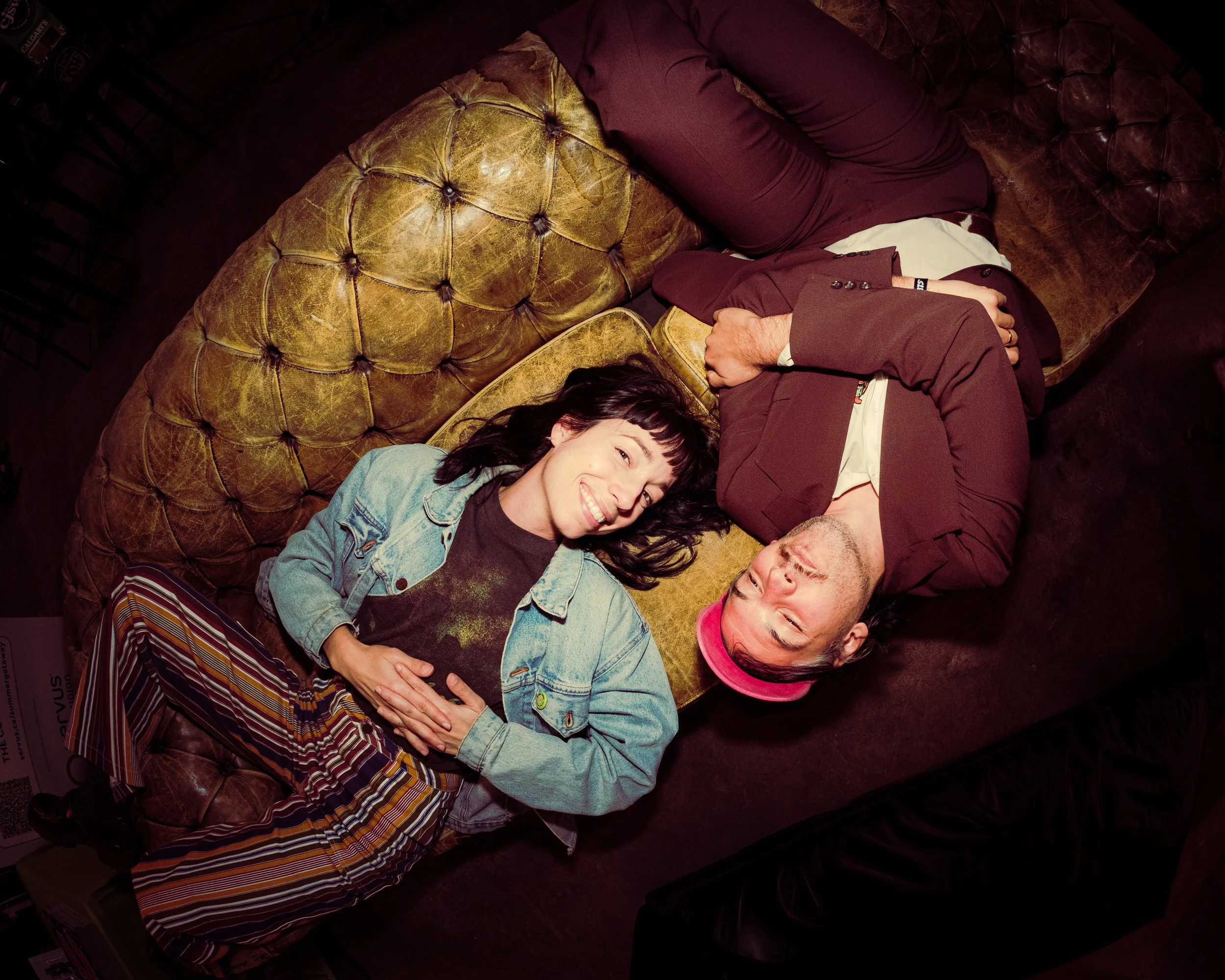
Photo credit: Daman Singh (@damaan_)
Years before releasing records, Englehorn pursued another seemingly impossible dream as a professional snowboarder. After a serious knee injury interrupted that path, he began dedicating himself fully to songwriting.
For years, he wrote relentlessly without producing work he was satisfied with. Then something clicked. Looking back, he sees parallels between both pursuits as neither offered guarantees and both demanded complete commitment. That same mentality continues to guide him.
“I always try to keep a good perspective,” he says. “Why does the band even have to get big? It’s just fun to do what we’re doing right now.” It’s a sentiment that feels woven throughout The Broken Balladeer. For all its melancholy, the album never collapses into defeatism. Its characters may be lost, hunted, forgotten, overlooked, or waiting endlessly for their lucky break, but they keep moving, searching, and singing.
Maybe that’s what the broken balladeer ultimately represents. Not failure, but perseverance. It’s the willingness to continue creating despite uncertainty and to keep chasing something just beyond reach. More importantly ,it’s to keep telling stories even when it feels like nobody is listening.
A year after first meeting in Austin, with another album cycle already behind them and new songs beginning to take shape, Englehorn and Preda remain exactly where they’ve always been: making art, telling stories, and finding reasons to keep going. Their music has travelled with me through my own music industry endeavours and challenges over the past year, and perhaps that’s what makes The Broken Balladeer resonate so deeply. It’s a reminder that uncertainty is easier to carry when you find the right people to share the weight with.
The hounds may still be out, but the balladeer hasn’t stopped singing and for those willing to listen, there’s still comfort to be found in his song.
‘The Broken Balladeer’ is out everywhere now - follow and listen on Bandcamp.