Bonnie Trash are Writing Their Soundtrack to Grief
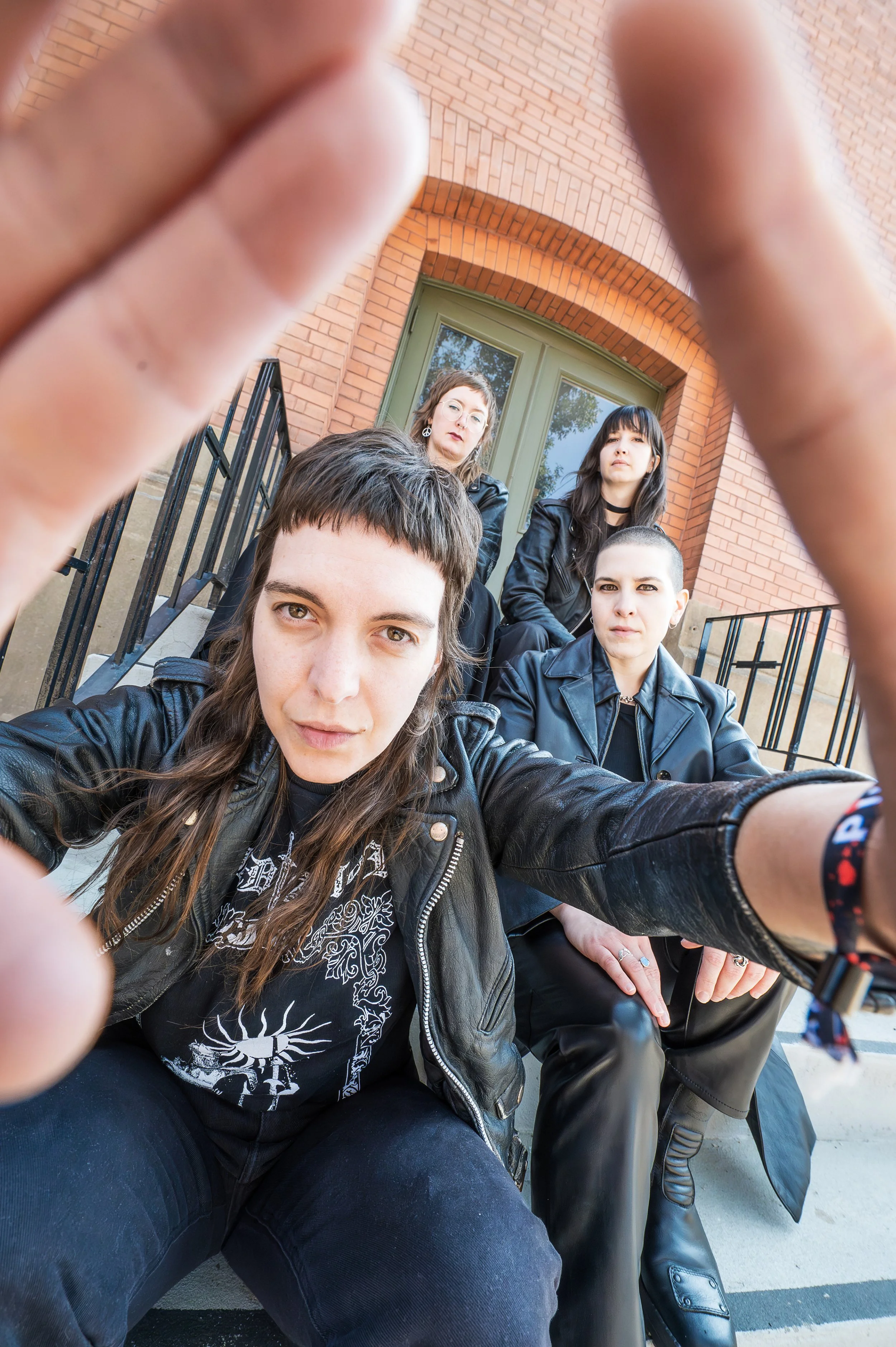
Photo credit: Shannon Johnston (@me_onlylouder)
The air inside Uwe Klubhaus was thick with fog and bathed in deep washes of red as Bonnie Trash hit the stage at Germany’s Reeperbahn Music Festival. Before a single chord rang out, the speakers carried the voice of their late Nonna Maria, recounting an old Italian ghost story in Veneto dialect. Sometimes it’s a story about Ezzelino Ill da Romano, the cannibalistic tyrant of their town of San Zenone degli Ezzelini, or a poltergeist spirit that haunted their farmhouse when their family moved back to Italy from Canada. For those who recognize the dialect, it sparks instant recognition.
Moments later, twin siblings Emmalia and Sarafina Bortolon-Vettor unleashed their brooding guitars and menacing vocals, kicking off with lead single “Veil of Greed” with Emma Howarth-Withers on bass and Dana Bellamy on drums, turning lineage and loss into a communal experience. Their new album, Mourning You, released on Toronto label favourite Hand Drawn Dracula, is grief rendered loud enough to rattle the altar. By the time we sat down to talk in Hamburg, it felt less like an interview and more like meeting old friends. A few months earlier we crossed paths in Edmonton’s Purple City Music Festival, where REVERIE shot the photos for this feature on the balcony of the Chateau Lacombe. To meet them again in Germany was a full-circle moment: across two different cities, they held the same magnetic energy that made Germany feel like a piece of home.
Photo credit: Shannon Johnston (@me_onlylouder)
Bonnie Trash’s story begins in Guelph, Ontario. The Bortolon-Vettor twins grew up surrounded by Veneto dialect, spoken by their grandparents and neighbours. “Writing down these stories became a really important way for us to preserve an archive of our Nona’s stories, that a lot of other people knew of too,” Emmalia laughs. “And it’s important to recognize that this dialect is leaving with our elders.” They met their future bandmates through Girls Rock Camp Guelph, a community project they’ve been part of for over a decade. “That’s where we first hung out,” Sarafina remembers. Over the years, what started as a youth mentorship space became the foundation for the band itself. Determined to preserve their family’s stories, the siblings began recording their grandmother’s old ghost tales: stories of tyrants, spirits, and warnings about Malocchio, the evil eye. The stories became part of their early work, notably the 2022 album Malocchio, where folklore and goth rock melded together into a masterpiece of a record. As for the name, Sarafina explains, it’s both tongue-in-cheek and defiant. “Bonnie Trash means good trash. We were wanting to reclaim the way femmes have been trashed in music and society, and I’m also a Johnny Cash fan so it’s a play on that.” The mixture of irreverence and homage is pure Bonnie Trash, with equal parts reclamation and reverence. When their Nonna Maria passed, the band’s songwriting shifted. Their new album Mourning You is their most direct work yet as they tackle grief without veil or metaphor. “It was difficult to write, but necessary. It just felt right to name the record that.” And it’s a topic that Bonnie Trash tackles well — mourning is love with no-where to go.
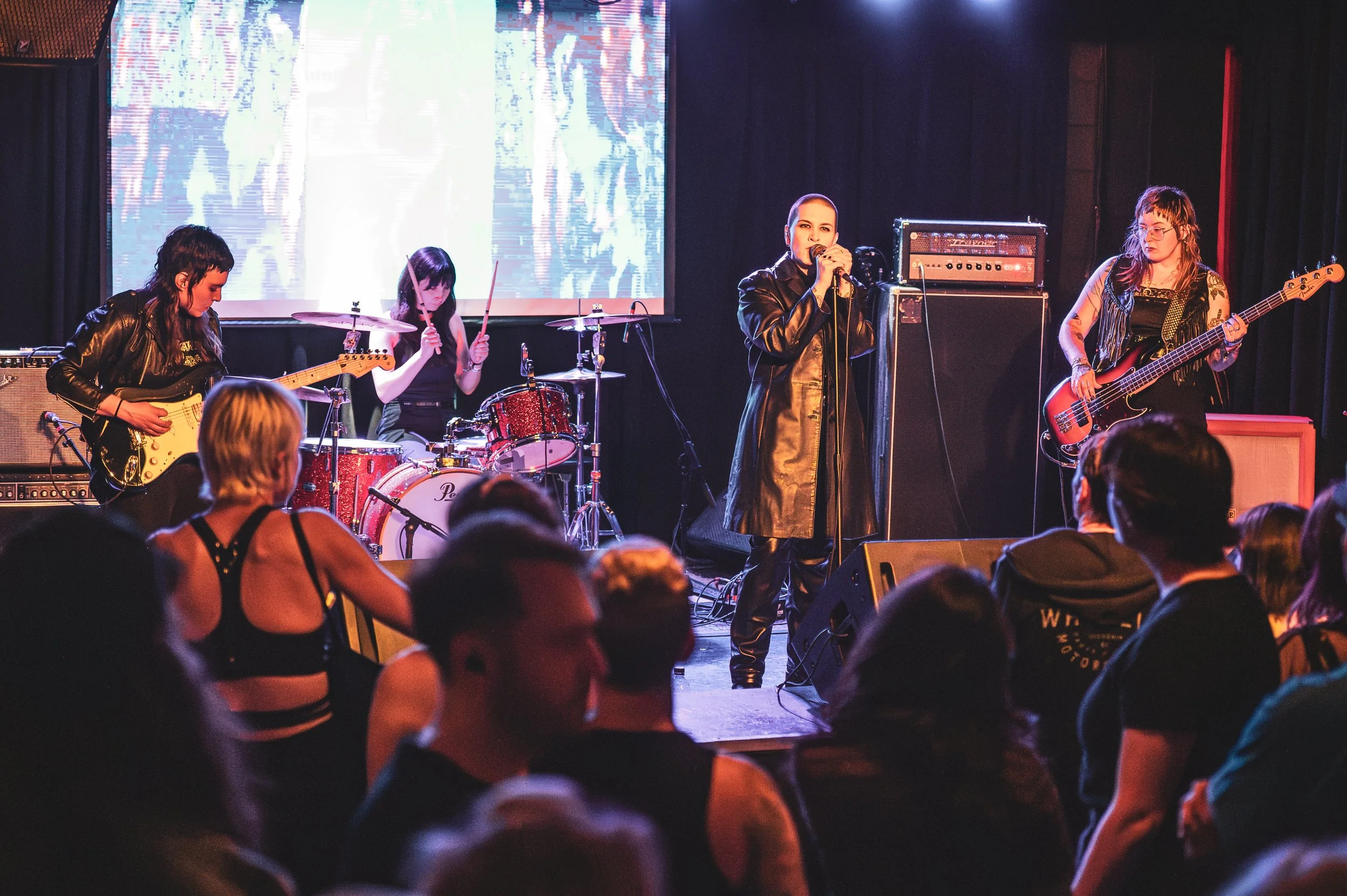
Photo credit: Shannon Johnston (@me_onlylouder)
On stage, the album transforms. Sarafina’s voice runs through a Boss VE-20 pedal with triple reverb, becoming a chorus of phantoms. Emmalia’s guitar thrashes between baritone weight and looping layers. Emma’s American Deluxe P-Bass and compressor carve out the low end, while Dana’s vintage snare cracks through the fog. The live set feels both immense and personal, it’s not just a show you watch, it’s an invitation for dialogue that continues despite the uneasiness around grief. Though they draw heavily from horror aesthetics, Bonnie Trash insists their music is about real life. Death is not a prop; it’s an inevitability, and their music faces it head on. But for all the darkness, there is light. The siblings are central to GGRC+ (formerly Girls Rock Camp Guelph), which they’ve helped run for nearly a decade. It’s a place where kids, specifically many queer, trans, and femme, pick up instruments for the first time, write songs in three days, and perform them for a packed community crowd.
“The music is amazing,” Sarafina says, “The most important thing for GGRC+ is it creates a space for youth to be themselves and express themselves creatively. They can try out new names, try out new pronouns, and that means a lot. The music part is incredible, but when you realize that you’ve cultivated a space where they feel safe enough to do that, that’s really important.” Community has always been at the heart of Bonnie Trash. The band rattles off shout-outs: Guelph friends like World Eaters, Habit, ENOBINI, and Steph Yates; Toronto’s Shiv and the Carvers, Dermabrasion, Ace of Wands, OLEXA and Gloin; Pantayo, and Calgary’s Sunglaciers. When I ask what’s next, the band lists a UK run, shows across Ontario and Montreal, followed by a U.S. tour and a slew of festivals in 2026. But writing is already on the horizon. “This chapter is still open because we’re playing these songs,” Sarafina says, “but I’m excited for the next story.” Across countries Bonnie Trash transform stages into liminal spaces: fog-drenched, spectral, and rooted in something deeply human. Their music is about grief, yes, but also about voices passed down, stories that might otherwise be lost, the terror and tenderness of memory. And like their Nonna’s tales, these songs are meant to be told again and again, carried into the dark and sung back into the light.